
G: James Guthrie & Jeanette Wilson

Guthrie Family Group 2A · Branch G · Family Hub
James Guthrie &
Jeanette Wilson
Irish connections · Cumberland & Westmoreland Counties, Pennsylvania
The family of James Guthrie and Jeanette Wilson connects the farms of Back Creek with the growing communities of western Pennsylvania. Deeds, wills, and family accounts follow their household through the Guthrie, Moore, Parker, Culbertson, Brownlee, and Parr families.
Jeanette brought a Moore family history to her marriage with James. Later accounts identify her as the widow of William Moore and mother of Judge John Moore. Four Guthrie children form the working family presented here: Mary, James, William, and Elizabeth. Their stories lead to mills and farms, public service in Greensburg, Presbyterian ministry, and families spreading beyond Pennsylvania.
Y-DNA evidence supports a close paternal relationship between this family and the John Guthrie and Jane Reed family, consistent with the possibility that John and James were brothers. Their proposed brotherhood remains unproven by documentary evidence.
The Family at a Glance
James Guthrie
About 1720–after 1801
Working chronology; exact dates unknown
- Birth & Origins
- About 1720; Irish origins are reported. Londonderry is a proposed connection, not a documented birthplace.
- Parents
- Unknown. His precise relationship to other early Pennsylvania Guthries remains under investigation.
- Marriage
- Jeanette Wilson, widow of William Moore. The date and place have not been established.
- Home & Work
- Associated with Back Creek and Hamilton Township in Cumberland County; later a farmer of Westmoreland County in the 1790 corrective deed.
- Death & Burial
- The working family chronology places his death after 1801. He was deceased by the 1817 partition of his land. The exact death date and burial place remain unknown.
Jeanette Wilson
About 1720–death unknown
Living in 1790; apparently in 1791
- Birth & Origins
- About 1720, an estimate. Accounts differ between Ireland and Pennsylvania; neither birthplace is established.
- Parents & Family
- Parents unknown. Later accounts associate her with brothers Charles and John Wilson.
- Marriages
- First, William Moore; second, James Guthrie. Their marriage dates remain uncertain.
- Moore Family
- Judge John Moore is identified in later historical accounts as her son by William Moore.
- Last Documentary Appearance
- James and Jannet’s deed of 30 July 1790 strongly fits this couple. Its acknowledgment appears to read 30 July 1791. Her exact death and burial are unknown.
A family with Moore and Guthrie connections. John Moore belongs in Jeanette’s family story alongside the four Guthrie children below. Later histories identify him as James’s stepson and describe his service as president judge in Westmoreland. The family connection is supported by those accounts; the precise sequence of Jeanette’s marriages and moves still needs contemporary documentation.
Four working child lines. The 1817 land partition expressly names the elder James’s issue James, William, and Elizabeth, wife of Isaac Parr. Mary Parker remains in the family reconstruction, supported by the Parker/Moore historical tradition, although she is not named in that instrument. Her omission is discussed in the records below.
The Next Generation
Select a child’s name to explore that family.
| Child | Spouse or Spouses | Family & Evidence |
|---|---|---|
| Mary Guthrie Birth estimated 1749–1759 Death after 1808 |
William Parker | William’s December 1808 will names wife Mary, sons John, William, and Samuel, daughter Mary McKee, and grandson Thomas McKee. The traditionally reported son George needs further reconciliation. Mary’s place in the Guthrie/Moore family remains a research question. |
| James Guthrie, Esq. Before 1751–14 May 1812 |
Jennet Culbertson Later Martha Scott |
The Greensburg public official and father of Rev. James, Hettie Morrow, and Samuel Guthrie. His 1812 will also calls Jane and Elizabeth daughters; their biological or step relationships remain unresolved. “Before 1751” is a working estimate, not a recorded birth. |
| William Guthrie Reported 9 July 1751–10 March 1828 |
Elizabeth Guthrie, widow of Joseph Brownlee | Married 7 July 1784. His reported birth conflicts with the age in his obituary. Their shared family and pension evidence are developed in Elizabeth’s account; William’s page follows his own paternal family. |
| Elizabeth Guthrie About 1754–death unknown |
Isaac Parr | Named as Isaac’s wife in the 1817 partition’s recital of the elder James’s heirs. Isaac’s 1840 will names wife Katherine and children Isaac G., Jane Henry, Sarah Hill, and Hetty Taylor; it does not identify each child’s mother. |
Reading the Family StructureThree James generations, and the limits of a list of heirs.
The three James Guthries
Elder James / Jeanette Wilson → James Esq. / Jennet Culbertson → Rev. James Guthrie. James Esq. later married Martha Scott. The Reverend’s four marriages belong to the following generation. James Guthrie and Margaret Dixon belong to John and Jane Reed’s family and are kept separate.
What the records do and do not settle
The 1817 partition establishes relationships relevant to that land. It does not explain Mary’s omission, prove that Jeanette was the mother of every named heir, or give an exact death date for the elder James. Mary is retained while the Parker and Moore connections are investigated. A later estate list should not automatically replace a family’s lifetime child list.
Historical Highlights
From Back Creek to Western Pennsylvania

Back Creek provides the family’s earliest substantial Pennsylvania setting. Laurence R. Guthrie’s compilation places James among Hamilton Township’s taxables in 1753 and describes property near Wilson’s Run and Denney’s Run. That early tax reference remains a useful source trail. A 1748 survey associated with the land concerned George Reynolds, however, and cannot establish James’s arrival or purchase in that year.
War and settlement shaped the Cumberland years. A 1755 defense petition, reproduced in the Pennsylvania Archives and cited by Guthrie, includes Jas. Guthrie among residents asking for arms and ammunition. The compilation also associates James with the 1756 campaign against Kittanning. The petition and the later service narrative are different kinds of evidence: the service details and the identity of the participant require their own documentation.
The move west was more complicated than a single migration date. The Back Creek conveyance to Robert Peebles belongs to 1777; a 1779 deed abstract still describes a James Guthrie as of Chambersburg. By 30 July 1790, the James who joined Jannet in correcting the Peebles title was described as a farmer of Westmoreland County. Together, the documents trace property and residence without making every same-name transaction an act of the elder James.
Jeanette’s earlier marriage connected the household to the Moore and Wilson families. Later histories identify Judge John Moore as her son by William Moore and describe Charles and John Wilson as her brothers. Moore’s public career and the repeated appearance of Moore, Parker, Guthrie, and Parr names make this an important family network to follow. Those associations are most useful when checked against deeds and estate records.
The next generation took different paths. Mary’s Parker family is associated with milling and the Venango County region. James Esq. appears in Greensburg’s public and property records; his son, Rev. James, became a Presbyterian minister. William’s marriage to Elizabeth Guthrie Brownlee joined the two principal Branch G families. Elizabeth’s marriage to Isaac Parr led to the household that cared for the elder James.
“James Guthrie, William Guthrie and Elizabeth Guthrie intermarried with Isaac Parr”
Named issue of the elder James in the 1817 partition; Westmoreland County Deed Book 12, pp. 350–352.
A land partition preserves an account of family care. The 1817 instruments explain that the elder James owed Isaac Parr for boarding and related expenses, and that the younger James assumed the debt. After James Esq.’s death, his executors and Parr divided their interests. The record links three generations of family business while preserving a practical detail of the elder James’s later life.
Artwork is interpretive; it does not depict an identified family property or surviving possessions. Return to Menu ↑
The Family Timeline
Documented events are distinguished from estimates, later accounts, and unresolved identities.
-
About 1720Estimated births
James and Jeanette’s beginnings
Both are placed about 1720 in the working family chronology. Their parents and exact birthplaces remain unknown. Irish connections are part of the research, not a proved migration itinerary.
Source: Family accounts and research-tree chronology.
-
Before the Guthrie marriageMoore family
Jeanette’s first household
Later histories identify Jeanette as William Moore’s widow and Judge John Moore’s mother. The date and place of her marriage to James are unresolved.
Source: Boucher’s Westmoreland history and the Moore/Wilson family accounts.
-
1753–1761Cumberland leads
A household on Back Creek
The published trail includes James in Hamilton’s 1753 tax list, the 7 August 1755 defense petition, and the 2 December 1760 will of John Burns, proved 17 March 1761, naming James Guthrey a coexecutor. Each source must be correlated to the correct James.
Source: AGAF, printed p. 181 and appendix pp. 696–697; Cumberland Wills A:83.
-
1777–1779Land transfers
Selling property in the east
The 1790 correction recites an agreement of 23 January 1777 and a deed of 7 April 1777 to Robert Peebles. A separate 12 April 1779 abstract describes James of Chambersburg. The original earlier deeds are still needed for a complete comparison.
Source: Franklin Deeds 8:133–134; Cumberland F:230 and G:207 abstract/index trails.
-
1783 & 1786Mount Pleasant
Two James taxpayers
The published 1783 return lists James with 100 acres and James Sr. with 210 acres. The 1786 return again lists them separately. These entries help distinguish namesakes; the Senior label does not itself state a relationship.
Source: Pennsylvania Archives, third series, XXII, printed pp. 432–433 and 521.
-
7 July 1784Marriage
William and Elizabeth join two family lines
William Guthrie married Elizabeth Guthrie, widow of Joseph Brownlee and daughter of John Guthrie and Jane Reed. Their descendants connect the two principal Branch G households.
Source: Reviewed family Bible and pension evidence; Brownlee pension W3245.
-
30 July 1790Corrective deed
James and Jannet settle the Peebles title
The grantors are described as James Guthrey, farmer of Westmoreland, and Jannet his wife. John Parker, William Guthrie, and Isaac Parr witness the instrument. The acknowledgment appears to be dated 30 July 1791; the 1808 copying date is a separate event.
Source: Franklin County Deed Book 8:133–134, record-book images.
-
9 September 1791Patent recital
The Crabtree Run property
The later partition recites a patent to the elder James for land on Crabtree Run, then in Salem Township. The patent date is distinct from his later death and the 1817 division.
Source: Westmoreland Deeds 12:350–352, reciting the 1791 patent.
-
After 1801Working death bound
The elder James’s final years
After 1801 remains the working chronology. The 1817 instruments establish that he died intestate and describe his debt to Isaac Parr for boarding, but do not state his exact death date.
Source: Family chronology; Westmoreland Deeds 12:350–352.
-
1812The next generation
James Esq.’s will and death
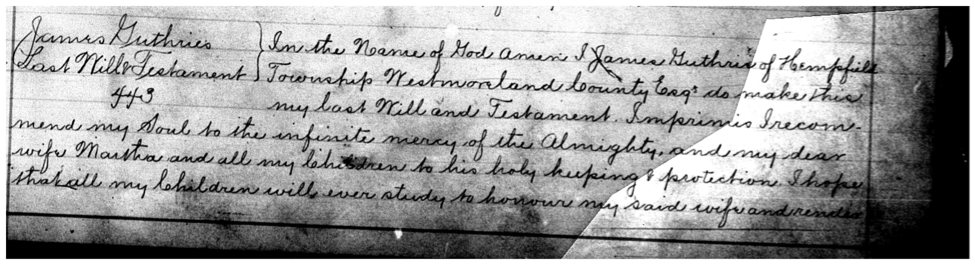
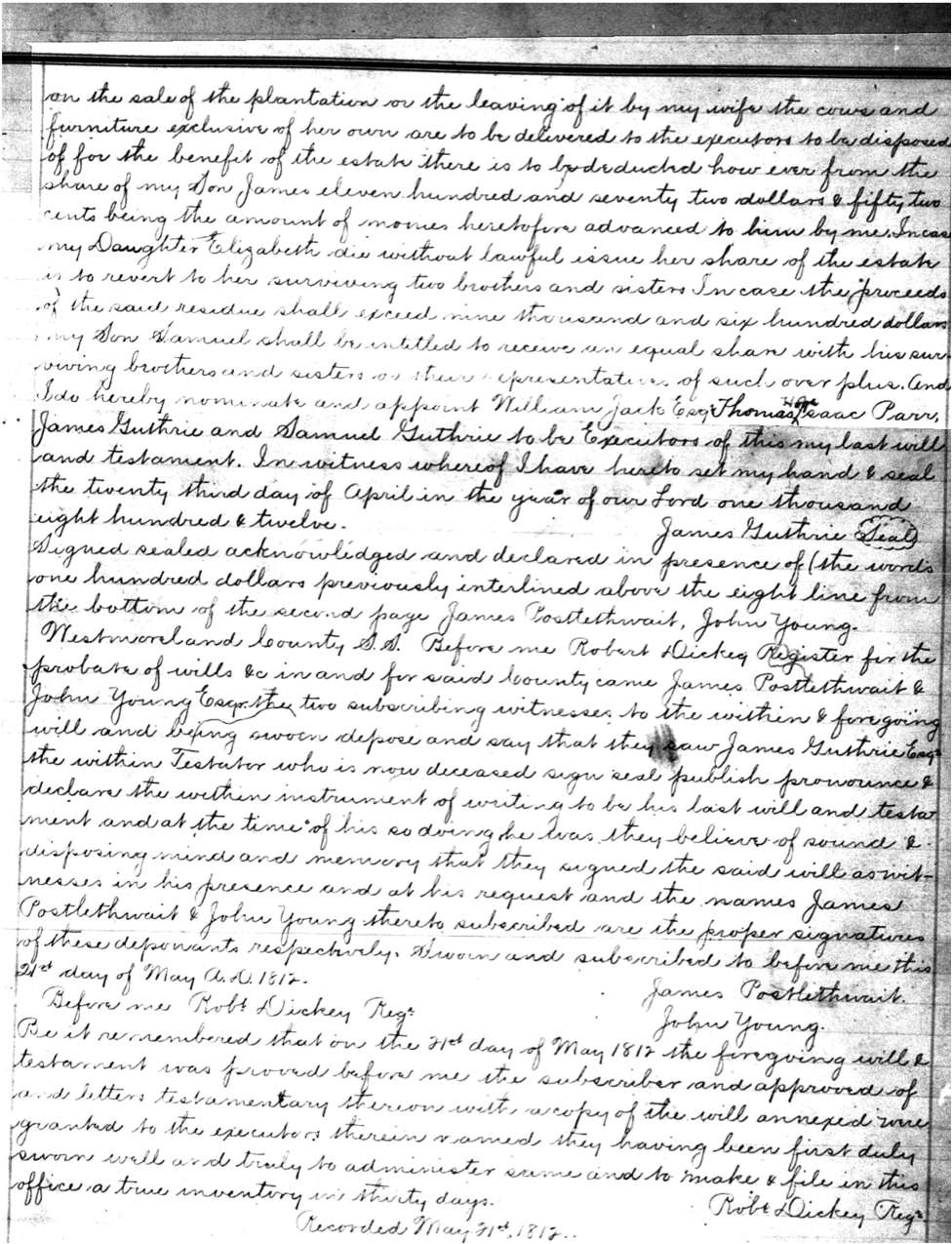
James Esq. made his will 23 April 1812, died 14 May, and his will was proved 21 May. The will names Jane and Elizabeth as daughters alongside other family provisions; their biological or step relationships remain open.
Source: Westmoreland Wills 1:283–285, no. 443.
-
15–16 May 1817Partition & recording
The inherited land is divided
James Esq.’s executors and Isaac Parr execute reciprocal instruments on 15 May, recorded 16 May. The documents name elder James’s issue James, William, and Elizabeth, wife of Parr. Mary Parker’s omission remains unexplained.
Source: Westmoreland Deeds 12:350–352.
Continue to Explore the Records →.
Explore the Records
Land transactions provide the strongest connections across the elder James’s family. Wills, family testimony, published histories, and DNA project lineages add context. An abstract is kept distinct from the underlying record, and a later recording date is kept distinct from the event it describes.
The Guthrie DNA Project
Five Y-DNA kits represent two sons’ lines: James Esq. and William. This table carries forward the project comparison and member notes dated 15 October 2026. It is a dated participation snapshot, not a new live-results audit or proof of every intervening relationship.
| Child Line | Y-DNA | Big Y | Autosomal |
|---|---|---|---|
| Mary / William Parker | Not a paternal Y-DNA route | Not applicable through Mary | Participation reported; route needs further documentation |
| James Esq. / Jennet Culbertson | 93071, 213881 | Not verified for these kits | Not identified in the reviewed notes |
| William / Elizabeth Guthrie Brownlee | 282078, 494912, 1004186 | Not verified for these kits | Participation reported |
| Elizabeth / Isaac Parr | Not a paternal Y-DNA route | Not applicable through Elizabeth | Not identified in the reviewed notes |
A daughter does not transmit her father’s Y chromosome. “Not identified” means that participation was not established in the reviewed notes; it does not mean no descendant has tested. Reported autosomal participation is not a completed match or segment analysis. Big Y status is not inferred from STR coverage.
| Kits | Reported Descent from the Elder James | Big Y |
|---|---|---|
| 93071 213881 |
James Esq. / Jennet Culbertson → Rev. James → James Culbertson / Mary Rogers Work → John Work / Eleanor Gilchrist | Not verified for these kits |
| 282078 494912 1004186 |
William / Elizabeth Guthrie Brownlee → James → James B. / Elizabeth Bish | Not verified for these kits |
The two James-line kits share the same recent route and are not two independent sons of the founder. Kit 494912 lacks DYS712 coverage in the reviewed comparison. Kit 1004186 appears in the reviewed STR export; the earlier “Family Finder only” description is therefore outdated.
The Branch G Pattern
The reviewed comparison uses DYS442 = 11 and DYS712 = 20, against GFG2A reference values of 12 and 19. Across the reviewed Branch G and related-line sample, nine kits show both values and two Y67 kits lack DYS712 coverage. An untested marker is neither a match nor a mismatch. DYS712 = 20 alone also occurs elsewhere in GFG2A.
Y-DNA evidence supports a close paternal relationship between these Branch G lineages, consistent with the possibility that John Guthrie and James Guthrie were brothers. Their proposed brotherhood remains unproven by documentary evidence. Their parents and the traditional Pitforthie connection remain unestablished.
William and Elizabeth’s descendants carry William’s paternal Y-DNA line. Their autosomal ancestry also includes Elizabeth’s John/Jane family, so comparisons must account for the overlap. Unplaced matching lineages are not used here to assign an ancestor or infer a Big Y result for either represented son’s line.
Identity Questions & Documentary Findings
James, Jannet, and the Peebles PropertyThe 1790 deed changes Jeanette’s last-known appearance.
Franklin Deeds 8:133–134, 30 July 1790: James Guthrey, farmer of Westmoreland, and Jannet his wife convey to Robert Peeples, innkeeper of Hamilton Township, Franklin County. The instrument recites an agreement of 23 January 1777 and a deed of 7 April 1777 recorded at Carlisle, Book F, p. 230. It corrects a patent issued on 8 September 1787 in James’s name when the title should have been vested in Robert.
Jannet’s mark appears with witnesses John Parker, William Guthrie, and Isaac Parr. The acknowledgment before John Moore appears to read 30 July 1791; that year remains a reading to verify. The clerk’s true-copy endorsement of 4 May 1808 is not the date of sale or evidence that the couple lived until 1808.
The Hamilton title chain and associated witnesses strongly support identifying this couple with the elder James and Jeanette. On that identification, she was alive in 1790 and apparently at the 1791 acknowledgment. Her death remains unknown. The deed supplies the wife’s name but does not itself establish her Wilson maiden name.
The earlier Cumberland F:230 and G:207 originals remain useful for comparing dates, acreage, and residence. The 1779 abstract’s Chambersburg residence cautions against assuming a completed westward move in 1777.
The 1817 Partition and Mary Parker’s PlaceThree named heirs do not explain every family relationship.
Westmoreland Deeds 12:350–352: reciprocal instruments dated 15 May 1817, recorded 16 May 1817, concern James Esq.’s executors and Isaac Parr. They recite the elder James’s 9 September 1791 patent on Crabtree Run, his intestate death, and issue James, William, and Elizabeth, wife of Isaac Parr. William’s undivided interest had been sold by the sheriff to James.
The elder James owed Parr for boarding and related expenses; the younger James assumed that debt. This is not an 1818 transaction, and it is not the separate Turney deed at 5:186–187. The partition does not provide the elder James’s exact death date.
Mary Parker is not named. Later Parker history describes William Parker’s wife as Judge John Moore’s sister or half sister and favors her birth in Jeanette’s Guthrie marriage. Mary is retained in the working family, with that source qualification. The partition’s silence does not tell us whether she had received prior provision, released an interest, belonged to the Moore marriage, or was omitted for another reason. None of those explanations is established.
William Parker’s will, executed in December 1808 and proved 19 March 1810, names Mary as his wife and identifies four children: John, William, Samuel, and Mary McKee. It gives the 200 acres adjoining John Beatty to Samuel. George’s traditionally reported place in the family remains a separate question.
Three James Generations and Two Women Called DaughtersKeep the corrected lineage while preserving the will’s actual wording.
The working sequence is elder James / Jeanette Wilson → James Esq. / Jennet Culbertson → Rev. James. An additional James/Barr generation is not inserted. James Esq. later married Martha Scott; those marriages must not be combined with the Reverend’s four marriages.
James Esq.’s will, Westmoreland Wills 1:283–285, no. 443, was made 23 April 1812 and proved 21 May. It calls Jane and Elizabeth daughters or children and includes them in its provisions. A later interpretation identifying them as Scott stepdaughters is not established by that wording.
John Scott’s Franklin will B:118–119, made 22 September 1801 and proved 2 December, names wife Martha and principally nephew Alexander, without naming the proposed stepdaughters. That omission is neutral: stepchildren might have been provided for through their own father’s estate. It neither proves nor disproves their relationship to James.
The Culbertson genealogy identifies Jennet Guthry among Samuel’s children and gives a 1789 will/probate chronology. AGAF prints 1799. The original Franklin Wills A:154–159 remains the controlling target for that discrepancy. The different 1803 dates reported for James’s marriage to Martha also require the original notice or register.

Taxpayers, Warrants, and Public OfficeSeparate a named person from an inferred identity.
Mount Pleasant, 1783 and 1786: the published tax returns list James Guthrie and James Guthrie Sr. separately. In 1783, their acreages are 100 and 210 respectively. John Guthrie Esq., John Jr., and William Guthrie, captain and single, also appear. These are valuable points of comparison with the land records; Senior and Junior are not, on their own, statements of parentage.
A 7 March 1785 warrant for James Guthrie concerns 100 acres near Loyalhannah, adjoining William Guthrie, James Wilson, and Alexander Barr. Its interest date of 1 March 1769 is not proof of James’s residence or purchase in that year. A separate 10 March 1785 warrant for William concerns the headwaters of Little Sewickley and the old Pennsylvania road, with Brownlee/Brown neighbors. The two descriptions should not be treated as one parcel.
A notice dated 5 August 1789, printed in the 15 August Gazette, schedules a militia-fine appeal for 24 September at Mr. James Guthrie’s house in Greensburgh. It identifies a meeting place, not his military rank. County history also lists James in 1790 under Sheriff and under Register of Deeds and Recorder of Wills; it does not establish a continuous term in every office.
Two 1810 census candidates remain distinct: James in Hempfield and Capt. James in Derry. Hempfield is the stronger working candidate for James Esq. in light of his residence and probate, but the original schedules and neighbors are needed before treating the choice as settled.
William’s Shared Family and the Parr HouseholdUse the existing family evidence without importing namesakes.
William and Elizabeth: William’s death on 10 March 1828 is supported by the reviewed family and pension evidence. His obituary’s age of about 73 differs from the reported 9 July 1751 birth. The obituary places the wagon accident at a bridge while he was coming to town. The fuller shared family, Elizabeth’s earlier Brownlee marriage, captivity, and pension history are covered in Elizabeth’s account. The relevant Brownlee pension file is W3245, not S40063.
Elizabeth and Isaac Parr: the 1817 partition directly identifies their marriage in its heir recital. Isaac’s will, Westmoreland Wills 3:34–35, no. 1383, dated 11 December 1840 and proved 14 June 1841, names wife Katherine, son Isaac G., and daughters Jane Henry, Sarah Hill, and Hetty Taylor. It does not name Elizabeth or identify each child’s mother. The adjacent John Nelson will contains Nancy and Robert; those names must not be imported into Isaac’s family from a combined index entry.
Sources & Record Trails
County Records and Contemporary EvidenceBook and page references lead to the underlying instruments.
- Franklin County Deeds 8:133–134: James and Jannet to Robert Peeples, 30 July 1790; acknowledgment apparently 30 July 1791; true-copy endorsement 4 May 1808. Supplied record-book images reviewed.
- Westmoreland County Deeds 12:350–352: executors of James Guthrie and Isaac Parr, reciprocal partition instruments, 15 May 1817, recorded 16 May.
- Westmoreland Deeds B:380–382: Guthrie’s Fortune, 20 April 1787; 165¼ acres, James of Greensburg, tavernkeeper, with wife Jean/Jinnet. Elder/younger attribution requires correlation. 5:186–187: James Esq. and Jane to Daniel Turney, 12 April 1800, a separate transaction.
- Cumberland Deeds F:230 and G:207: 1777 Peebles and 1779 Ferguson transactions known through indexes, abstracts, and later recitals; complete originals remain comparison targets.
- Westmoreland Wills 1:283–285, James Esq., 1812; 3:34–35, Isaac Parr, 1840–1841; Franklin Wills B:118–119, John Scott, 1801. These supplied record images have been reviewed; they are not wholly missing sources.
- William Parker’s will: December 1808, proved 19 March 1810. The image appears to read 12 December while an index gives 14; the month is secure pending a complete transcription.
- Joseph Brownlee pension W3245: Elizabeth’s testimony, family information, return certificates, and later supporting statements. William’s family must be read alongside this earlier marriage.
- Pennsylvania land warrants: James, no. 64, 7 March 1785; William, no. 65, 10 March 1785. Gazette, 15 August 1789, p. 3: notice of a forthcoming militia-fine appeal at James’s Greensburgh house.
Published Histories, Tax Returns, and Family ResearchUseful compilations retain their own evidence limits.
Laurence R. Guthrie, American Guthrie and Allied Families (1933): printed pp. 181–184, 528–529, and appendix pp. 696–700. Its records and family accounts are valuable, but its proposed ancestry and conflated generations require correction. The later Laurence research collection and John Z. Speer material preserve additional leads. Read AGAF →
William Henry Egle, editor, Pennsylvania Archives, third series, volume XXII, Returns of Taxables (1898; general series title dated 1897): Mount Pleasant 1783, printed pp. 432–433; Mount Pleasant 1786, p. 521. Derry and Hempfield entries help distinguish other Guthrie clusters. This volume does not verify the separate Cumberland 1753 reference.
John Newton Boucher, History of Westmoreland County: Judge John Moore account, cited at p. 324 in the family research. Charles A. Babcock, Venango County, Pennsylvania: Parker family account discussing Mary’s Moore/Guthrie connection. These later narratives are not contemporary marriage or birth records.
Lewis R. Culbertson, Genealogy of the Culbertson and Culberson Families (1923), pp. 211–215: Jennet’s family and the reported 1789 will chronology. Read p. 214 →
History of the Presbytery of Redstone (1889), pp. 41–45 and 187: Rev. James’s ministry and successive marriages, including a contributor’s recollections. It concerns the grandson, not the elder James or James Esq. Read the text →
Della Reagan Fischer, Wills and Letters of Administration of Westmoreland County, and the Elisha B. Iams collection: later extracts, cards, and indexes used to locate estates and associates. Their summaries do not replace the county record images. A collection’s navigation label may differ from the actual county named in an entry.
Guthrie Research Tree and DNA Project: working family profiles, supplied record images, descendant research, and the 15 October 2026 project snapshot. James’s Research Tree profile →
Most Wanted Documents
Can Your Family Help Fill a Gap?Targeted records can settle the remaining questions.
- James and Jeanette’s origins: contemporary records naming their parents, documenting their marriage, or explicitly stating James’s relationship to John Guthrie.
- Moore, Wilson, and Parker relationships: family papers, probate distributions, or deeds establishing Jeanette’s first marriage and Mary Parker’s place in the blended family.
- Cumberland F:230 and G:207: complete original-record images, including endorsements and continuations, to compare with the 1790 corrective deed already reviewed.
- Samuel Culbertson’s Franklin will A:154–159: the original dates and family wording; the original notice or register for James Esq.’s marriage to Martha Scott; records directly identifying Jane and Elizabeth’s parents.
- Final years and burial: contemporary evidence fixing the elder James’s death, Jeanette’s death, and their burial locations.
- Parr family land: the full 1847 Hill-to-Henry deed, Westmoreland 29:559, and related releases identifying heirs and their relationships.
Please include the repository, collection, volume, page, date, and a complete image where possible. The 1790 Franklin deed, 1817 partition, John Scott will, James Esq. will, and Isaac Parr will are already part of the reviewed evidence.
Every family holds a piece of the story
Help Build the Family Story

The story of James Guthrie and Jeanette Wilson survives in records that often began with practical concerns: conveying a farm, correcting a title, providing for a widow, or settling a debt for care. Their children’s families preserved other parts of the story through memories, letters, and the names carried into later generations.
Contributions concerning the Guthrie, Wilson, Moore, Parker, Culbertson, Brownlee, Parr, and related families are welcome. A family Bible, estate receipt, marriage entry, or complete deed may answer a question that a later history could only suggest. Please explain how the record connects to the family and include its source.
Family research is welcome with or without DNA results. Descendants interested in genetic genealogy can learn about joining the Guthrie DNA Project. Public DNA discussions use kit numbers and historical ancestors to protect living participants’ identities.