
Mistaken Identities
Guthrie Genealogy · Research & Resources
Mistaken Identities
Identify errors. Correct trees. Prevent repeats.
An invented name. A misplaced parent. A borrowed date. Or a pedigree that leaves a real family out of the story.
The Case of the Three Adams
Adam Guthrie
Online Family Trees
Three men. Three family files. One name that cannot sort them.
Adam Guthrie, associated with Mary Anderson, has been confused with two namesakes: the son of Thomas Guthrie and Jean Duncan, and the husband of Hannah Polke. The resulting profiles borrow parents, spouses, children, and dates from different families. Let’s put each detail back in its own case file.
The story in circulation
One Adam inherits another Adam’s pedigree
The Guthrie–Anderson family is attached to the Guthrie–Duncan parents, or combined with the Guthrie–Polke household.
A shared surname and overlapping locations make the match tempting. They do not establish that the men were the same person.
The identities to retain
Keep three separate profiles
Adam associated with Mary Anderson: GFG7; his parents remain unidentified.
Adam, son of Thomas Guthrie and Jean Duncan: the Scottish-born son in the GFG9 family.
Adam, husband of Hannah Polke: the man identified in the family history as a son of James Guthrie and Elizabeth Dunlap.
What to update in your tree
Retain each Adam with his own family and supporting records. Remove parentage attached to the Anderson-line Adam solely because another Adam had named parents. Do not combine Mary Anderson and Hannah Polke as wives of one man on the strength of the shared name.
Review the children and dates as well as the parents. Preserve the useful records, but move misassigned material to the correct profile and leave a note explaining the separation.
Case basis: Guthrie Genealogy’s existing three-Adam comparison, the Guthrie–Anderson family study, and the GFG9 research summary.
Open the case file: Adam and the Anderson family
A will helps identify the household
This Adam’s published chronology runs through Virginia and eastern Tennessee to Cumberland County, Kentucky. His commonly estimated birth in the 1740s and reported Irish origins are not a located birth record.
- 1 May 1825
- The reproduced will of Adam Guthery names James, George, Thomas, Polly, and Nancy, and includes property on the French Broad River in eastern Tennessee.
- 20 August 1827
- The accompanying clerk’s certificate records the will’s proof at the August court term. This is probate evidence, not an exact death date.
The will supplies a useful family-and-property combination. Compare that combination with a proposed match rather than relying on the heading “Adam Guthrie.”
A separate Anderson clue: George Anderson’s will names Adam Guthery as a son-in-law but does not name Adam’s wife. Her identification as Mary belongs to the family reconstruction, not the will’s explicit wording.
Sources: Adam Guthery’s will and probate certificate, Cumberland County, Kentucky, reproduced in the Guthrie–Anderson study; George Anderson’s will abstract on the same page. These descriptions use the published transcription and abstract, not newly examined manuscript images.
Open the case file: Adam, son of Thomas and Jean
The Scottish-born Adam in the GFG9 family
The existing case identifies this Adam as born about 1761 in Scotland, a son of Thomas Guthrie and Jean Duncan. The family’s migration history leads to Georgia and South Carolina.
The GFG9 study places Thomas and Jean’s family in Georgia in September 1774, followed by South Carolina. That family history should remain attached to their household—not transferred to the Anderson-line Adam.
What does “before 1797” mean here? The existing research reports that Adam is absent from Thomas’s 1797 will and therefore proposes that he had already died. An omission alone does not establish a death date. Retain the proposed conclusion with its qualification, rather than presenting it as a burial or death entry.
No descendants are identified for this Adam in the existing case. That is a research limit, not a reason to assign him another Adam’s children.
Sources: the existing three-Adam case and GFG9: Thomas Guthrie and Jean Duncan. The reported omission from Thomas’s 1797 will is carried from the published research; the original will has not been independently examined for this block.
Open the case file: Adam and Hannah Polke
The other Virginia–Kentucky family
The existing family account identifies Adam Guthrie, 1762–1826, husband of Hannah Polke, as the son of James Guthrie and Elizabeth Dunlap.
Their children are identified as Elizabeth, Edmund, James, John Berry, Mary, Sarah, Nancy, and Hannah. Keep that household together rather than importing its children into the Anderson family.
Both Kentucky Adams have Virginia connections. That overlap explains why geography alone does not settle the question: the spouses, children, and associated records must travel with the correct man.
The published 1762–1826 chronology belongs with the Guthrie–Polke profile. It should not replace the Anderson-line Adam’s dates merely because both men appear in Kentucky research.
Family identification follows the existing three-Adam comparison and the separate Guthrie–Polke discussion in the Guthrie–Anderson study. These are published research summaries, not a new examination of the Guthrie–Polke family’s original records.
Follow the DNA clue: GFG7 is not GFG9
A paternal-line distinction—not a replacement pedigree
The Guthrie DNA Project places the Anderson line in GFG7 and the Thomas Guthrie–Jean Duncan family in GFG9. The reported results do not support the proposed father-to-son connection between those families.
The GFG9 summary identifies its Thomas–Jean evidence as coming through descendants of their son John Guthrie, including two separate sons of John. It is not presented as a test from a known descendant of their son Adam.
Keep that distinction with the correction. Excluding a proposed paternal line does not identify the Anderson-line Adam’s missing parents, and it does not establish that two families could never be related through another route.
Nor should the Guthrie–Polke Adam receive either group designation simply because his name appears in this case. Each assignment needs evidence for that particular line.
Project evidence: GFG7, Branch D — Adam Guthrie and Mary Anderson; GFG9, Branch A — descendants of Thomas Guthrie and Jean Duncan. These statements summarize the project’s published findings; they are not a new analysis of individual test results.
One clue to pocket: Give each namesake a family file before giving him a pedigree. The right Adam is the one whose records fit together—not the one with the most complete set of parents.
Further reading: Adam Guthrie & Mary Anderson · The Guthrie–Duncan family and GFG9
The Case of the Borrowed Bride
Charles Guthrie — Mariah / Mary Hendrickson
Online Family Trees
Similar names, different family files—and a marriage reference attached to the wrong couple.
A marriage reference for Charles Guthrie and Mary Hendrickson looks inviting when a tree already contains Charles Guthrie and a wife called Mariah. But a similar pair of names does not establish the same couple.
In this case, the Carteret County, North Carolina, marriage reference has been attached to the Virginia–Kentucky family. The resulting wife appears as Mariah Hendrickson or the combined Mary Mariah Hendrickson. Let’s return the name and the record to their separate family files.
The Virginia–Kentucky family
Mariah — maiden surname unknown
Wife of the Charles Guthrie whose published chronology is approximately 1760–1840, with connections to Caswell County, North Carolina, Halifax County, Virginia, and Todd County, Kentucky.
Her maiden surname is not established by the Hendrickson marriage reference.
The Carteret County reference
Mary Hendrickson
Named with Charles Guthrie in the marriage/bond reference dated 23 March 1801 in Carteret County, North Carolina.
The existing research places this record with the Carteret family. Which of its Charles Guthries was the groom remains to be resolved.
What to update in your tree
For the Virginia–Kentucky family, retain Mariah, maiden surname unknown. Remove Hendrickson and the combined “Mary Mariah” unless independent evidence for this woman establishes those names.
Detach the 23 March 1801 Carteret County reference from that couple. Preserve it with Mary Hendrickson and her recorded Charles Guthrie, without choosing an unproved Carteret pedigree merely to complete the profile.
Recheck the children and their maternal assignments. Correcting the wife’s name will not automatically repair relationships imported with the mistaken marriage.
Family distinction and carried marriage references: Guthrie Genealogy, “1A-B: John Guthrie”, the Charles Guthrie and Mariah discussion within Garritt Guthrie’s family. These identifications follow the published research; the original marriage documents have not been independently examined for this block.
Open the case file: two marriage references
- 7 June 1786
- The family study gives this as the reported Virginia marriage date for Charles Guthrie and Mariah. The existing case describes the attribution as likely. Retain that qualification rather than presenting a newly verified marriage entry.
- 23 March 1801
- The Carteret County reference names Charles Guthrie and Mary Hendrickson, with John Marshall as bondsman and Saml. Leffers as witness.
- What the record needs
- Keep the date attached to the event actually documented. Review the original bond and any associated marriage return before treating an indexed date as an independently verified ceremony date.
The bondsman and witness are useful people to investigate when identifying the Carteret groom. Their appearance does not, by itself, establish a family relationship to either spouse.
The interval is a clue, not the whole proof. The two dates are almost fifteen years apart. That alone would not rule out remarriage by one man. The question is whether the family, location, and relationship evidence connects the Carteret couple to the Virginia–Kentucky household. A matching husband’s name does not supply that connection.
Do not solve the discrepancy by making Mariah a first wife and Mary Hendrickson a second wife of the Kentucky Charles without evidence. That preserves the same mistaken attachment in a different arrangement.
Reported 1786 date and the bondsman/witness details: the Charles–Mariah family discussion. Carteret record reference: Ancestry marriage-record entry for Mary Hendrickson and Charles Guthrie. The associated FamilySearch county-marriage citation identifies microfilm 296,813 and record VXTB-4R5. These are record-access references, not a claim that the original images were available during this review.
Which Charles belonged to the Carteret marriage?
A separate question inside the correct family file
The published comparison distinguishes the Virginia–Kentucky line from the Carteret family descending from Daniel Guthrie and Mary Little. Several men in the Carteret family were named Charles.
The existing study offers two possible placements for Mary Hendrickson’s marriage:
- Charles Guthrie Jr.
- Given in the study as 1748–1809 and associated with Mary Morse. A later marriage to Mary Hendrickson is proposed conditionally, not established.
- His son Charles
- Given as approximately 1764–before 1820 and associated with a wife named Nancy. He is the alternative proposed groom.
The study makes those alternatives dependent on resolving the earlier wives’ death dates and the men’s marriage histories. Neither candidate should receive the 1801 marriage simply because his name fits.
Keep the correction separate from the remaining identification. Removing the Carteret record from Mariah’s profile does not mean that every detail of Mary Hendrickson’s husband has been settled.
Alternative Carteret placements and their qualifications: Guthrie Genealogy’s Charles–Mariah comparison. The dates and previous-spouse associations above identify the study’s candidates; they are not independent proof selecting either man as the 1801 groom.
Follow the attachment: Mariah acquires Hendrickson
A public WeRelate profile provides a visible example of the disputed combination. It presents Mariah Hendrickson, with a Kentucky death and burial, as the wife of Charles Guthrie, approximately 1760–1840.
Its sources include the 23 March 1801 Carteret County references for Charles Guthrie and Mary Hendrickson. The profile therefore shows the record attached to the Kentucky identity—not merely a general warning that such an error might occur.
This demonstrates an online association, not its first appearance or the route by which it spread. It also does not turn the contributed profile into independent evidence of Mariah’s maiden surname.
Separate the source from its attachment. A record can correctly name a bride and groom while being attached to the wrong family. The mistake may be in the identification, not in the record’s transcription.
Several database citations for the same event do not supply several independent reasons to assign that event to a particular person. Check the underlying record and the family connection separately.
Example of the disputed attachment: WeRelate, “Mariah Hendrickson (2)”, profile and source list. Its citations include FamilySearch records F8BL-YW1, Q29D-1587, and VXTB-4R5. The contributed profile is cited here as evidence of the circulating claim, not as proof that the Carteret bride was the Kentucky wife.
A note to keep with Mariah’s profile
Suggested research-note wording—not a quotation from a historical record. Add your citations and the date of your revision.
This profile represents Mariah, wife of Charles Guthrie of the Caswell County, North Carolina; Halifax County, Virginia; and Kentucky family. Her maiden surname remains unidentified.
The Carteret County reference dated 23 March 1801 names Charles Guthrie and Mary Hendrickson. It is not retained as evidence of this couple’s marriage or Mariah’s surname. The combined names Mariah Hendrickson and Mary Mariah Hendrickson are preserved only as disputed identifications in this note.
The reported 7 June 1786 Virginia marriage remains qualified pending verification. Mary Hendrickson’s precise placement among the Carteret County Charles Guthries is a separate unresolved research question.
Review each child’s supporting records before changing a mother’s identity. Do not use the 1801 date alone to divide the children between two supposed wives of one Charles.
One clue to pocket: Match the couple, not just the names. A marriage record belongs in your tree only when the people in that record belong there.
Further reading: Charles & Mariah’s family context · The Carteret marriage reference
The Case of the Mixed-Up Edwins
Edwin Guthrie & Captain Edwin Guthrie
Online Family Trees
A Georgia–Alabama farmer, a New York–Iowa officer, and a combined name that does not solve the puzzle.
Two Edwins, similar generations, and plenty of opportunities for a record to land in the wrong tree. Adding “Thomas” or another name may make the profile look more complete, but it does not make the people interchangeable.
This case calls for separate family files. The most useful clue is not an extra name or initial: it is the point where their timelines stop agreeing.
The Georgia–Alabama family
Edwin Guthrie
Husband of Mary Elizabeth Cagle. His household is traced from Hall County, Georgia, to Winston County, Alabama.
The family chronology places him alive in 1870 and his wife widowed in 1880. His exact death date remains unresolved.
The New York–Iowa family
Captain Edwin Guthrie
Husband of Adaline Jewett; son of Samuel Guthrie and Sybil Sexton.
The published family history identifies him with the Fifteenth United States Infantry and records his death on 20 July 1847.
What to update in your tree
Keep Edwin and Mary Elizabeth Cagle separate from Captain Edwin and Adaline Jewett. Return each spouse, child, record, and event to the appropriate family.
Remove the officer’s military death from the farmer’s profile. Do not retain “Thomas Edwin” as a compromise between competing identities, or import the captain’s parents into the Alabama family.
Keep Thomas Guthrie and Elizabeth Cape in their own family file as well. Their marriage reference is not a substitute for evidence of Edwin’s marriage to Mary Elizabeth Cagle.
Officer’s family and death: Laurence R. Guthrie, American Guthrie and Allied Families (1933), Book II, pp. 96–97. Farmer’s household and the separate Guthrie–Cape identification: Edwin Guthrie & Mary Elizabeth Cagle. The census descriptions below follow that study’s published abstracts, not newly examined original schedules.
Open the case file: the timeline that separates them
- 1847 · The officer
- American Guthrie and Allied Families gives 20 June 1847 for the captain’s wounding and 20 July 1847 for his death. These are separate events, a month apart.
- 1860 · Alabama
- The Winston County census abstract identifies Edwin, a farmer, with Elizabeth and their household at Township 12, Range 10, post office Eldridge.
- 1870 · Alabama
- The Houston post-office household is abstracted under Edward, with Elizabeth and family. This is the later household associated with Edwin—not a reason to create the combined name “Edwin Edward.”
- 1880 · Alabama
- Elizabeth Guthery appears as a widowed mother-in-law in the Martin household. The resulting death interval is an inference from the correlated households, not an exact death date.
The dates do the separating. Once the later household has been identified with the farmer, the officer’s earlier death rules out combining their lives. A matching name cannot overcome that chronological conflict.
Name variations still deserve attention. Compare the spouse, children, residence, and neighboring households before deciding whether “Edwin” and “Edward” represent a recording variation or two different people.
Keep estimates separate from recorded events: The family study uses an estimated death about 1875 for the farmer. The census sequence cited here does not independently establish that particular year. Retain the uncertainty rather than replacing it with the officer’s documented military chronology.
Death account: Laurence R. Guthrie, American Guthrie and Allied Families, Book II, pp. 96–97. Census references: 1860 United States census, Winston County, Alabama, Township 12, Range 10, post office Eldridge; 1870, Winston County, post office Houston; and 1880, Winston County, Martin household. Household details and the estimated 1875 death follow the published Cagle-family study. The distinction between its estimate and the census-supported interval is retained here.
And where does “Thomas Edwin” fit?
The form Thomas Edwin Guthrie circulates with Mary Elizabeth Cagle in online pedigrees. The longer version Thomas Edwin Edward Guthrie combines still more name forms.
Neither construction supplies the missing evidence that these names belonged to one man. A combined profile needs to be separated, not explained by continually extending its name.
Keep the two Elizabeths with their own husbands
There is a separate Thomas Guthrie–Elizabeth Cape marriage reference, dated 19 August 1827 in Hall County, Georgia. It must not be repurposed as the marriage of Edwin Guthrie and Mary Elizabeth Cagle.
Compare the whole couple. Similar surnames, a shared county, and wives called Elizabeth make a promising search result—not a completed identification. Cape and Cagle should not be treated as interchangeable simply because both fit an existing tree.
Parent attachments need the same treatment. Removing the added “Thomas” does not validate parents that entered the profile through the Thomas identity. Recheck the relationship itself before keeping it.
An initial is not a solution either: The cited family-history passage and reproduced letters use Edwin Guthrie for the captain. They do not establish “B.” as an addition to his preferred name. Keep Captain as a title, and do not introduce an unsupported middle initial to distinguish the two men.
The circulating combined names are retained from the existing case comparison. The Guthrie–Cagle family study also identifies the merge with Thomas Guthrie and Elizabeth Cape. Previously cited contributed-tree search results establish neither an original source nor the first appearance of the error. Separate marriage reference: Hall County, Georgia, Thomas Guthrie and Elizabeth Cape, 19 August 1827; this is a carried record reference, not a newly checked transcription of the original register. Captain’s name evidence: American Guthrie and Allied Families, Book II, pp. 96–97.
A birthplace clue that still needs its original record
The existing case research reports 27 June 1808, Buncombe County, North Carolina, attributed to a published transcription of 1867 Winston County voter and loyalty-oath material. The census abstracts instead give South Carolina.
Keep those statements attached to their sources. The family study reports that the voter-registration image does not contain the birthplace information. The original loyalty oath still needs to be located and checked before the detailed birth information can be treated as verified from that document.
Do not tidy away the disagreement. Record the competing information and what still needs checking. Choosing the more precise-looking birthplace does not resolve the source conflict.
This uncertainty concerns the farmer’s origins. It does not make the deceased officer a candidate for his later Alabama life.
Reported transcription lead: 1867 Winston County voter and loyalty-oath material, Edwin Guthrie entry. The exact birth-detail attribution is carried from the existing case research; the original oath remains unverified. The voter-list description and comparison with the census birthplaces follow the Guthrie–Cagle family study. A transcription, a voter-registration entry, and an original oath are not interchangeable sources.
A note to take back to your tree
Suggested research-note wording—not a historical quotation. Add your record citations and the date of your revision.
This profile represents Edwin Guthrie, husband of Mary Elizabeth Cagle. Records belonging to Captain Edwin Guthrie, husband of Adaline Jewett, have been separated from it. The captain’s death on 20 July 1847 does not belong to the farmer whose household is identified in later Alabama censuses.
The combined “Thomas Edwin” and “Thomas Edwin Edward” names are not retained as established names. The separate Thomas Guthrie–Elizabeth Cape marriage reference is not evidence of the Guthrie–Cagle marriage. Dates and parent relationships previously attached through either mistaken identity require their own supporting evidence.
The farmer’s exact death date and the conflict between the reported North Carolina birth information and South Carolina census birthplaces remain unresolved.
After separating the profiles, check their children and attached sources as well. Changing the heading alone will not repair a family whose records are still mixed.
One clue to pocket: Follow the household, not just the name. A spouse, a set of children, and a consistent timeline can tell you which Edwin belongs on your branch.
Further reading: The officer’s published family account · Winston County voter transcription · Edwin & Mary Elizabeth Cagle’s family study
The Case of the Two Georges
George Guthrie & George Nelson Guthrie
Online Family Trees
Two family histories, two paternal genetic groups, and one set of parents that cannot be shared merely because the names fit.
George Nelson Guthrie’s missing parents have sometimes been supplied by attaching him to Robert Guthrie and Bridget Dougherty. That couple did have a son named George—but the Pennsylvania George and George Nelson belong to separate family histories.
The merge can also work in the other direction: the Pennsylvania man acquires “Nelson” and records from the other family. Let’s separate the relatives and evidence, not simply shorten a name while leaving the combined pedigree intact.
The Pennsylvania family
George Guthrie
GFG2A · Branch E
Approximately 1750–1813
Son of Robert Guthrie and Bridget Dougherty; husband of Margaret Campbell. His family history follows Cumberland County, Huntingdon, and Hollidaysburg, Pennsylvania.
The New York–Ohio family
George Nelson Guthrie
GFG14 · Branch A
Exact birth and death dates unresolved
His parents and wife remain unidentified. Later family accounts associate his origins with New Jersey and New York; descendant families are traced into Ohio.
What to update in your tree
Keep George Guthrie and Margaret Campbell with the Pennsylvania family. Do not assign their children, military history, or estate records to George Nelson.
Keep George Nelson Guthrie in a separate profile, without the borrowed Guthrie–Dougherty parents or Campbell wife. Preserve his supported descendant lines and the questions that remain open.
Do not add “Nelson” to the Pennsylvania George solely through this identification. Check the attached sources and relationships as well as the preferred name.
Identity comparison: GFG2A–Branch E: Robert Guthrie & Bridget Dougherty and GFG14. Both studies distinguish these men and their paternal lineages. Online Family Trees identifies the source category of the circulating merge, not the date of a later article explaining its correction.
Open the Pennsylvania file: George & Margaret
Laurence R. Guthrie’s American Guthrie and Allied Families places this George in the Robert–Bridget family and describes his marriage to Margaret Campbell during the 1770s. The author revised his earlier birth estimate of about 1746 to about 1751; these are estimates, not competing birth entries.
The family account identifies children James, William Campbell, Sara, and Jane, with an additional daughter discussed in connection with Robert Provines. Its possible extra sons should not be treated as established identities.
Follow the Pennsylvania records
- 27 April 1803
- The published abstract reports letters of administration on James Guthrie’s estate granted to George Guthrie. The family study identifies James as his son.
- March 1813
- George released his interest in a tract of land to Robert Provines, according to the cited Huntingdon County deed reference.
- 13 November 1813
- Letters of administration on George Guthrie’s estate were issued to Robert Provines. This is an administration date, not an exact date of death.
The 1933 family account gives George’s death as October–November 1813. Keep that account distinct from the dated administration reference.
A relationship still needs its own evidence. Provines’s involvement in the land transaction and estate is a useful connection. His proposed identification as George’s son-in-law remains a hypothesis in the family study, not a relationship proved simply by serving as administrator.
Laurence R. Guthrie, American Guthrie and Allied Families (1933), Book II, pp. 334–337. Record references supplied in “2A-E: George Guthrie”: Huntingdon County, Pennsylvania, Will Book 1, p. 290; Deeds, Book 1, p. 343; and Probates, Liber 2, p. 131. The record descriptions above follow the published abstracts; the original manuscripts were not independently examined for this block.
Open the other family file: George Nelson
Work backward through the descendants
The GFG14–Branch A study identifies descendant lines through John Ernest Guthrie, husband of Susannah Hodgkinson; Richard Guthrie, husband of Mary Van Scoyoc; and Samuel Guthrie, whose wife is identified as Mary, maiden surname unknown.
It also discusses William Guthrie and Hannah Guthrie, wife of Isaac Slater. William’s proposed census identification and birth estimates remain qualified in that study.
These are the family connections to investigate. They should not be combined with George and Margaret Campbell’s children merely because both histories contain familiar Guthrie names.
Keep George Nelson’s dates open. The family study’s 1730–1750 birth range is a broad estimate based on the proposed family chronology. It does not establish an exact birth date or birthplace.
The descendants’ Ohio residences do not establish that their father accompanied them. His own final residence, death, and burial remain unresolved in this research.
Family reconstruction and its qualifications: GFG14–Branch A: George Nelson Guthrie & Unidentified Spouse. The page’s visible designation is Branch A, although its existing URL contains “b-george-nelson.” Its descendant studies and record abstracts are research evidence, not a newly located birth or marriage record for George Nelson himself.
Follow the family story back to its source
Henry F. Guthrie’s 1946 account
The source trail leads to Henry F. Guthrie’s The Early History of the Guthrie Family (1946). The project’s research identifies Henry Franklin Guthrie as a grandson of Richard Guthrie and Mary Van Scoyoc.
Extracts attributed to that paper preserve the name George Nelson Guthrie and a story of the family leaving the Revolutionary War’s combat area while brothers remained behind in military service.
Guthrie Genealogy’s discussion of the source trail identifies an earlier Genealogy.com presentation, Wade Gunter’s Ancestors, as a source of the extracts. The complete original paper has not been examined for this case.
Preserve the account without completing it. The brothers are not securely identified, and the summaries differ over their number. Do not fill those unnamed places with members of the Pennsylvania family.
This is a source for George Nelson’s family tradition—not proof that he was Robert and Bridget’s son. Nor does the paper’s 1946 date establish when the mistaken merge began.
Source trail: “Past, Present, and Future,” 26 December 2024, GFG14–Branch A discussion; and the attributed extracts reproduced in the George Nelson family study. The latter’s introductory summary and reproduced extract differ on the number of brothers. Neither version supplies their established identities.
Follow the DNA clue: GFG2A is not GFG14
Compare the represented paternal lines
The Branch E project lists a tested line through George Guthrie and Margaret Campbell’s son William Campbell Guthrie. It also includes lines through George’s brother Robert. The reported results match GFG2A.
GFG14–Branch A lists tested lines through John Ernest, Richard, and Samuel. Their reported paternal profile is distinct from the Pennsylvania family’s profile.
Together with the family reconstructions, this evidence supports keeping the two Georges separate. It does not support the merged pedigree.
What the Joyce / Joice matches do—and do not—supply
The project reports GFG14 matches with men bearing the Joyce / Joice surname. Its interpretation is that an adoption or another change in the paternal line may explain the surname difference.
That is not an identification of a particular father, an adoption document, or proof of the generation in which the difference arose. Do not replace the borrowed Guthrie parents with an equally unproved Joyce couple.
Keep the conclusion within its scope. Y-DNA concerns the direct paternal line. Distinct paternal profiles do not establish that every descendant of these families must be unrelated through every other ancestral route.
Published participant lineages and findings: GFG2A–Branch E; GFG14–Branch A; and the Guthrie DNA Project’s results overview, GFG14 section. This summarizes the project’s reported evidence, not a new analysis of individual test results.
A note to keep with the corrected profiles
Suggested research-note wording—not a quotation from a historical record. Add your citations and the date of your revision.
These profiles have been separated. The Pennsylvania George belongs to the Guthrie–Dougherty family and married Margaret Campbell. George Nelson belongs to a different reconstructed family whose parents and wife remain unidentified.
The project places their represented paternal lines in GFG2A–Branch E and GFG14–Branch A, respectively. Names, relationships, and events introduced solely through the mistaken merge are not retained as established facts.
George Nelson’s later family-history account is preserved with its source attribution. It does not supply the missing connection to the Pennsylvania parents or wife.
Review attached documents one at a time. Preserve a useful record with the person it actually concerns, rather than deleting it merely because it appeared in a mixed profile.
One clue to pocket: Finding parents who had a son with the right name is the beginning of an investigation—not the missing link itself.
Further reading: George Guthrie & Margaret Campbell · George Nelson Guthrie’s family · GFG14 research overview
The Case of the Three Nancys
Gulielmus Coleman Jr. & the Nancy Guthries
Online Family Trees
Two wives named Nancy, another Nancy in the family, and a marriage index that introduces Sarah.
Gulielmus Coleman Jr. married two women named Nancy Guthrey. The difficulty is not recognizing that there were two marriages—it is identifying the right Nancy for each one.
A third woman, Nancy Turner Guthrie, has frequently been placed in the second wife’s position. The estate and family evidence instead points to Nancy, daughter of Henry Guthrey and Patience “Patsy,” whose maiden surname remains unknown.
The mistaken attachment
Nancy Turner Guthrie
Daughter of William “Buck” Guthrie and Elizabeth Coleman.
She belongs in their family, but not in the position of Gulielmus Coleman Jr.’s second wife. Her mother was his sister.
The two wives to retain
Two Nancys, two parental households
First wife: Nancy Ann Guthrey, daughter of William Guthrey and Rebecca Noel, previously married to a White.
Second wife: Nancy Guthrey, daughter of Henry Guthrey and Patience “Patsy”.
What to update in your tree
Keep the two wives as separate people. Retain Nancy Ann (Guthrey) White as the first wife and Henry and Patience’s daughter Nancy as the second.
Detach Nancy Turner Guthrie from the second marriage without deleting her own family identity. Do not turn her into an additional wife to preserve the existing attachment.
Review the children and their maternal grandparents. Preserve the actual marriages and descendants; correct the mistaken identity of the wife.
Reconstruction: William Guthrey & Rebecca Noel’s family; Henry Guthrey & Patience’s family; and Patrick Hoggard’s Addendum 1, “Nancy Guthrey and Gulielmus Coleman”. The addendum records a correction developed through Hoggard’s research and discussion with Ann Guthrie. Its publication is part of the correction’s history, not the established origin of the online error.
Open the marriage file: Nancy, Sarah, and the dates
- 1812 · First marriage
- The family studies give 1 July 1812 for Gulielmus Coleman Jr.’s marriage to the widow White. The reproduced marriage-bond index card, however, names Sarah White, gives July 1812 without a day, and lists William Guthrey as surety.
- Before 1826
- The first Nancy died before the second marriage. The later family reconstruction places her death between 1822 and 1826; this is not an independently verified exact death date.
- 1826 · Second marriage
- The reproduced passage from American Guthrie and Allied Families gives 20 May 1826. Ann Guthrie’s published comments and the subsequent William and Henry family studies give 20 March 1826. The month remains unresolved here.
An index discrepancy is not another wife
Hoggard proposes that “Sarah” in the 1812 index is an error. That interpretation fits the reconstructed widow’s identity, but it should not be presented as a reading of an original bond that has not been examined.
A real Sarah White also belongs in this family: the daughter of the first Nancy’s White marriage. The published genealogy identifies her later husband as John Stanback Coleman. Keep mother and daughter separate rather than combining their names.
Preserve both the entry and its interpretation. Transcribe the index as “Sarah White,” then explain why the family reconstruction identifies the bride as Nancy. For the second marriage, use 1826 with a note recording the March/May conflict until the underlying record settles it.
The earlier marriage to James White, reportedly 8 December 1803, also needs its original supporting record. The 2022 research discussion explicitly records that the cited marriage had not been located.
Index-card image and discussion: Hoggard, Addendum 1, pp. 1–3. The card is a derivative index, not the original bond. The reproduced genealogy passage is attributed to Laurence R. Guthrie, American Guthrie and Allied Families (1933), pp. 523–524. Competing dates and the White-marriage research limit: Addendum 2, “Ann Guthrie Comments”, printed pp. 7–9; and the William and Henry family studies.
Follow the inheritance: which Nancy was his wife?
The strongest distinction comes from the relationships described in estate and land records—not from choosing the most familiar Nancy in a tree.
- 24 September 1827
- In the division of enslaved people from William Guthrey’s estate, Gulielmus Coleman received one of four allotted shares. Hoggard correlates this with William’s daughter Nancy. The entry does not itself name the two daughters; their identities require the related family evidence.
- 1831 & 1833
- Instruments filed in Madison County, Alabama, on 3 January 1831 and 13 March 1833, concerning Bernard Guthrey’s estate, name Coleman in right of his wife Nancy, formerly Nancy Guthrey. The family relationships connect this Nancy to Henry Guthrey’s children.
- 2 November 1837
- The published discussion of Rebecca Guthrey’s estate division identifies the representatives of the deceased Nancy Coleman as Sarah W. Coleman, John Coleman, and Virgil Coleman. This is the first Nancy’s family.
- 23 October 1846
- A Cumberland County deed, as abstracted in the William Guthrey study, explicitly identifies Nancy Coleman as a daughter of William Guthrey Sr., Gulielmus Coleman as her husband, and John and Virgil Coleman as her sons and heirs.
The 1846 deed provides a particularly useful relationship chain. It describes Nancy’s share of her father’s land, her husband’s earlier sale of his interest, and the interests of her two sons. It does not rely on a matching first name alone.
Read that chain alongside the Bernard estate instruments identifying the other Nancy. The records support two successive wives from different parental households—not one woman with interchangeable parents.
An estate reference can look backward. A husband’s involvement in his deceased first wife’s family estate does not mean that she was still alive, or that his current wife was the same person.
Record references supplied in Addendum 1, p. 3: Cumberland County, Virginia, Will Book 8, p. 330; Madison County, Alabama, Deed Book O, pp. 438–440 and 505–506. Rebecca’s estate discussion: Addendum 2, printed p. 9; Cumberland County Will Book 10, p. 367, cited in the William Guthrey study.
Land evidence: Cumberland County, Virginia, Deed Book 26, p. 315, 23 October 1846; FamilySearch film 008358481, image 169. The description follows the abstract in “4-A: William Guthrey”. The deed image required sign-in during this review; the original manuscript was not independently examined.
Compare the relatives: cousins, a niece, and Henry
The two wives were first cousins
In the corrected reconstruction, William Guthrey and Henry Guthrey were brothers, sons of Thomas Guthrey and Sarah Oakes. Their daughters Nancy Ann and Nancy were therefore first cousins.
The older genealogy estimated a more distant cousin relationship. Retain its wording when quoting it, but distinguish that estimate from the relationship established in the later reconstruction.
The brother named in the account matters
American Guthrie and Allied Families describes the second wife as a “sister of Henry Guthrie.” The reconstructed Henry–Patience household supplies that brother: Henry Sidney Guthrey.
That clue becomes useful when combined with the estate relationships. It is not a reason to attach the wife to any family containing a man named Henry.
Nancy Turner belongs to another generation
Nancy Turner’s father, William “Buck” Guthrie, was the first Nancy’s brother. Her mother, Elizabeth Coleman, was Gulielmus Coleman Jr.’s sister. Nancy Turner was therefore a niece within both sides of this closely connected family.
That relationship is a reason to investigate the proposed marriage carefully. The decisive correction, however, comes from the records identifying Henry’s daughter as the wife—not simply from finding an uncle–niece marriage unlikely.
Kinship comparison: Addendum 2, printed pp. 5–7, including the two family diagrams on p. 6. The older genealogy’s wife-and-brother identification is reproduced in Addendum 1, p. 1. Henry Sidney’s placement follows the Henry Guthrey family study.
Keep the children with the correct mother
The later family studies reconstruct the children as follows. These lists summarize those studies; they are not presented as newly transcribed birth registers.
- Nancy Ann’s White marriage
- Sarah Howard White, also encountered as Sarah W. Coleman. She was Gulielmus Jr.’s stepdaughter, not his daughter by birth.
- Nancy Ann & Gulielmus
- John Baptist, James W., Virgil, Ann Rebecca, and Alexander Gulielmus “Elmus” Coleman.
- Henry’s Nancy & Gulielmus
- Judith Anderson, David M., Josiah, Marietta, and Nancy “Nannie” Coleman.
A particular estate document may identify only the surviving children or the heirs involved in that transaction. John and Virgil’s appearance in the 1846 deed should not be treated as a complete birth list.
Keep the Coleman generations separate too. Gulielmus Coleman Sr., husband of Eleanor Turner, was the father of the younger man in this case. Moving a disputed marriage to the father is not a substitute for resolving its evidence.
Children and parental assignments: William Guthrey study, Nancy Ann’s family; Henry Guthrey study, Nancy’s family. The later lists expand on the children in the genealogy excerpt reproduced in Addendum 1. Father-and-son discussion: Addendum 2, printed p. 9.
Still under investigation: Nancy Turner’s own life
Separating Nancy Turner from Gulielmus Jr. does not settle her own marriage and death. The research contains competing leads that should not be combined into another profile.
The earlier case discussion proposes John Wiley Coleman and a 6 February 1878 death in Petersburg. The 2022 comments instead discuss John H. Coleman and a 4 July 1878 Dinwiddie County reference.
Those identifications have not been reconciled here. Retain them as separate, attributed leads—not established events for Nancy Turner, and not dates to transfer to Henry’s daughter merely because she also became Nancy Coleman.
A correction can be secure while another biography remains unfinished. Keep the wrongly attached woman separate without inventing a replacement husband or an exact death date for her.
Competing leads: Addendum 2, printed p. 8, compared with the earlier Mistaken Identities Coleman discussion. The underlying death and marriage records for these alternative identifications have not been independently verified for this block.
A note to keep with the corrected marriages
Suggested research-note wording—not a quotation from a historical record. Add your citations and the date of your revision.
Gulielmus Coleman Jr.’s two wives are kept separate: Nancy Ann Guthrey, widow White and daughter of William Guthrey and Rebecca Noel; and Nancy Guthrey, daughter of Henry Guthrey and Patience. Nancy Turner Guthrie, daughter of William “Buck” Guthrie and Elizabeth Coleman, is not retained as his second wife.
The correction follows the family relationships in the published estate and deed research. The 1812 index’s “Sarah White” wording and the March/May 1826 date conflict remain recorded as unresolved source discrepancies. The children and maternal grandparents have been reviewed separately from those date and transcription questions.
One clue to pocket: When several brides share a name, follow their parents, siblings, and heirs. The relationship written in a record may identify the woman more securely than the name in an index.
Further reading: Patrick Hoggard’s study and the two addenda · William & Rebecca’s family · Henry & Patience’s family
The Case of the Misplaced Son
James Guthrie — Betts / Hickox
Published Data (1898, 1933)
Two men named James, two different wives, and a published pedigree that combined their lives.
A familiar genealogy placed the husband of Mehitable Hickox in the family of James Guthrie Sr. and Abigail Betts. The couple’s actual son James had a different wife: Elizabeth, also called Betsey.
This is not simply a choice between two spellings or two wives for one man. The correction requires separating the men, restoring the displaced family, and returning each record to its proper subject.
The man wrongly placed as their son
James Guthrie & Mehitable Hickox
Born approximately 1761–1762; the pension evidence identifies Pound Ridge, New York, as his birthplace.
He married Mehitable in Connecticut and died there in 1839. His parents remain unidentified in the corrected research.
The son to restore to the family
James Guthrie & Elizabeth “Betsey”
Born 19 November 1757 in Woodbury, Connecticut, son of James Guthrie and Abigail Betts.
His later family is traced through New York to Ohio. Elizabeth’s maiden surname remains unknown; his estate was under administration by June 1813.
What to update in your tree
Detach the Guthrie–Hickox family from the unsupported Guthrie–Betts parentage. Keep James and Mehitable’s marriage, children, and supporting records together.
Restore James and Elizabeth “Betsey” to the Guthrie–Betts family. Do not combine the two women as successive wives merely to preserve the existing profile.
Review birth details, military service, migration, death, and children individually. Changing the parent links alone will not repair a biography that still contains the other man’s records.
Corrected family placement: “2A-F: James Guthrie (II)”, section on the son born in 1757; and “CT/MA: Guthrie-Hickox,” 1 May 2023. The latter brings together the pension, property, and estate evidence behind the correction.
Open the printed pedigree: the error was there in 1898
Harriet N. Dunn and Eveline Guthrie Dunn’s Records of the Guthrie Family lists the following among James and Abigail Betts’s children on printed p. 11:
James, b. Nov. 19, 1757, in Woodbury; m. Mehitable Hicock.
The expanded entry, no. 23 on p. 17, repeats the marriage and combines it with settlement in Sherburne and removal to Ohio.
Laurence R. Guthrie’s American Guthrie and Allied Families repeats the combined identity on pp. 98–99. Its Ohio migration statement belongs to the other James’s history, not to the Connecticut Guthrie–Hickox household.
Keep the useful book—and annotate the error. An incorrect marriage assignment does not invalidate every statement in a family history. Separate its claims and test the connections between them.
These editions establish dated appearances of the mistaken identification. They do not, by themselves, identify its first author or establish every later copying route.
Harriet N. Dunn and Eveline Guthrie Dunn, Records of the Guthrie Family, of Pennsylvania, Connecticut, and Virginia (Chicago, 1898), printed pp. 11 and 17, entry 23. Laurence R. Guthrie, American Guthrie and Allied Families (1933), printed pp. 98–99. Both passages were located in the digitized editions; their assertions are the subject of this correction.
Open the Connecticut file: Mehitable’s husband
- 5 June 1777
- The military description gives Pound Ridge as birthplace, Danbury as residence, and 15 as his age.
- 25 September 1783
- The pension-file account places the marriage to Mehitable Hickox at her father Thaddeus’s home in Washington, Connecticut.
- 1820
- His stated age of 59 supplies another approximate birth estimate, not an exact birth date.
- 7 September 1839
- The cited chronology records his death in Bethlehem, Connecticut.
Do not replace those age statements with the precise Woodbury date simply because the older pedigree supplies one. Precision is useful only when the record concerns the right person.
A difference of a few years would not, on its own, settle the identification. Here the birthplace, wife, later residence, and lifespan must be considered together.
Revolutionary War pension file W.25.667, James Guthrie / Mehitable Hickox, as described in the 2023 document review. The Fold3 images were not accessible during this rebuild; the entries above follow that review’s abstracts rather than a new manuscript transcription.
Follow James and Betsey from New York to Ohio
- 3 March 1808
- A Sherburne conveyance names James Guthrie and wife Elizabeth; an Anslem Guthrie appears among its witnesses.
- 6 April 1812
- James and Elizabeth sell their interests in Lots 59 and 60 to Asa Gifford.
- 1 June 1813
- Ohio administration is granted to Anslem Guthrie for James’s estate.
- 30 October 1813
- New York administration identifies James as formerly of Avery, Huron County, Ohio, connecting his Ohio death with his remaining New York affairs.
This is the sequence that restores the displaced family. The deeds identify a wife; the estate proceedings carry the same investigation across the state boundary.
June and October are administration dates. They are not two competing death dates. The earlier proceeding establishes that James was already dead by then. Do not enter the later grant as his exact death.
Taken with the Connecticut chronology, the distinction is decisive: the man whose estate was being administered in 1813 cannot also be Mehitable’s husband living afterward.
Chenango County, New York: Deed Book BB, pp. 350–351; Deed Book P, pp. 276–278; and Letters of Administration, Book A, p. 52, 30 October 1813. Ohio: Cuyahoga County administration entry, 1 June 1813. Record descriptions follow the linked abstracts in the 2023 study; the original images were not independently examined here.
Restore the family without filling every blank
The corrected study distinguishes the 19 November 1757 birth from the 5 March 1758 baptism. Neither date should remain attached to the Hickox husband through the rejected identification.
Its reconstruction of James and Betsey’s children identifies Anselm or Anslem, David B., Erastus, Elisa, Abigail, and Beulah, with two sons and one daughter still unidentified. The nine-child outline combines census and other evidence; the early censuses do not name all those children.
Keep Elizabeth’s maiden surname unknown. A corrected husband and family do not supply a missing surname or marriage date.
Do not transfer the pension with the parentage
The Massachusetts service entries for a James Guthrie still require separation between the father and son. The family study does not securely allocate all of them.
Detaching Mehitable’s husband from the Betts parents does not make his pension the other James’s service record. Each military claim needs its own identification.
Birth, baptism, reconstructed children, and unresolved Massachusetts service: “2A-F: James Guthrie (II)”, section on James born in 1757. The birth and baptism references are attributed there to Connecticut records and the Barbour Collection; they were not newly transcribed from the original registers for this block.
What remains open for the Guthrie–Hickox line?
The corrected family study places the Guthrie–Hickox descendants in Ungrouped status, pending Y-DNA evidence. That is a project classification reflecting an unresolved placement—not proof that they are unrelated to every GFG2A family.
The Branch F results include a paternal line through James Guthrie and Abigail Betts’s son Benjamin. That does not amount to a test of Mehitable’s husband’s line.
A family-group match would not restore the rejected parents by itself. Even a matching paternal profile would still require records to identify the particular father and connect the generations.
The next task is to establish the Hickox husband’s ancestry—not to replace one borrowed pedigree with another convenient set of parents.
Ungrouped status: the corrected James–Betts family study. Represented paternal line: GFG2A–Branch F, published participant lineages. These are the project’s published descriptions, not a new analysis of individual test results.
A note to keep with the separated profiles
Suggested research-note wording—not a historical quotation. Add your citations and revision date.
The two James Guthries have been separated. The published marriage assignment in Dunn and Dunn and in American Guthrie and Allied Families is not retained as proof of the Hickox husband’s parentage.
Each man retains his own wife, children, and supported records. The corrected relationship follows the birth, pension, property, and estate comparison, not a matching name alone. Unresolved parentage, military identifications, and exact dates remain qualified in the individual profiles.
Keep a citation to the mistaken passage alongside the correction. That allows another researcher to recognize why a familiar book and the revised tree no longer agree.
One clue to pocket: A printed pedigree can preserve correct facts about two people while joining them incorrectly. Test the connections—not just the individual dates.
Further reading: The full Guthrie–Hickox document review · James & Abigail Betts’s corrected family · Dunn & Dunn’s 1898 genealogy
The Case of the Two James-and-Elizabeth Families
James & Elizabeth Guthrie — Dunlap / Surname Unknown
Online Family Trees
Two husbands named James. Two wives named Elizabeth. Only one of those wives is identified as a Dunlap.
The missing maiden surname of the Maryland–North Carolina Elizabeth has often been filled with Dunlap. That name belongs to the wife of another James Guthrie.
Once the wives are treated as interchangeable, their husbands’ origin stories and the children can become mixed as well. This correction needs two separate family files—not just an adjustment to one woman’s surname.
The Scotland–Cork family
James Guthrie & Elizabeth Dunlap
The later family account describes a Scottish-born James raised in County Cork, Ireland. It reports that he and Elizabeth died at sea while bound for Virginia in 1774.
Their family includes Adam Guthrie, husband of Hannah Polke.
The Maryland–North Carolina family
James Guthrie & Elizabeth — surname unknown
Their family history leads from northern Ireland through the Baltimore area to Orange County, North Carolina.
James made his will in 1800. Elizabeth survived him and appears in the family’s 1810 land transaction. Her maiden surname remains unidentified.
What to update in your tree
For the Maryland–North Carolina couple, retain James Guthrie and Elizabeth, maiden surname unknown. Remove Dunlap when its only support comes from the other couple’s identity.
Keep James Guthrie and Elizabeth Dunlap with their own family account and descendants. Do not add a second Elizabeth as another wife of one James merely to preserve both histories.
Check every child, spouse, date, and attached source. Removing the borrowed surname will not repair a pedigree whose relationships remain mixed.
Case comparison: James Guthrie & Elizabeth, maiden surname unknown. The separate Dunlap family account is referenced in Laurence R. Guthrie, American Guthrie and Allied Families (1933), Appendix, p. 721. Online Family Trees identifies the circulating error’s source category; the genealogy and corrective studies are not assigned as its origin.
Open the North Carolina file: a will and a surviving widow
- 1 November 1800
- James Guthrie’s will names his wife Elizabeth, sons James and Robert, and daughters Ann, Mary, Margaret, Martha, Jean, and Elizabeth.
- May Term 1801
- The probate wording reproduced with the will records its proof at this court term. The interval between the will and its proof is not an exact death date.
- 6 November 1810
- The published deed abstract names Elizabeth Guthrie, John Madden, and Alexander McMinnamy as sellers to Richard Hinslee. The family study identifies Elizabeth as James’s widow.
These records belong with the North Carolina family. They must not be combined with the other couple’s reported deaths during the Atlantic crossing.
Keep the wife’s name within the record’s scope. The will identifies Elizabeth as James’s wife. It does not supply her maiden surname. “Dunlap” cannot be added by finding another James whose wife had that surname.
The widow’s later appearance also does not establish when she died. Preserve the dated land evidence without turning it into a precise death event.
Orange County, North Carolina, Will Book D, p. 40: James Guthrie, will dated 1 November 1800, proved May Term 1801. Orange County Deed Book 13, p. 448: Elizabeth Guthrie, John Madden, and Alexander McMinnamy to Richard Hinslee, 6 November 1810, proved February Term 1811. Descriptions follow the transcription and abstract in the James–Elizabeth family study. The original manuscripts were not independently examined for this block.
Compare the migration accounts without combining them
The Cork and Virginia-bound account
The Dunlap family narrative says James was sent from Scotland to live with his uncle John Guthrie, a lawyer in County Cork. It describes the parents sailing with their daughters while their son Adam initially remained in Ireland with his great-uncle.
According to that account, Adam later joined his sisters in Virginia after their parents’ deaths. The Cork upbringing, uncle, and voyage belong to this narrative; they should not become the North Carolina James’s biography through the shared name.
A grandson’s recollection of the other family
In the typed copy of his Sketch of Tennessee and Missouri Guthries, Rev. Allen Washington Guthrie recalls his grandfather’s migration from northern Ireland to the Baltimore area, followed by settlement in North Carolina.
He identifies his father Robert and Robert’s older brother James. He also acknowledges incomplete knowledge of his aunts. His recollection of six or seven daughters should not override the six daughters named in the will.
Two family accounts—not two passenger lists. Preserve the stories with their authors and limitations. Neither account should be presented as a contemporary record of embarkation, arrival, or death aboard ship.
Dunlap narrative: American Guthrie and Allied Families, Appendix, p. 721, as summarized in the existing case research; that original printed page was not newly inspected for this block. Maryland–North Carolina recollection: Rev. Allen Washington Guthrie, Sketch of Tennessee and Missouri Guthries, typed copy, p. 1. The displayed scan of that page was examined.
Sort the children into their own families
The children provide a more useful comparison than the parents’ matching first names. The following spouse associations follow the existing family studies; not every marriage is named in the father’s will.
James & Elizabeth Dunlap
Adam — Hannah Polke.
Margaret — a Walker.
Another daughter, given name unidentified — a Walker.
Elizabeth “Betsey” — described as never married.
Jennie — a Jennings.
Mary — Jacob Bilderback.
The family account describes Adam as the only son. Do not supply missing Walker or Jennings first names without supporting evidence.
James & Elizabeth, surname unknown
James — Jane Smith.
Robert — Mary Smith.
Ann — John Shannon.
Mary — Alexander McMenamy.
Margaret — John Forrest.
Martha — Hugh Barnett; later Joseph Snodgrass.
Jean — John Madden.
Elizabeth — Robert Patton.
Matching names among the daughters do not make their husbands interchangeable. Mary Bilderback and Mary McMenamy, for example, should not become one woman with two marriages merely to accommodate a merged tree.
The two child-and-spouse lists preserve the existing James–Elizabeth case comparison. North Carolina children are named in James’s 1800 will; spouse identifications are developed in the linked individual studies within the parent family page. Martha’s two marriages and estate connections are discussed separately in Martha Guthrie’s family study.
Two daughters named Elizabeth—and neither is Lucy
Elizabeth Guthrie Patton
The North Carolina will provides for daughter Elizabeth at her marriage or her mother’s death. A separate 28 July 1803 Orange County marriage bond names Elizabeth Guthrie and Robert Patton.
Keep the bond date attached to the bond. It is not automatically an independently verified date for the marriage ceremony.
Elizabeth “Betsey” Guthrie
The Dunlap family’s daughter Betsey is described in the later family account as never married. The account also associates her with an injury during the Atlantic voyage.
That recollection does not identify her as Robert Patton’s wife. It should remain with Betsey’s family rather than being transferred to another Elizabeth.
Keep Lucy’s separate case separate. Neither daughter supplies an additional name or a set of parents for Lucy Guthrie Vinson. Combining Lucy with either Elizabeth repeats the same mistake at the next generation.
Elizabeth Guthrie Patton: individual family study, citing Orange County Will Book D, p. 40, and the Guthrie–Patton marriage bond, 28 July 1803. Betsey: Laurence R. Guthrie, American Guthrie and Allied Families (1933), Appendix, p. 721. The latter is a published family recollection, not a contemporary marriage register.
A correction note for the two family profiles
Suggested research-note wording—not a historical quotation. Add your citations and revision date.
These two James-and-Elizabeth families are kept separate. Dunlap is not retained as the maiden surname of the Maryland–North Carolina wife. The other couple’s migration narrative and reported deaths at sea are not assigned to this household.
The children and their spouses have been checked against the appropriate family evidence. Similar names are preserved as separate identities rather than reconciled through invented additional marriages or combined names.
Keep a note of the rejected identification so another researcher can recognize it. An unknown maiden surname is a question to investigate, not an empty space that must be filled.
One clue to pocket: A matching husband and wife are still only a pair of matching names. Compare their children, records, and whole lives before joining the families.
Further reading: James & Elizabeth’s North Carolina family · Allen Washington Guthrie’s family sketch · The three Adams · Lucy and the two Elizabeths
The Case of the Borrowed Family Photograph
James “Jim” Guthrie & James Irvin Guthrie
Online Family Trees
Similar names, Tennessee births about the same year, and a photograph that belongs to only one family.
The Tennessee–Arkansas Jim Guthrie and the Sumner County James Irvin Guthrie have been combined in online trees. Their children can become mixed, and a wife named Nancy in each history makes the mistaken match look more convincing.
The error also acquired a face. Ann Guthrie’s family photograph of James Irvin was attached to Jim’s profile. Correcting this case means separating the families and restoring the photograph’s identification.
The Tennessee–Arkansas family
James “Jim” Guthrie
Born about 1827 in Tennessee; son of Carter Guthrie and Barbara Beal.
Associated with Elvira, whose surname is reported as Randolph or Arbuckle, and later with Nancy, maiden surname unknown. His family is traced to Madison County, Arkansas.
The Sumner County family
James Irvin Guthrie
26 November 1827–5 March 1904; son of Robert Guthrie and Aseneth C. Motheral.
Husband of Nancy Elizabeth Guthrie, daughter of Robert Wesley Guthrie and Nancy Foster. Their home was in Sumner County, Tennessee.
What to update in your tree
Keep the two men with their own parents, spouses, children, and records. Do not assign Jim’s Arkansas family to James Irvin and Nancy Elizabeth.
Keep Jim’s second wife Nancy separate from Nancy Elizabeth. A matching given name does not supply her surname, parents, or biography.
Remove James Irvin’s photograph from Jim’s profile. Retain the image with its correct identification and provenance; do not replace it with another unverified portrait.
Family comparison: “Mistaken Identities: 2,” Jim / James Irvin discussion; Carter Guthrie & Barbara Beal’s family; and the James Irvin entry in the James Guthrie Jr. family study. The article explains the correction; its publication date is not assigned as the origin of the error.
Open Jim’s file: preserve the Arkansas family
The existing comparison places Jim’s family in Madison County before 1850. It treats Warren County, Tennessee, as his likely birthplace because his parents were there in 1830—not because a birth record identifies the county.
- Marriage to Elvira
- The case discussion estimates 1845–1848; the Carter family page gives approximately 1849. Neither estimate is presented here as a newly verified marriage date.
- A later Nancy
- The reported 1860 household includes a Nancy interpreted as Jim’s second wife. Her maiden surname remains unidentified.
- Reported death
- Family tradition says Jim was killed by bushwhackers in Madison County about 1864–1865. Preserve that attribution rather than presenting it as a verified death record.
Do not settle one uncertainty by borrowing another person’s record. An unresolved marriage or death date does not make James Irvin’s documented family events available for Jim’s profile.
Arkansas chronology, the 1860 household interpretation, and the death tradition: the published Jim / James Irvin comparison. Alternative marriage estimate: Carter and Barbara’s family study, child 11. These descriptions follow the published research; the original census schedules and marriage documents were not independently examined here.
Follow James Irvin’s continuing Tennessee household
- 11 November 1852
- The existing family comparison gives this date for his marriage to Nancy Elizabeth Guthrie.
- 1860
- The Sumner County census abstract identifies James, 32, and Nancy E., 27, with their children.
- 1870
- The later abstract identifies James, 42, and Nancy, 38, with Callie and Robert.
- 5 March 1904
- The family study records James Irvin’s death and reproduces a notice published in The Tennessean the next day.
His household continues beyond Jim’s reported death period. Keep that Tennessee sequence intact rather than combining it with the Arkansas family’s history.
Census ages and familiar names are starting points. Compare the associated people across the records; a “James and Nancy” household is not automatically the same couple.
Marriage date: the existing Jim / James Irvin comparison. Census abstracts and the transcription of The Tennessean, 6 March 1904: “2A-A: James Guthrie Jr.”, James Irvin entry. These are published abstracts and a newspaper transcription, not a fresh examination of the original schedules or that newspaper issue.
Read the obituary that identifies his wife and family
A clipping preserved in another collection
An obituary headed James Irvin Guthrie survives in the Charles B. Moore Family papers at the University of North Texas.
It describes his home at Dry Fork, calls his wife Lizzie Guthrie before marriage, and names surviving members of the Guthrie, Albright, and Perce families. It reports seven children, three surviving.
The account also describes his Mexican War service. That is a temporary absence from the Sumner County community—not evidence that he established Jim’s Arkansas household.
Open the repository record or read the reproduced clipping.
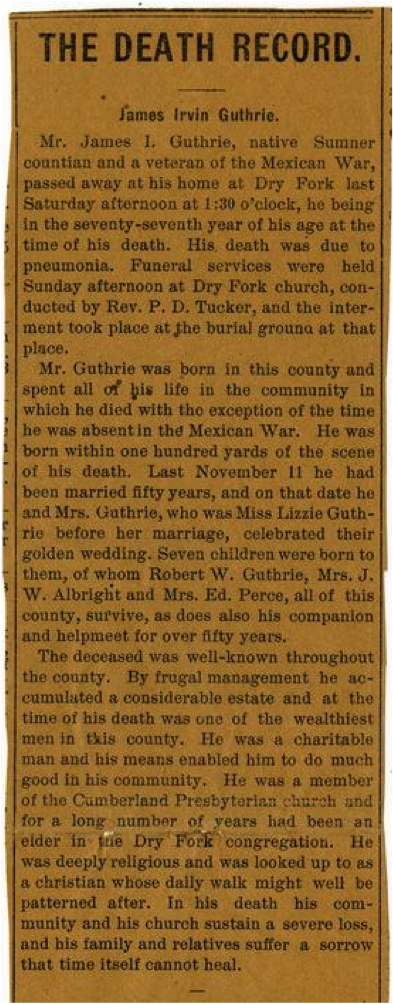
Keep the clipping’s limits visible. Its catalogue leaves the creator and publication date unidentified. Do not automatically label it as the separate dated Tennessean notice.
UNT Libraries Special Collections, Charles B. Moore Family papers, “Obituaries for James Irvin Guthrie and Sarah Ann McKinley”, accession CBM_2090-008-002, ark:/67531/metapth198763. The clipping image reproduced in Guthrie Genealogy’s Tennessee collection was inspected. The repository description and the clipping are distinguished from the dated newspaper transcription cited above.
Sort the children before accepting another hint
Jim & Elvira’s family
Cherry Matilda “Tilda”; John Alexander; Emley Tennessee; Louisa Jane; Nancy; and James Guthrie.
James Irvin & Nancy Elizabeth’s family
Zerelda Caledonia “Callie”; William H.; Louanna Jane; Edward Motheral; Mary Ella; Robert Wesley; and Nancy Acenith “Nannie” Guthrie.
These are the child lists in the published family studies. Keep each child’s individual evidence with the appropriate parents.
In particular, do not equate Louisa Jane with Louanna Jane, or the two daughters named Nancy, merely because their names look similar. The wives’ matching first names do not make the children interchangeable either.
Child lists: the original Jim / James Irvin comparison and the James Irvin family entry. These lists summarize the family reconstructions; they are not presented as a single birth register or one census household.
Follow the photograph back to its original upload
The original uploader’s account
Ann Guthrie identifies James Irvin as her direct ancestor and the disputed portrait as her family photograph. She uploaded the original to James Irvin’s tree and subsequently found it used in Jim’s profile.
“I had uploaded the original to James Irvin Guthrie’s tree, so I know the photo’s origins.”
This is firsthand information about the upload and the later misassignment. It is not an identification based on whether the person in the photograph looks like someone else in a family tree.
A copied caption is not new provenance. Reusing the image under Jim’s name does not create a second identification of the sitter. Preserve the original family attribution with the photograph.
When correcting a copy, keep the photograph’s source, the person who supplied it, and the explanation of the mistaken attachment together. A changed profile title alone may leave a misleading image caption behind.
Do not invent a photographer, date of exposure, or chain of transfers to make the provenance look complete. Record the parts that are actually known.
Photograph provenance: Ann Guthrie, descendant and original uploader, firsthand statement supplied for this case. Her published Mistaken Identities discussion also identifies the image as her family photograph and reports its misassignment. This account does not establish the first erroneous attachment or every subsequent copying route.
Keep the DNA context with the represented family
The Carter–Barbara study places that family in GFG8A, Branch D. Its listed Y-DNA line runs through Hamilton Wade Guthrie, Jim’s brother—not through Jim himself.
The GFG2A, Branch A study lists paternal lines descending through James Irvin Guthrie.
Preserve that distinction when citing the project. Do not turn a test through Jim’s brother into a direct test of Jim’s descendants, or use a family-group label to bypass the documentary identification of an individual.
The photograph’s identification remains a separate provenance question. Neither a matching surname nor a genetic group supplies the name of a person in an unverified image.
Published participant lineages: Carter Guthrie & Barbara Beal, DNA section; and GFG2A–Branch A. This describes the project’s represented lines, not a new analysis of individual test results.
A note to keep with the corrected profiles
Suggested research-note wording—not a historical quotation. Add your citations and revision date.
James “Jim” Guthrie and James Irvin Guthrie are retained as separate people. Their spouses, children, and records have been reviewed independently rather than joined through the matching names and approximate birth information.
The photograph formerly attached to Jim belongs to James Irvin’s family, according to its original uploader, Ann Guthrie. The mistaken image attachment has been removed, with its explanation preserved so that the error can be recognized if it appears again.
Check the image captions and source attachments as well as the family relationships. Each can continue to carry the old identification after the main profile has been corrected.
One clue to pocket: A familiar face is only as reliable as its identification. Follow the photograph’s source with the same care as the family’s records.
Further reading: Jim’s Carter–Barbara family · James Irvin’s Sumner County family · The obituary clipping’s repository record
The Case of the Three Johns
John Guthrie — Scotland/Ireland & Connecticut
Online Family Trees
A real genetic relationship does not make an unsupported family merger correct.
These are related branches of the same genetic family, not unrelated Guthries who happen to share a surname. Y-DNA places them within Guthrie Family Group 2A. That genuine relationship is part of what makes the mistaken identification appealing.
The error occurs when researchers try to join the branches by matching their earliest named ancestors. A John in one family becomes a John in another, or a familiar ancestral couple is assigned children from several branches. The DNA relationship is real; the particular merger is not supported.
How the mistaken connection is made
“These families match genetically, and both have an early John Guthrie, so the Johns must be the same man—or belong to the same immediate household.”
That is the unsupported leap. The project’s branch-specific findings distinguish a closer A/E/H relationship from the broader ancestry shared with B/F/I. The unidentified ancestor connecting the broader lines is likely farther back in the tree.
The branch distinction that the merged trees overlook
Branches A · E · H
A closer genetic relationship
These branches share a distinguishing mutation not found in the other represented GFG2A branches.
The current Y-DNA and Big Y interpretation favours a shared father for the Branch E and Branch H progenitors. Branch A’s James likely belongs to the following generation, making that proposed ancestor his grandfather.
Branch H supplies the named-couple origin tradition: John Guthrie and Jane Stuart of Scotland and northern Ireland. The proposed links from A and E are genetic and genealogical hypotheses—not recovered records naming their parents.
Branches B · F · I
The separate Three Brothers research
These represented lines do not carry the distinguishing mutation shared by A, E, and H.
Their origin account identifies three brothers in the iron-manufacturing business in or near Edinburgh. The John associated with Branch F carried that trade to America.
The claimed brotherhood and the men’s movements still require work. Arrival stories and proposed timelines differ, and the earliest documentary evidence is thin. Those gaps do not justify merging the ironworker with Jane Stuart’s husband.
Genetic distinctions and the current father-versus-grandfather interpretation: Guthrie DNA Project research notes supplied by Ann Guthrie for this case. Related published discussions: Branch A, Branch E, Branch H, and Branch F. The current generational interpretation is distinguished from older suggestions that all three A/E/H progenitors were brothers.
What to update in your tree
Keep the branches related without forcing the missing connection. Do not merge the Connecticut immigrant John with John Guthrie of the Jane Stuart tradition, or assign the Connecticut family to that couple through a general GFG2A match.
Preserve the proposed closer relationship among A, E, and H with its qualifications. Do not present the proposed father or grandfather as established parentage.
Keep the Connecticut father and son separate, and leave the immigrant’s three other reported sons unidentified. Matching names from another branch do not fill those places.
The three Johns whose profiles must remain separate
- John 1 · Branch H tradition
- John Guthrie, husband of Jane Stuart. The published family account associates this couple with Scotland and northern Ireland. Contemporary records identifying them there have not been found in the project’s research.
- John 2 · Branch F immigrant
- John Guthrie, the ironworker who settled in Connecticut. His wife is unidentified. The family account gives him four sons.
- John 3 · Branch F son
- John Guthrie, husband of Abigail Coe. He is identified in the family account as the immigrant’s youngest son. His three brothers remain unidentified.
Individual identities and origin accounts: the Branch H and Branch F studies linked above. The four-son household is preserved as published family evidence, not presented as a newly located register naming all four children.
Two common-ancestor questions—not one ready-made pedigree
Where do A, E, and H meet?
The shared mutation and the project’s combined Y-DNA and Big Y interpretation support investigating a comparatively close relationship among these branches.
The current proposal places the E and H progenitors as likely brothers, with Branch A’s James a generation farther down. The John–Jane Stuart tradition provides a possible identity for the proposed ancestral couple.
The names come from Branch H’s family tradition, not from the DNA test. The genetic evidence does not itself name John, identify Jane, or supply the missing parent-child documents.
Where do those branches meet the wider GFG2A family?
That is a different question. The B/F/I lines share broader GFG2A paternal ancestry but lack the distinguishing A/E/H mutation in the represented tested lines.
The project’s working interpretation places the common ancestor connecting these broader lines farther back than the earliest named men being forced together. That ancestor remains unidentified.
Related branches do not have to join at their earliest known names. An unknown earlier ancestor is a legitimate research conclusion. It is not a gap that must be closed by merging two Johns.
Likewise, the absence of the A/E/H mutation in B/F/I does not by itself prove that the three men in their origin account were brothers. That historical relationship remains a separate question to investigate.
Interpretation follows Ann Guthrie’s current project assessment supplied for this case. The distinction is between a proposed close A/E/H relationship and an unidentified earlier relationship within the wider genetic family. No independent reanalysis of individual Y-DNA or Big Y results is claimed here.
Branch H: what the John–Jane Stuart tradition actually supplies
Branch H preserves the specific origin story naming John Guthrie and Jane Stuart. It describes John fleeing Scotland for Ireland during the Covenanter era because of religious persecution.
That is published family evidence. It is not a chain of contemporary Scottish and Irish records establishing the couple and every generation descending from them.
No such contemporary identification of John and Jane has yet been found in the project’s research. The proposed connections from Branches A and E depend on the genetic findings and subsequent reconstruction, not on separate documentary pedigrees independently naming this couple.
Do not give the parents their descendants’ American history
The project has not established a record of John Guthrie or Jane Stuart emigrating to America. Their reported son’s migration and the Pennsylvania family’s later history belong to those descendants.
Do not assign the older couple an American arrival, residence, or death simply because a merged tree carries those events. This is an absence of an established migration—not proof that neither person could ever have travelled.
Laurence R. Guthrie, American Guthrie and Allied Families (1933), Book II, p. 159, Oxford Township family account; and Branch H, Origin Theories and Their Story. The publication preserves the tradition; the project’s research limits distinguish it from contemporary documentary proof.
B, F, and I: the ironworkers’ story has its own unresolved history
The Three Brothers account identifies Robert, John, and James Guthrie as iron manufacturers in or near Edinburgh. Their proposed descendant lines are associated with Branches B, F, and I.
The John associated with Branch F is described as taking his iron-manufacturing trade to America. His personal reason for leaving is not established. The Guthrie–Stuart account of a Covenanter’s flight does not identify this man or explain his departure.
The brothers’ arrival stories do not fit neatly together
Different versions disagree over when the men left, whether they travelled together, and where they first settled. The proposed timelines for B and I do not align comfortably with F.
Very little early documentary evidence survives in the present reconstruction. Oral tradition, later published accounts, and the first sparse American records must be distinguished rather than compressed into one certain itinerary.
The Three Brothers theory still needs work. The questions include the men’s identities, their claimed brotherhood, their arrival dates, and whether later retellings have confused people or generations.
None of those uncertainties supports replacing the ironworker with Jane Stuart’s husband. The two men are not made identical by their surname, their shared genetic family, or incomplete immigration histories.
Three Brothers accounts and chronological questions: Branch F; Harriet N. Dunn and Eveline Guthrie Dunn, Records of the Guthrie Family (1898), opening account; and Ann Guthrie’s current research notes. Dunn and Dunn’s retelling includes a persecution explanation. That variant is not treated as proof of this John’s motive or as a link to the Guthrie–Stuart couple.
Within Branch F: four reported sons, only one identified
The Connecticut family account gives the immigrant John four sons. The youngest is identified as John, husband of Abigail Coe. The other three remain unidentified.
Those three unnamed sons are not available places for the founders of A, E, H, or any other branch. A proposed identification needs evidence that connects the person to this particular household.
The younger John’s Connecticut family has its own local record sequence. The published account associates him with a 1726 Stratford property purchase, his 1727 marriage to Abigail Coe, and a 1756 will naming his later wife Susanna and children.
These records help distinguish the son’s household. They do not identify the immigrant’s wife or supply the missing Scottish ancestry.
Four sons and the youngest John: the Branch F family account. Younger John’s property, marriage, and will: Dunn and Dunn, Records of the Guthrie Family, entry 2 and printed pp. 7–9. These references follow published accounts and transcriptions, not a new examination of the original deeds, registers, or probate papers.
A note to preserve the correction in your tree
Suggested research-note wording—not a historical quotation. Add your citations and revision date.
This family shares broader GFG2A paternal ancestry with other Guthrie branches, but that relationship does not establish the merged pedigree previously attached here.
The project’s Y-DNA and Big Y findings distinguish the closer A/E/H relationship from the broader ancestry shared with B/F/I. The common ancestor connecting the broader lines remains unidentified and is likely farther back than the named men being combined.
John Guthrie associated with Jane Stuart is therefore kept separate from the Connecticut immigrant ironworker and from the latter’s youngest son, John, husband of Abigail Coe. The origin traditions and proposed relationships retain their individual qualifications.
One clue to pocket: A genuine DNA relationship can still be represented by an incorrect tree. Keep the relationship—and remove the unsupported merger.
Further reading: Branch H’s Guthrie–Stuart tradition · Branch F and the Three Brothers research · Branch A · Branch E · The separate ministerial-ancestry claim
The Case of the Two Halifaxes
John Guthrie — Halifax, Virginia / North Carolina
Online Family Trees
Two Johns, two wives, and a county name that needs its state attached.
Which John Guthrie married Betty Ann Allen? “The one from Halifax” does not answer the question. These two men belonged to different families associated with counties of that name in different states.
The Virginia marriage has been attached to the North Carolina man, displacing Anna Smith. The result can combine wives, parents, children, and military records—not just an incomplete place name.
Cumberland & Halifax, Virginia
John Guthrey & Betty Ann Allen
GFG4
Son of Thomas Guthrey and Sarah Oakes
in the family reconstruction.
Their marriage bond is dated 25 May 1785 in Cumberland County, Virginia. His later pension application places him in Halifax County, Virginia.
Halifax & Buncombe, North Carolina
John Guthrie & Anna Smith
GFG5
Son of William Guthrie,
placed with Eleanor Harris Abbott
in the published family reconstruction.
Anna was a daughter of Peter Smith. Their family is traced through North Carolina, Georgia, and back to North Carolina.
What to update in your tree
Keep Betty Ann Allen with the Cumberland–Halifax, Virginia, John. Keep Anna Smith with the Halifax–Buncombe, North Carolina, John.
Detach the Virginia marriage bond from the North Carolina couple. Do not combine the women as successive wives simply to retain both existing attachments.
Review the parents, children, pension files, and estate records as well. Preserve the state and county on each citation, even when a short profile display shows only “Halifax.”
Family distinction: “4-A: John Guthrey” and “5-A: John Guthrie”. The 2022 Mistaken Identities comparison documents the reported online spouse substitution. Its publication date is not assigned as the origin of that error.
Open the Virginia marriage file: Betty Ann Allen
The family study identifies the 25 May 1785 Cumberland County bond with John Guthrey and Betty Ann Allen. William Guthrey provided surety.
That William is interpreted in the study as probably John’s older brother. His presence is not evidence that the groom was the other John, whose father was named William.
Read the role as well as the name. A surety is not automatically the groom’s father. The family relationship must be established separately from the role recorded in the bond.
Keep the date attached to the marriage bond. Without examining a marriage return or other supporting record, do not describe it as a separately verified ceremony date.
Nor should the longer name “Elizabeth Betty Ann” be treated as a verbatim bond transcription merely because variations appear in family profiles. Preserve the wording of the actual source being cited.
Cumberland County, Virginia, marriage-bond reference, John Guthrey and Betty Ann Allen, 25 May 1785; William Guthrey, surety. Details and the proposed brother identification follow the Virginia family study. The original bond was not independently examined for this block.
Follow Anna Smith’s family connection
The daughter named Anna Guthrey
The existing case cites Peter Smith’s Halifax County, North Carolina, will as naming his daughter “Anna Guthrey.” That is the reported family connection behind the Smith identification.
The North Carolina John–Anna study also connects their children with Peter Smith’s estate. This is a different family context from the Cumberland marriage bond.
A daughter’s married name in her father’s will can help identify her, but the full record and surrounding relationships still matter. The precise will reference and original wording remain to be checked against the manuscript.
A missing marriage record does not justify borrowing one. The study estimates the Smith marriage at about 1775, probably in Halifax, North Carolina, and states that no marriage record has been located. The Allen bond does not fill that gap.
Keep the estimated date and proposed location qualified. Neither should become an exact marriage event simply because the wife’s identity is being corrected.
Peter Smith will reference and quoted daughter’s name: “Mistaken Identities: 2,” Halifax comparison. Marriage estimate and estate connections: the John–Anna family study. The will’s original image and exact book/page citation were not established in this review; its wording is retained as reported research.
Compare the two pension files
- S.8642 · Virginia
- On 25 September 1832, John Guthrey appeared before the Halifax County, Virginia, court. He stated that he was born in Cumberland County in 1760, remained there after the war, and later moved to Halifax County, Virginia.
- His service
- He described Virginia militia service beginning in May 1780, including service under Captain Charles Balloo and participation at Guilford Court House.
- S.10776 · North Carolina
- In his affidavit dated 16 October 1820, John Guthrie identified his permanent residence as Buncombe County, North Carolina, and discussed his earlier residence in Georgia.
- His service
- He described work at an armory near Halifax town, North Carolina, followed by enlistment as a private and continued armory service. He reported being wounded on 7 May 1781.
These are separate applications with different service and residence histories. Retain the file number with each citation; “John Guthrie, Revolutionary soldier” is not a sufficient identifier.
A campaign location is not automatically a home address. The Virginia applicant also described service in North Carolina. That does not turn him into the man whose family lived in Halifax County, North Carolina.
The pension narratives help distinguish the men. They do not, by themselves, identify the two wives in this comparison. Keep the marriage and family evidence alongside the military records.
John Guthrey, S.8642, transcribed and annotated by C. Leon Harris; and John Guthrie, S.10776, transcribed by Will Graves, revised 30 November 2015. Both two-page transcriptions were reviewed. They are derivative presentations, not the original pension-file images. Graves explicitly notes editing of spelling and the omission of some material.
Separate the deaths from the later estate proceedings
The Virginia date needs correcting
The earlier case gave the Virginia John’s death as 1833. The fuller family study reproduces an August 1837 court entry reporting that the Revolutionary pensioner died on 17 January 1836.
The entry also reports no surviving widow and identifies twelve adult children and heirs. Its associated family names include Crews, Keeling, and Rowlett.
Use the reported 1836 death with that citation. Do not retain the older 1833 date without contrary evidence, or substitute the court’s 1837 sitting as the death date.
The North Carolina estate is a different one
The North Carolina family chronology records John’s death on 4 September 1821. It separately describes a paper presented as his will at the October 1823 Buncombe court session.
Those events belong to the Buncombe man. They should not be combined with the Virginia pension application or the later Halifax, Virginia, heirs’ proceeding.
Virginia: Halifax County Minute Book 7, 1836–1838, p. 154, August Court 1837; FamilySearch film 008572490, image 459. The death and heirs’ details follow the transcription in “4-A: John Guthrey”.
North Carolina: Buncombe court record, October 1823, linked and discussed in “5-A: John Guthrie”. The original images for these court references were not accessible during this review; the descriptions are attributed to the published family research.
Check the memorial separately from the inscription
The published case reports the Allen identification on a Find a Grave memorial associated with the North Carolina family. The John–Anna study describes the wife’s marker as reading simply “Wife of John.”
Those are different kinds of information. A name entered on a memorial page is not necessarily a name engraved on the marker.
Do not make the inscription say more. “Wife of John” supplies neither Allen nor Smith. Identifying the woman requires the family evidence, not an expanded online caption.
When submitting a correction, explain the two couples and cite the supporting records. Preserve the inscription exactly as it appears, separately from the biographical identification.
Reported memorial error: the 2022 Halifax comparison. Reported marker wording: the John–Anna family study. Neither the stone nor the memorial’s present contents were independently inspected here; this section preserves the published report, not a claim that the online entry remains unchanged.
Keep the genetic evidence within its scope
The project places the Thomas Guthrey–Sarah Oakes family in GFG4 and the William Guthrie family in GFG5. Their represented paternal profiles are distinct.
The GFG5 participant list includes a paternal line through John Guthrie and Anna Smith’s son Shadrack. Cite the represented line, not simply a general Guthrie surname match.
These findings reinforce the need to keep the family files separate. Y-DNA does not identify a wife’s maiden surname, and different paternal groups do not establish that all their descendants are unrelated through every other ancestral route.
Published project findings: GFG4 overview and GFG5–Branch A, William Guthrie & Eleanor Harris Abbott, participant lineages and findings. This summarizes the project’s published evidence, not a new analysis of individual test results.
A note to keep with the separated couples
Suggested research-note wording—not a historical quotation. Add your citations and revision date.
These Halifax families are kept separate. Betty Ann Allen belongs with the Virginia John Guthrey; Anna Smith belongs with the John Guthrie associated with Halifax, North Carolina, Georgia, and Buncombe County, North Carolina.
The Virginia marriage bond is not used as evidence of the Smith marriage. The two pension files and later estate proceedings are assigned separately. County names retain their states, and unresolved dates remain qualified.
Check each child’s maternal grandparents and attached sources after correcting the spouse. A mistaken marriage can leave errors elsewhere in an otherwise familiar family tree.
One clue to pocket: Finish the address before joining the family. “Halifax” is a clue—not a complete identification.
Further reading: John & Betty Ann’s Virginia family · John & Anna’s North Carolina family · Virginia pension transcription · North Carolina pension transcription
The Case of the Borrowed Captain & the Added Name
John Guthrie of Middlesex
Online Family Trees
Christ Church Parish, Middlesex County, Virginia
Husband of Elizabeth Baskett · Died 1706
The profile called “Captain John Montrose Guthrie” combines two different questions. Was Elizabeth Baskett’s husband the captain of the Ewe & Lamb? And what supports giving him the middle name Montrose? Removing one unsupported attachment does not resolve the other.
Keep the Middlesex family and the shipmaster’s career separate, then examine the added name on its own evidence. A complete-looking profile is not necessarily a single, documented biography.
Keep the generations straight: This case concerns John Guthrie, husband of Elizabeth Baskett. The separate John Guthrie / John Howard Paul Guthrie case concerns their son John.
In this case: The borrowed captain · The added “Montrose”
Issue 1 — The Borrowed Captain
The Virginia family
John Guthrie of Middlesex
The planter associated with Elizabeth Baskett and their Christ Church Parish family. His local chronology continues beyond 1687 and records his death in 1706.
The captain’s title and maritime career are not established parts of this man’s biography.
The maritime career
Captain John Guthrie
The Scottish Privy Council names him as skipper of the Ew and Lamb on 16 November 1671, petitioning with merchant Laurence Trent.
Keep this shipmaster’s records in a separate file. The Brechin estate entry discussed below is a possible identification for him—not an established record of the Middlesex planter.
What to update in your tree
Retain John Guthrie, husband of Elizabeth Baskett, with his Virginia family and supporting records. Remove the unsupported Captain title from his profile.
Keep the Ewe & Lamb career separate. Do not attach the possible Brechin estate record as the planter’s death or probate event. Parents introduced through the combined identity also need independent evidence before they can remain in his pedigree.
Sources: Tidewater Virginia Families, Middlesex family chronology and captain comparison; P. Hume Brown, ed. and abr., The Register of the Privy Council of Scotland, Third Series, vol. III (1910), p. 407, 16 November 1671, transcribed and discussed in the RPCS Third Series study. The Virginia chronology follows the published reconstruction; it is not a new transcription of the original parish and court records.
A clue in the captain’s final chapter
The Brechin testament index lists Captain John Guthrie, merchant in Brechin, under 29 September 1687. His identification as the Ewe & Lamb shipmaster remains provisional.
Why the date matters: If the deceased merchant was the shipmaster, the captain was dead by those estate proceedings. He could not also be the Middlesex man whose reconstructed life continues to 1706.
The possible chronological exclusion belongs in this comparison, but its condition must stay visible: first establish that the Brechin merchant was the shipmaster.
Francis J. Grant, ed., The Commissariot Record of Brechin: Register of Testaments, 1576–1800 (Scottish Record Society, 1902), p. 58: Captain John Guthrie, merchant in Brechin, 29 September 1687. This is a published testament-index reference, not a verified exact death date or a newly examined original testament.
Open the Scottish death & estate evidence
- The indexed man
- Grant’s index supplies a name, a title, a mercantile description, a location, and an estate date. It does not name the Ewe & Lamb in the cited entry.
- The proposed match
- Those details make the estate relevant to the shipmaster’s research. They justify investigating the connection, but do not establish it by themselves.
- The 1683 lead
- The maritime chronology includes a voyage attributed to the Ewe & Lamb in 1683. That is compatible with later estate proceedings, but a vessel’s voyage does not automatically identify its commander.
- The identity test
- Examine the underlying testament for relatives, residence, creditors, debtors, and business associates. A vessel name, Laurence Trent connection, or other securely correlated details could help identify the deceased merchant.
- The consequence
- Establishing the shipmaster’s identity with the deceased Brechin merchant would exclude him from the later Middlesex biography. Until then, the estate attribution must remain qualified.
Keep the date with the correct event. A testament’s confirmation date is not necessarily its subject’s death date. An estate connection to Brechin does not, by itself, establish where the person physically died.
The unresolved question is “Was the Brechin merchant the shipmaster?” It is not a reason to preserve the combined “Captain John Montrose” profile for Elizabeth Baskett’s husband.
Estate evidence: Grant, Brechin Register of Testaments, p. 58. Maritime context: Tidewater Virginia Families. For the distinction between a testament, confirmation, and death, see ScotlandsPeople: Wills and Testaments. The proposed shipmaster identification is an interpretation to test, not wording supplied by the published index.
Compare the timelines—not just the names
- 20 November 1669
- The Privy Council entry on printed p. 98 names Captain James Guthrie, skipper of the Ewe and Lamb. Preserve that forename; do not silently change it to John.
- 16 November 1671
- The entry on printed p. 407 explicitly names Captain John Guthrie, skipper of the Ew and Lamb, with merchant Laurence Trent.
- 6 February 1686
- The Christ Church Parish marriage entry, as dated in the published transcription, names John Guthry and Elizth Basket. The date is retained in the form used by that transcription.
- 29 September 1687
- The Brechin testament index lists Captain John Guthrie, merchant in Brechin. His identification as the shipmaster is the proposed connection being tested.
- After 1687
- The Middlesex parish chronology includes baptisms of children of John and Elizabeth in 1689, 1691, and 1701/2. These are baptism dates, not automatically birth dates or proof that a parent was present at the ceremony.
- 5 June 1704
- The Tidewater reconstruction associates the Middlesex man with an order summoning John Gutteridge, surveyor of the Upper Precincts, to answer a grand-jury presentment. This is a later adult-activity reference within that local reconstruction.
- 1706
- The Middlesex chronology records the death of John Guthrie senior, husband of Elizabeth Baskett.
Scotland versus Virginia is not, by itself, the deciding test: a shipmaster could appear on both sides of the Atlantic. The question is whether the records support one coherent life. A securely identified death before later personal activity would exclude a match.
James is not silently changed to John. The differing forenames in the 1669 and 1671 printed entries remain part of the evidence. A shared vessel name does not authorize us to rewrite the earlier entry or combine another identity into the case.
Chronology sources: Brown, Register of the Privy Council of Scotland, Third Series, vol. III, pp. 98 and 407; Grant, Brechin Register of Testaments, p. 58; and Christ Church Parish and Middlesex court entries transcribed or summarized in Tidewater Virginia Families. The Virginia identifications follow that study’s reconstruction. The Brechin-to-shipmaster identification remains provisional.
Issue 2 — The Added “Montrose”
Even after the captain’s career is removed, Montrose still needs its own evidence. The records cited for Elizabeth Baskett’s husband do not establish it as his middle name.
The unsupported addition
John Montrose Guthrie
A middle name repeated in online profiles, but not established for this John by the cited family records.
The name to retain
John Guthrie
Keep the name separate from titles and geographical descriptions. Preserve the original surname spellings when transcribing individual records.
What to update in your tree
Use John Guthrie as the preferred name. Move the disputed “Montrose” into an explanatory research note rather than retaining it as an established middle name.
Do not substitute M. as a compromise. That would keep the same unsupported claim in abbreviated form.
Naming comparison: the John Guthry–Elizth Basket marriage transcription and related Middlesex family chronology in Tidewater Virginia Families. The conclusion is that the added name lacks support in the cited evidence—not a claim that every surviving record of this man has been examined.
Open the name and Scottish-parentage evidence
A Scottish child is not yet a Virginia identification
The proposed parents, James Guthrie and Elizabeth Ouchterlony, are associated with an Arbroath parish entry dated 9 August 1661 for Jhon Guthrie.
That is a Scottish family to investigate. It does not establish that their son became Elizabeth Baskett’s husband, and it does not supply Montrose as the Middlesex man’s middle name.
Keep the questions separate. Removing the borrowed captain does not identify the planter’s parents. Finding a Scottish child with a matching name does not establish the child’s later Virginia life. Neither connection is completed by adding an extra name.
The Middlesex man’s parents and exact birth details therefore remain unresolved. Retain the Arbroath reference as a qualified research lead, not an established parent-child relationship in his pedigree.
Scottish parentage lead: ScotlandsPeople, Old Parish Registers, Arbroath, entry dated 9 August 1661 for Jhon Guthrie, son of James Guthrie and Elizabeth Ouchterlony. This is the previously cited parish-record lead, not a fresh transcription of the original entry. Its proposed connection to John Guthrie of Middlesex has not been established.
A note to take back to your tree
Suggested research-note wording—not a quotation from a historical record. Add your citations and the date of your revision.
This profile represents John Guthrie of Middlesex County, Virginia, husband of Elizabeth Baskett, whose death is recorded in the family chronology in 1706. His Virginia family is kept separate from Captain John Guthrie’s Ewe and Lamb career.
The unsupported Captain title and Montrose middle name have been removed from the preferred name. The Brechin testament-index entry dated 29 September 1687 is a possible identification for the shipmaster, not an estate or death event to assign to this planter. The proposed Scottish parentage remains unproved.
Their son John is a different member of the Middlesex family and is the subject of the separate John Howard Paul mistaken-identity case.
Preserve the rejected wording in the explanation so another researcher can recognize the error. Check attached records and parent relationships as well as the name; changing the heading alone will not separate a combined biography.
One clue to pocket: A title, a middle name, and a pair of parents are separate claims. Each needs evidence connecting it to the person—not merely to a matching name.
Further reading: The Tidewater John Guthries · The captain in the Scottish records · The Brechin testament index
The Case of the Borrowed Ministers
John Guthrie & Abigail Coe — Claimed Ministerial Ancestry
Online Family Trees
Connecticut · GFG2A–Branch F
A proposed Scottish pedigree with more than
one connection to untangle.
A connection to a well-known ancestor can look especially convincing when a tree supplies several neatly named generations. Here, the proposed ancestry leads from John Guthrie and Abigail Coe back through an added “John William” to the ministers of Fenwick and Stirling.
The difficulty is not simply a missing record somewhere along the way. The pedigree confuses different men named James and William, adds unsupported names, and assigns a surviving son where the family evidence does not support one.
The disputed descent
Four profiles joined as successive generations
Rev. James Guthrie of Stirling
↓ “Rev. William Fenwick Guthrie”
↓ “John William Guthrie”
↓ John Guthrie, husband of Abigail Coe
This is the claim being examined—not an accepted family tree.
The distinctions to retain
Separate the Scottish households
William of Fenwick’s father was James Guthrie of Pitforthie, not the minister of Stirling.
James of Stirling’s son William was a different person. Neither Scottish household supplies the proposed father-to-son chain into the Connecticut family.
What to update in your tree
Detach the unsupported ministerial ancestry from the Connecticut profiles. Preserve John Guthrie and Abigail Coe, their family, and their supported records.
Keep the earlier immigrant John within the qualified Connecticut reconstruction, but do not give him William of Fenwick as a father or “William” as an established middle name.
Retain the ministers in separate research profiles with their own families. Correcting this pedigree does not require deleting their histories—or inventing another route to keep them attached.
The disputed sequence is preserved from Guthrie Genealogy’s existing False Parentage example. Correction evidence: Hew Scott, Fasti Ecclesiæ Scoticanæ, vol. III, pp. 93–94, Fenwick; and vol. IV, pp. 318–319, Stirling. These ministerial entries were consulted for this rebuild. They are published compilations, not newly examined original parish registers.
Start with the two fathers named James
James of Pitforthie is not James of Stirling
The Fenwick entry in Fasti identifies William as the eldest son of James Guthrie of Pitforthie and a daughter of the Lyon family of Easter Ogil. The current family reconstruction identifies his mother as Janet Lyon.
The same entry describes James Guthrie the martyr as William’s cousin and philosophy teacher at St Andrews. It does not describe him as William’s father.
Teacher, relative, and father are different relationships. William’s association with James at university does not turn the Stirling minister into the Pitforthie father.
Keep the cousin relationship qualified
The two ministers were repeatedly described as cousins or near relations. Their exact genealogical connection remains unresolved in the revised research.
The proposed connection through Janet Lyon’s maternal Guthrie ancestry is a hypothesis, not a completed pedigree. Rejecting the father-son claim does not require pretending that every detail of their cousinship has been proved.
William’s father and the description of James as his cousin and teacher: Fasti Ecclesiæ Scoticanæ, vol. III, p. 93. Janet Lyon’s identification and the current limits of the cousinship: Rev. William Guthrie’s revised biography, Family Origins and Were They Cousins? The biography distinguishes its reconstructed family evidence from the more limited wording of the printed ministerial entry.
William of Fenwick did have a son John—but not this immigrant
William and Agnes Campbell had six known children. The proposed Connecticut descent cannot be assessed simply by finding a John among them: his later history matters.
- Son William
- The parish reconstruction identifies his baptism on 21 August 1653 and burial on 5 April 1655.
- Son John
- Baptized 19 September 1658. The study identifies him as very likely the John buried at Fenwick on 13 June 1662. That burial identification remains qualified.
- Surviving daughters
- Agnes married Matthew Miller of Glenlee; Mary married Rev. Patrick Warner. These are the documented surviving descendant lines.
The printed Fasti account independently lists the sons among the children who died young. That does not support turning John into an adult ironworker who emigrated and founded the Connecticut family.
No surviving male line does not mean no descendants. William’s daughters had families. The correction rejects this proposed father-to-son pedigree; it does not erase the Miller and Warner descendants.
Fasti Ecclesiæ Scoticanæ, vol. III, p. 94, William and Agnes Campbell’s children. The more precise baptism and burial dates follow the Fenwick Old Parish Register reconstruction in William’s revised biography. Those original register images were not newly examined for this block; the study’s qualification of John’s burial is retained.
Separate the martyr’s son William from the Fenwick minister
Another William in another household
James Guthrie of Stirling married Jane, also called Jean, Ramsay. The cited family evidence identifies two children: William and Sophia, also called Sophie.
Fasti records this William’s death in Edinburgh in April 1674, on the eve of being licensed. The project’s family reconstruction estimates his birth at about 1656–1657 and has found no documented wife or children.
The Fenwick minister, by contrast, was born about 1620 and died in 1665. James’s young son William cannot be substituted for that older minister.
The shared given name does not connect the pedigrees. James having a son William does not establish that the son was William of Fenwick—or that either William fathered the Connecticut immigrant.
Sophia’s unanswered history stays unanswered
Sophia survived her father and appears with her mother in later proceedings. Her eventual marriage and descendants have not been established in the project’s current research.
Do not turn that uncertainty into a claim that she certainly left no descendants. Equally, an untraced later life is not evidence connecting her to the Connecticut family.
James’s wife and children: Fasti Ecclesiæ Scoticanæ, vol. IV, p. 319, Stirling East Church. William of Fenwick’s chronology: vol. III, pp. 93–94. The younger William’s approximate age and the unresolved descendant questions follow the project’s existing Fasti research sketch for James of Stirling; they are not new findings from an original birth or death record.
Check the added names: “John William” and “William Fenwick”
The immigrant’s added “William”
The Connecticut reconstruction identifies the earlier immigrant as John Guthrie. “William” has not been established as his middle name in the sources cited for this case.
Remove the unsupported addition from the preferred name, but keep an explanatory note so the disputed profile can be recognized when it reappears.
Fenwick identifies the ministry
Use Rev. William Guthrie, minister of Fenwick. In the cited sources, Fenwick identifies his parish—not an established middle name.
Do not solve the pedigree by lengthening the names. A name assembled from two men or from a man and his location still needs evidence for that individual.
The older Connecticut accounts preserve an ironworking-family tradition. They do not supply the ministerial parentage inserted into this online chain.
Connecticut naming and origin account: Harriet N. Dunn and Eveline Guthrie Dunn, Records of the Guthrie Family (1898), opening Connecticut entries; and the Branch F family study. William’s ministerial designation: Fasti Ecclesiæ Scoticanæ, vol. III, Fenwick entry. These sources support the naming correction; they do not identify who first introduced the disputed forms.
Keep the Connecticut family without supplying new Scottish parents
The rejection of this pedigree does not disturb John and Abigail’s supported Connecticut household. The earlier immigrant’s ancestry and the identity of his wife remain separate research questions.
The project places represented descendants of the Connecticut family in GFG2A–Branch F, including paternal lines through James, Joseph, and Ephraim. That classification does not identify either Scottish minister as an ancestor.
A test match must still be connected through documented generations. It cannot convert an unsupported name or an incorrect father-son relationship into an established pedigree.
Another Scottish question does not repair this connection. The separate Memus investigation concerns James of Stirling’s own parentage. It does not establish descendants linking him to Connecticut.
The alternative confusion involving John and Jane Stuart belongs in John Guthrie — Scotland/Ireland & Connecticut. Keep that comparison separate rather than replacing this rejected pedigree with another unproved connection.
Represented paternal lineages: GFG2A–Branch F. Separate parentage inquiry: Guthrie of Memus, including the provisional identification from Fasti, vol. VIII, p. 393, citing a sasine dated 30 April 1659. That underlying sasine remains an outstanding source in the project; it is not evidence of the Connecticut descent claimed here.
A note to preserve the correction
Suggested research-note wording—not a historical quotation. Add your citations and revision date.
The proposed ministerial ancestry has been detached from this Connecticut family. The online sequence through “John William Guthrie” and “Rev. William Fenwick Guthrie” is not retained as an established pedigree.
William of Fenwick was the son of James Guthrie of Pitforthie, not James Guthrie of Stirling. The martyr’s son William was a different person. The ministers’ family evidence does not support the claimed succession of fathers and sons.
The supported Connecticut relationships remain intact. Unresolved Scottish ancestry is left open rather than filled with another speculative pedigree.
Preserve the rejected chain in the explanation, not as active parent links. That gives the next researcher a way to recognize the claim and understand why it was removed.
One clue to pocket: A pedigree needs evidence at every parent-child connection. A well-documented famous person at the top cannot supply the missing links below.
Further reading: John & Abigail’s Connecticut family · William of Fenwick’s family · James of Stirling in Fasti, vol. IV
The Case of the Constable and the Tailor
John Guthrie & Jane — Sixsmith / Laidlaw
Online Family Trees
Matching parents’ names have sent children into the wrong household.
Both husbands were John Guthrie. Both wives appeared as Jane, and both families lived in England. A record naming only John and Jane Guthrie can therefore appear to fit either tree.
In the reported error, the tailor’s family is overlooked and his children are assigned to the constable’s household. The correction depends on following occupation, address, and family relationships together, rather than stopping at the parents’ names.
The Windsor household
John Guthrie & Jane Sixsmith
Police constable, with Liverpool given as his birthplace in the published census comparison.
The marriage reference is 24 June 1822, St Anne, Soho. The later family is traced in Windsor / New Windsor, Berkshire.
The Edinburgh–Shoreditch household
John Guthrie & Jane/Jean Laidlaw
Tailor, described in the family study as Scottish-born, about 1790.
The marriage reference is from St Cuthbert’s, Edinburgh. The family’s later English records belong to Shoreditch, London.
What to update in your tree
Keep Sixsmith with the constable and Laidlaw with the tailor. Do not treat the two Janes as one woman, or retain them as successive wives of one John simply to accommodate both sets of records.
Review each child’s original entry and household connections. Move a misassigned record to the appropriate family rather than discarding useful evidence.
Check the resulting maternal ancestry too. Correcting a child’s mother may also require removing the wrong grandparents.
Case evidence: “Mistaken Identities: 2,” John Guthrie & Jane Sixsmith / Jane Laidlaw comparison. The discussion supplies parish-record extracts and the census-based family reconstruction. Its publication date identifies the corrective article, not the beginning of the online error.
Follow the tailor through the Scottish entries
- The marriage entry
- The published extract calls John a “taylor” at No. 13 South Saint David’s Street. His bride is recorded as Jean Liddle, daughter of the late David Liddle.
- The daughters’ entries
- The extracts for Jane and Catherine identify their father as a merchant tailor and their mother as Jean Laidlaw, with a St Andrew’s Street address.
- The English household
- The study follows the family into London by the birth of son John in 1824, then through Shoreditch records.
The study connects these entries through the husband, trade, Edinburgh addresses, and children. It does not rely solely on the similarity between the wife’s recorded surnames.
Preserve the wording and explain the identification. Record Liddle where the entry says Liddle and Laidlaw where it says Laidlaw. Do not silently rewrite the transcription or assume that those surnames always identify the same family.
Likewise, retain Jean or Jane as recorded. A familiar name variation can guide a search, but it cannot identify a woman without the surrounding evidence.
Scottish Old Parish Register extracts and their correlation are reproduced in the published Sixsmith / Laidlaw comparison. The original marriage entry’s date and register reference are not supplied in that passage. No missing date, page number, or manuscript reading has been invented here.
Compare the children before accepting the parents
These are the children assigned to each couple in the existing study. The years are carried from that reconstruction, not newly verified birth or baptism dates.
John & Jane Sixsmith
James (1824); John (1826); Anna (1828); Alfred (1831); Joseph William (1833); Thomas (1826); Henry (1836); Jane (1839).
John & Jane/Jean Laidlaw
Jane (1821); Catherine (1822); John (1824); Harriett (1830); George (1833); James (1835); Emma (1837).
A child’s matching name is another comparison to make—not a reason to combine the lists. Check the father’s occupation and the family’s address alongside the parents’ names in the entry.
One date still needs checking. The published Sixsmith list gives 1826 for both John and Thomas. That is retained as printed, not silently corrected. It establishes neither that they were twins nor that one year is necessarily wrong. Their underlying records must settle it.
Child lists and associated locations: the 2022 family comparison. The list combines a family’s records over time; it is not a transcription of a single census household.
What the comparison does not yet establish
The constable’s proposed Liverpool parents
The study suggests the constable may be the John born 13 January 1794 to James Guttery, carpenter, and Ellen Eccleston. This remains a candidate identification, not established parentage.
The tailor’s Scottish origins
His parents remain unidentified. A matching Scottish birth entry is not enough to select a family without evidence connecting that child to the adult tailor.
The Windsor death estimates
The existing research places the constable’s death between 1852 and 1859 and Jane Sixsmith’s between 1861 and 1871. These remain research intervals, not exact death dates verified for this rebuild.
Keep the correction focused. An unresolved birth or death does not justify borrowing one from the other household. Separate the families without pretending every detail of either life is settled.
Proposed parentage and death intervals: the existing Sixsmith / Laidlaw research. The cited Ancestry family links did not open during this review. The underlying birth, census, and death images were not independently examined.
A note to keep with the separated households
Suggested research-note wording—not a historical quotation. Add your citations and revision date.
These two John-and-Jane households are kept separate. The wives’ identities and the children’s assignments have been reviewed using the associated occupations, addresses, and family records, rather than matching names alone.
Original name spellings are preserved in transcriptions. Proposed parentage and unresolved dates remain qualified; records from the other family are not used to fill those gaps.
Occupation is a useful clue, but not an infallible label: a person could change employment. The identification must fit the combined record sequence, not depend on one occupational word.
One clue to pocket: When both parents’ names match, read the rest of the entry. The address and occupation may show which household the child actually belongs to.
Further reading: The original Sixsmith / Laidlaw comparison and parish-record extracts
The Case of the Two Rachels
John Guthrie & Rachel — Law / Wick
Online Family Trees
One couple crossed the Atlantic. The other stayed in Kirkwall.
Two men named John Guthrie married women named Rachel within a few years of one another in Scotland. That resemblance has been enough for some online trees to combine their wives, parents, children, and death records.
The comparison becomes much clearer once the couples are followed beyond the marriage entry: John the mason and Rachel Law emigrated to America, while John the carter and Rachel Wick remained in Kirkwall, Orkney.
Edinburgh to America
John Guthrie & Rachel Law
John was a mason. The published marriage transcription places the couple at St Cuthbert’s, Edinburgh, on 3 June 1850.
By 17 August 1853, John, Rachel, and daughter Eliza were arriving in New York aboard the Ann Harley.
Kirkwall, Orkney
John Guthrie & Rachel Wick
John was a carter. This couple married in Kirkwall on 28 December 1848.
They continued to appear in Scottish census and death records in Kirkwall long after the other couple had emigrated.
What to update in your tree
Keep Rachel Law with the mason who emigrated to the United States. Keep Rachel Wick with the Kirkwall carter.
Do not use the Wick parents, Orkney children, or Scottish death records to complete Rachel Law’s American profile. Likewise, do not attach the American passenger or military records to the Kirkwall household.
Review each child’s birthplace and the husband’s occupation. Those details help identify which John-and-Rachel couple a record actually concerns.
Core comparison and record transcriptions: “Mistaken Identities: 2” — John Guthrie & Rachel Law versus John Guthrie & Rachel Wick. The article documents the circulating online-tree confusion; its 2022 publication date is not treated as the origin of the error.
Follow the mason and Rachel Law across the Atlantic
- 3 June 1850
- The published St Cuthbert’s marriage transcription names John Guthrie, mason, residing at No. 5 Castle Barns, and Rachel Law, residing at the same place. Rachel is described as the fourth daughter of the late William Law, farmer at Bellfield, Parish of Lanark.
- 17 August 1853
- The published passenger-manifest transcription records John Guthrie, 24, mason; Rachael Guthrie, 22; and Eliza Guthrie, 10 months, arriving from Glasgow on the British ship Ann Harley, with New York as destination.
- United States
- Later children were born in America, and the family moved from New York to Michigan.
- Civil War period
- John enlisted in Company E of a Michigan infantry unit. The published family chronology gives his death as 3 October 1864.
These events form a coherent American migration sequence. Once John and Rachel are documented crossing the Atlantic in 1853, later Kirkwall census entries cannot describe this same household.
Occupation is especially useful here. The marriage and passenger descriptions both identify the American immigrant as a mason. That repeated trade helps distinguish him from the Kirkwall carter.
Marriage and passenger-manifest transcriptions: the published Law / Wick comparison. The later Michigan association is also summarized in Guthrie Genealogy’s Michigan collection. The original marriage register, manifest image, and military file were not independently examined for this rebuild. :chatgpt-content-reference{index=”2″}
Keep the American children with Rachel Law
The existing case reconstructs the children of John Guthrie and Rachel Law as:
- Eliza Guthrie
- About 1852 in Scotland; appears with her parents in the 1853 passenger transcription.
- Rachel Guthrie
- About 1855–1859.
- Anna Guthrie
- About 1857–1861.
- William James Guthrie
- 1859–1938.
- Rachel L. Guthrie
- 1862–1942.
The repeated use of Rachel is not a reason to collapse two daughters into one without checking the underlying death and birth evidence. Preserve the reconstruction with the qualifications already attached to it.
Nor should any of the Kirkwall children be imported merely because both mothers were named Rachel.
Child list and date ranges: the existing Law / Wick case. These dates summarize the family reconstruction; they are not presented as one contemporary family register.
Follow the carter and Rachel Wick through Kirkwall
The other couple married in Kirkwall, Orkney, on 28 December 1848. Their family remained in Scotland.
The published comparison reports the household in the Scottish censuses for 1851, 1861, 1871, and 1881. Rachel and unmarried family members, with some grandchildren, were still there in 1891.
That continuing Kirkwall chronology is incompatible with the American migrant household.
Same-age adults can still be separate people. The strongest distinction is not merely that two Johns had slightly different dates—it is that the two families have simultaneous histories on opposite sides of the Atlantic.
Kirkwall marriage and census chronology: the published case comparison. The original census images were not independently reviewed here; the repeated Scottish residence is retained from that source. :chatgpt-content-reference{index=”3″}
The Scottish death records identify the carter’s family
- 17 April 1881
- The published death-record transcription identifies John Guthrie, carter, married to Rachel Wick, dying at Strynd, Kirkwall, aged 53.
- His parents
- The same transcription names Thomas Guthrie, sexton, and Elizabeth Swaney, both deceased.
- 22 January 1892
- Rachel’s published death-record transcription identifies her as the widow of John Guthrie, carter, dying at the Strand, Kirkwall, aged 72.
- Her parents
- The transcription names Peter Wick, flesher, and Margaret Wick, with the mother’s maiden surname rendered in the source transcription as Harsue.
These death records belong to the Kirkwall couple. They should not supply parents or death dates for John the mason or Rachel Law.
Keep the source spelling visible. If the mother’s maiden surname is difficult to read or later found under another spelling, preserve the original transcription and explain the revised interpretation rather than silently replacing it.
Death-record transcriptions: the Law / Wick comparison. The transcriptions identify both occupation and parental households; the original statutory images were not newly examined for this block. :chatgpt-content-reference{index=”4″}
Keep the Kirkwall children in their own family
The existing study lists the children of John Guthrie and Rachel Wick as:
- Peter Wick Guthrie
- 1849–1935.
- Margaret Guthrie
- Born 1851.
- Jemima Wick Guthrie
- 1853–1907.
- Jamima Guthrie
- Born 1856 in the published reconstruction; later history unresolved there.
- Elizabeth Jean Guthrie
- Born 1858; later history unresolved in the case summary.
- John Guthrie
- 1861–1936.
The appearance of both Jemima and Jamima in the published list deserves source-level checking. Do not silently combine them, correct the spelling, or assume one replaced the other.
What matters for this case is that these children belong to the Kirkwall household—not to the American John-and-Rachel family.
Kirkwall child list: the existing case comparison. Any duplicate-name or spelling question remains open until the underlying birth and census records are checked.
What happened to Rachel Law after John’s death?
Rachel Law survived her husband. The existing research follows her west with family members to Santa Barbara, California.
It gives her death as 23 January 1901 and burial at Santa Barbara Cemetery.
Those events are part of the American widow’s later life. They are not alternative death information for Rachel Wick, whose Kirkwall death record belongs to 1892.
Follow the widow as well as the husband. A woman’s later residence can be as useful as her husband’s occupation when deciding whether two same-name couples have been confused.
Rachel Law’s later California chronology is summarized in the original case. The current page does not present a newly examined California death certificate or cemetery register for this rebuild. :chatgpt-content-reference{index=”5″}
A note to keep with the separated couples
Suggested research-note wording—not a historical quotation. Add your citations and revision date.
These two John-and-Rachel households are retained as separate families. John Guthrie the mason married Rachel Law and emigrated to the United States in 1853. John Guthrie the carter married Rachel Wick and remained in Kirkwall, Orkney.
Their spouses, children, occupations, migration histories, and death records are not interchangeable. Records formerly attached through the matching names have been reassigned to the family they actually describe.
One clue to pocket: When two couples share both first names, follow the trade and the geography. A mason crossing the Atlantic and a carter staying in Kirkwall cannot be one biography.
Further reading: The full Rachel Law / Rachel Wick comparison · Michigan Guthrie records
The Case of the Two Extra Middle Names
John Guthrie / John Howard Paul Guthrie
Online Family Trees
Middlesex County, Virginia, versus Bristol, England — separated by nearly two centuries.
This mistake began with something that really does look tempting in a search result: a son named John Guthrie with parents named John and Elizabeth Guthrie.
But the full record belongs to a much later English family. Once that record was attached to the Virginia John, the real English child’s names Howard Paul travelled with it. The result was a newly enlarged colonial identity: John Howard Paul Guthrie.
Keep the generation straight
This John is the son of John Guthrie and Elizabeth Baskett. He is not his father, John Guthrie Sr., the Middlesex planter whose profile became mixed with Captain John of the Ewe & Lamb and the unsupported name “Montrose.”
Two successive generations named John are involved in two different Mistaken Identities cases.
Middlesex County, Virginia
John Guthrie Jr.
Son of John Guthrie and Elizabeth Baskett.
Baptized 28 July 1689 in Christ Church Parish, Middlesex County, Virginia. He later married Sarah Stiff, Jane Mitcham/Meacham, and Mary Shay/Shae.
His family chronology ends in 1733. No middle name has been documented for him in the cited Middlesex records.
Bristol, England
John Howard Paul Guthrie
A real person appearing in a Church of England baptismal record nearly two centuries later.
The detailed case study reports his father as John and his mother as Elizabeth. The original image also supplies occupations and an English location that do not fit the colonial Virginia family.
What to update in your tree
Use John Guthrie for the 1689–1733 Middlesex man. Remove Howard, Paul, and the combined form John Howard Paul Guthrie unless some independent record for the Virginia man actually supports those names.
Detach the Bristol baptism from the Virginia profile. Preserve it with the later English John Howard Paul Guthrie.
Check every source copied in with the mistaken record. A corrected preferred name does not repair a tree if the English baptism remains attached as evidence.
Virginia family chronology and detailed mistaken-identity discussion: “1A-B: John Guthrie”. The earlier summaries appear in “Mistaken Identities” and “Mistaken Identities: 2”. The correction articles document circulation of the error; their publication dates are not treated as its origin.
Start with the Virginia John’s own records
- 28 July 1689
- The Christ Church Parish transcription records John, son of John and Elizabeth Guthrey, baptized in Middlesex County, Virginia.
- 1706/7
- After his father’s death, the published court chronology records William Finney acting in connection with the younger John’s guardianship and inheritance.
- 5 January 1708
- John married Sarah Stiff according to the parish chronology.
- 4 August 1710
- He married Jane Mitcham / Meacham.
- 23 September 1722
- He married Mary Shay / Shae.
- 24 October 1733
- The family study gives this as the Middlesex man’s death date.
That chronology belongs to one Virginia man. None of the cited Middlesex entries requires “Howard” or “Paul” to identify him.
The parents’ names are part of the trap. The colonial John really was the son of a John and Elizabeth. That makes a later record for another John with parents of those same names look superficially plausible.
Parish and family references: the John Guthrie Jr. family study, citing The Parish Register of Christ Church, Middlesex County, Va. from 1653 to 1812 (Richmond, 1897) and associated Middlesex records. This block follows the published transcriptions and chronology rather than claiming a new examination of every original parish and court entry.
Now open the English record instead of accepting the hint
The collection itself signals the problem
The published case identifies the source as Bristol, England, Church of England Baptisms, 1813–1921.
A record from a collection beginning in 1813 cannot document the baptism of a Virginia man who died in 1733.
Opening the image supplies still more identifying context. The detailed family study reports John Howard Paul Guthrie, father John, and mother Elizabeth, with the father described as a plumber and the mother as a decorator.
The original image matters. A short transcription can emphasize the attractive matching names. The image supplies the place, time period, occupations, and other context that make the identification impossible.
The record belongs to the later English family. Its correctness as an English baptism is not the problem. The mistake is attaching it to the wrong John Guthrie.
Online database identified in the published case: Bristol, England, Church of England Baptisms, 1813–1921, Ancestry. The image description and occupations above follow the detailed Guthrie Genealogy review. The Ancestry image itself was not independently reopened for this rebuild.
1880 or 1881? Preserve the source discrepancy
Guthrie Genealogy’s detailed family page states that the original image shows John Howard Paul Guthrie baptized on 2 January 1880.
The earlier 2021 and 2022 Mistaken Identities articles describe the English baptismal record as belonging to 1881.
That one-year discrepancy does not affect the identity correction: either date is nearly two centuries too late for the Middlesex man. But it should not be silently normalized.
For the English man’s own profile, check the original image again. Use its exact date and distinguish baptism from birth. The purpose here is to show that the English record cannot belong to the Virginia John—not to manufacture a definitive English chronology from conflicting secondary descriptions.
Date comparison: detailed family page — 2 January 1880; 2021 Mistaken Identities and 2022 Mistaken Identities: 2 — described as 1881. No attempt is made here to reconcile that discrepancy without the original record image.
How one wrong record can change a person’s name
The published family study reports that the Bristol record surfaced as an Ancestry Hint because it contained familiar names: John Guthrie, parents John and Elizabeth.
Once the record was attached to the colonial profile, the English child’s complete name could be copied into the Virginia man’s identity. Public online trees now provide visible examples of the colonial man appearing as John Howard Paul Guthrie.
This case is therefore both a record-identification error and a name error. “Howard Paul” was not independently discovered in a Middlesex record; it arrived with a document belonging to someone else.
A real name can still be an unsourced name for your ancestor. Howard and Paul are genuine names belonging to the later English John. They become unsupported only when transferred to the Virginia man.
The published case history describes how this particular suggestion appeared to the researcher. It should not be generalized into a claim about how every present-day Ancestry hint is generated.
Error history: John Guthrie Jr. family study. A current Ancestry public-tree result also shows the 1689–1733 colonial man under the name “John Howard Paul Guthrie,” demonstrating that the combined identity remains in circulation.
Do not confuse this case with his father’s case
The father
John Guthrie Sr.
Husband of Elizabeth Baskett
Died 1706
Mistakenly combined with the captain of the Ewe & Lamb and assigned the unsupported middle name Montrose.
The son
John Guthrie Jr.
Son of John and Elizabeth Baskett
1689–1733
Mistakenly assigned the much later English names Howard Paul through the Bristol baptismal record.
Both mistakes produce longer versions of the name John Guthrie, but they have different evidence trails. Do not merge the two corrections into a single “Captain John Montrose Howard Paul Guthrie.”
See the separate John Guthrie of Middlesex — Borrowed Captain & “Montrose” case for the father.
A note to keep with the corrected Virginia profile
Suggested research-note wording—not a historical quotation. Add your citations and revision date.
This profile represents John Guthrie Jr., son of John Guthrie and Elizabeth Baskett, baptized in Christ Church Parish, Middlesex County, Virginia, on 28 July 1689.
The names Howard and Paul are not retained. They entered the profile through a much later Bristol, England, baptismal record for a real person named John Howard Paul Guthrie whose parents were also named John and Elizabeth. That English record belongs to a different family and a different century.
The mistaken record attachment is preserved in this note so the error can be recognized if the combined name reappears.
One clue to pocket: Never stop at the matching names in a record hint. Open the image and check the date, place, occupation, and family before inviting the record into your tree.
Further reading: John Guthrie Jr.’s full family study · His father’s separate Captain / Montrose case · The earlier Mistaken Identities comparison
The Case of the Compressed Pedigree
John Guthrie of Eassie & Hiltoun
Published Pedigrees (1879–1880)
Several generations compressed into one “John Guthrie, 1st of Hiltoun.”
For generations, published pedigrees placed John Guthrie, “1st of Hiltoun” among the sons of Sir Alexander Guthrie and Margaret Lyon. That arrangement became familiar enough to look settled.
The contemporary records tell a more complicated story. A Guthrie family was established at Eassie decades earlier, and the surviving charters reveal more than one John and more than one David. The problem is therefore not a single wrong father: several generations were compressed into one pedigree.
The traditional pedigree
Sir Alexander & Margaret Lyon → John of Hiltoun
The older published arrangement makes John Guthrie of Hiltoun a younger son of Sir Alexander Guthrie of Guthrie/Kincaldrum and Margaret Lyon.
It then treats the later Hiltoun succession as though one short, numbered line explains all of the surviving records.
The documentary reconstruction
Eassie first — then Hiltoun
John Guthrie of Eassie is already documented in the fifteenth century. In 1487, David is explicitly named his son and heir apparent.
Later records show Eassie and Hiltoun territorial styles within the same wider family history. The 1544 evidence identifies a later John as son and heir of deceased David Guthrie of Eassie.
What to update in your tree
Remove the automatic parentage Sir Alexander Guthrie + Margaret Lyon → John Guthrie of Eassie & Hiltoun. That relationship is not supported by the contemporary Eassie–Hiltoun evidence.
Treat Eassie & Hiltoun as one family using different territorial descriptions over time. Do not recreate an artificial sequence of “1st, 2nd, 3rd, 4th, 5th of Hiltoun.”
Preserve the documented parent-child statements, but leave the remaining gaps open. A reconstructed succession should not be made more certain than the records permit.
Traditional placement and its reassessment: “Debunking Tradition: Charters Rewrite Guthrie of Hiltoun Pedigree”. The study traces the long-standing placement through nineteenth-century published pedigrees including Andrew Jervise and Alexander J. Warden. The modern correction article is not presented as the origin of the historical claim.
The chronology breaks the traditional parentage
The traditional pedigree faces a basic chronological problem. The Eassie–Hiltoun family is documented too early to begin with a child born to Sir Alexander Guthrie and Margaret Lyon.
- 1454
- John Guthrie of Eassie appears among the jurors in an inquest concerning the Carnegie family. This is the earliest presently identified record securely placing the family at Eassie.
- 1481–1493
- Further records continue to identify a John at Eassie. A 1493 instrument also names Alexander as a son of John Guthrie of Eassie.
- 1487
- Contemporary evidence explicitly identifies David Guthrie as son and heir apparent of John Guthrie of Eassie. This is the earliest secure generational anchor.
- 1505/06
- A John Guthrie of Hiltoun is already documented by this period. He likewise appears too early to fit neatly as a son born of the later Guthrie–Lyon marriage.
Margaret Lyon had previously married James Rynd. Her surviving chronology places her association with Sir Alexander Guthrie only in the early sixteenth century.
The problem is not merely an unusually young heir. The records show an Eassie family already active over several decades before the traditional Hiltoun parentage can reasonably begin.
Fifteenth-century Eassie chronology and the traditional-parentage comparison: Guthrie of Eassie & Hiltoun. Margaret Lyon chronology and the traditional pedigree problem: Debunking Tradition. The 1454 inquest is cited there from William Fraser, History of the Carnegies, vol. I, p. 18.
The first secure family link: John → David
1487 gives us something the traditional pedigree does not
The 1487 transaction explicitly identifies David Guthrie as the son and heir apparent of John Guthrie of Eassie. That relationship should anchor the reconstruction.
A 1493 record then identifies a David Guthrie styled of Hiltoun. The present reconstruction treats the Eassie heir and the Hiltoun man as probably the same person.
Probable identity is not an explicit equation. The surviving records do not yet provide a formula reading “David Guthrie of Hiltoun, son of John Guthrie of Eassie.” Keep the documented parentage and the territorial identification at their proper confidence levels.
The same caution applies to the generations that follow. The evidence supports a coherent Eassie–Hiltoun family, but not every connecting relationship has survived in a single contemporary statement.
1487 parent-child evidence and 1493 Hiltoun appearance: Eassie & Hiltoun profile; see also Register of the Great Seal — Volume III research.
A later David appears under both territorial styles
The revised backbone recognizes that the records likely contain more than one David. The earlier David belongs to the 1487/1493 generation. A later David appears in the 1530s.
- 14 April 1535
- David appears as David Guthrie of Eassie.
- 2 June 1535
- Less than two months later, a David appears under the Hiltoun territorial style. The close chronology strongly supports one contemporary man using both associations.
- 15 February 1538/39
- David is again styled of Hiltoun.
- 25 February 1538/39
- Ten days later he again appears of Eassie.
These paired appearances are why Eassie and Hiltoun should no longer be treated as unrelated pedigrees merely because the territorial designation changes.
Changing territorial styles do not necessarily mean changing families. Follow the chronology, property interests, relatives, and succession before splitting one lineage into separate people.
David under the paired Eassie / Hiltoun styles: RMS III, charters 1386 and 1465; NRS GD45/16/586 and GD16/12/289, summarized in the Eassie & Hiltoun profile. These summaries preserve the distinction between the record wording and the reconstructed identity.
1544–1546: the later John is David’s heir
The record that changes the parentage
On 3 November 1544, James, Lord Ogilvy issued a precept of clare constat recognizing John Guthrie as heir of his deceased father, David Guthrie of Eassie.
The following Hiltoun records carry John forward within the same period:
- 3 November 1544
- John is expressly identified as son and heir of David of Eassie.
- 15 October 1545
- A precept concerning Hiltoun places John of Hiltoun within the property succession.
- 10 May 1546
- The Hiltoun transaction receives confirmation, carrying the same family forward into the later territorial record.
This is why “son of Sir Alexander and Margaret Lyon” must come out of the preferred pedigree. The surviving contemporary evidence gives the later John a different father: David Guthrie of Eassie.
NRS GD16/3/42, 3 November 1544; National Library of Scotland Ch.14167, 15 October 1545; confirmation 10 May 1546. These records and their relationship to the Hiltoun succession are summarized in Guthrie of Eassie & Hiltoun.
Do not confuse Eassie John with John of Colliston
Another longstanding problem is the temptation to merge nearby Angus men named John Guthrie.
A warrant for remission from January 1543/44 lists John Guthre of Esse and John Guthre of Collistoun separately in the same document.
That contemporary distinction is particularly useful. The Colliston John belongs to the family associated with Henry Guthrie and Isobel Ogilvy. Those relationships should not be moved into the Eassie–Hiltoun pedigree.
Same county, same generation, same given name — still two people. When a contemporary document names both, the distinction should override a later merged pedigree.
January 1543/44 remission warrant: NRS SP13/45, discussed in the Hiltoun research and the revised Eassie & Hiltoun profile.
The 1773 Lyon correction preserves a different Hiltoun ancestry
The heraldic record contains its own warning against treating every retrospective pedigree as final.
James Guthrie of Craigie’s 1772 matriculation compressed the descent and linked the later family incorrectly around Bishop John Guthrie’s generation.
On 29 September 1773, the Lyon Office expressly recorded that an error had been discovered and supplied a fuller pedigree.
Its Hiltoun ancestry begins with:
William Guthrie of Hiltoun + Margaret Ogilvy
↓
David Guthrie of Hiltoun + Christian Wemyss
The pedigree then proceeds through the St Andrews family toward Craigie and identifies Rev. James Guthrie of Arbirlot as Bishop John’s brother rather than forcing the Hiltoun generation into that position.
The corrected pedigree helps, but it does not eliminate every gap. No surviving record yet explicitly proves the proposed father of William of Hiltoun. The working placement between the earlier John and later David remains reconstruction.
Court of the Lord Lyon: original Craigie matriculation, 25 September 1772; corrected pedigree, 29 September 1773, p. 499, no. 45. The corrected sequence and remaining limits are discussed in Guthrie of Craigie and Guthrie of Eassie & Hiltoun.
Possession is not the same as superiority
Another source of confusion is the assumption that a territorial designation proves ownership of the entire barony or membership in the principal line.
At Hiltoun, the Eassie family held heritable possession or feu interests within a complicated property structure. The wider superiority of Hiltoun remained associated with the Guthries of Guthrie.
A man styled “of Hiltoun” therefore did not automatically become a principal Guthrie of Guthrie or a son of the current baron.
Territorial style describes a legal relationship to land—not necessarily the place a person occupies in a pedigree. Check the grant, superiority, possession, and inheritance separately.
Property distinction: RMS Volume III and the Eassie & Hiltoun reconstruction. RMS III, charter 1386 identifies David Guthrie of Eassie as hereditary possessor of Hiltoun portions; the record does not make him superior of the entire Barony of Guthrie.
A note to preserve the corrected pedigree
Suggested research-note wording—not a historical quotation. Add your citations and revision date.
The traditional placement of John Guthrie of Hiltoun as a son of Sir Alexander Guthrie and Margaret Lyon is not retained. Contemporary records place an established Guthrie family at Eassie before that proposed generation and identify a later John as son and heir of David Guthrie of Eassie.
Eassie and Hiltoun are treated as one family using changing territorial styles. Documented parent-child statements are retained, while probable identities and reconstructed generations remain qualified.
The family is not presented as an artificial numbered sequence of “1st–5th of Hiltoun.” Unresolved ancestry before the earliest documented Eassie generations remains open.
One clue to pocket: A tidy pedigree can hide a messy chronology. When the contemporary records require more generations, give them the room they need.
Further reading: The revised Eassie & Hiltoun reconstruction · Debunking the traditional Hiltoun pedigree · The corrected Craigie pedigree
The Case of Lucy and the Two Elizabeths
Lucy Guthrie Vinson
Online Family Trees
One woman, two borrowed identities—and a name that keeps growing.
Lucy Guthrie, wife of William Vinson, appears in online family trees with extra names and borrowed parents. Some versions turn her into Elizabeth Lucile or Elizabeth Betsy Guthrie. Those additions draw together three different women: Lucy Guthrie Vinson, Elizabeth Guthrie Patton, and Elizabeth “Betsey” Guthrie. Let’s separate their case files before carrying any of those attachments into another tree.
The story in circulation
Lucy acquires another woman’s name and parents
William Vinson’s wife is identified as Elizabeth, Elizabeth Lucile, or Elizabeth Betsy Guthrie, then attached either to James Guthrie and Elizabeth of Orange County, North Carolina, or to James Guthrie and Elizabeth Dunlap.
Neither attachment is established by combining the names or borrowing the other family’s history.
The identity to retain
Lucy Guthrie, wife of William Vinson
The cited marriage reference places Lucy Guthrie and William Vinson in Wake County, North Carolina, on 22 January 1787.
Her parentage remains unresolved. The evidence carried in this case does not establish Elizabeth, Lucile, Lucille, or Betsy as additional names for her.
What to update in your tree
Retain Lucy Guthrie as William Vinson’s wife. Remove unsupported additions to her name and detach parents assigned solely through either Elizabeth’s identity. Keep Elizabeth Guthrie Patton with Robert Patton, and keep Elizabeth “Betsey” Guthrie in her own family.
Preserve Lucy’s supported records and an explanation of the correction. Leave her parents unidentified rather than filling the gap with a different woman’s pedigree.
Marriage reference carried in the existing case study: Lucy Guthrie and William Vinson, Wake County, North Carolina, 22 January 1787. This reference is retained from Guthrie Genealogy’s published research summary; it is not presented here as a new transcription of the original marriage record.
Open the case file: Elizabeth Guthrie Patton
A daughter in Orange County, not a renamed Lucy
Elizabeth Guthrie Patton belongs to the family of James Guthrie and Elizabeth, whose maiden surname remains unknown, of Orange County, North Carolina.
- 1 November 1800
- James Guthrie’s will, proved in May 1801, names his daughter Elizabeth and provides property for her at her marriage or her mother’s death. The family study identifies her as unmarried at that time.
- 28 July 1803
- An Orange County marriage bond names Elizabeth Guthrie and Robert Patton. This is the bond date; it should not automatically be described as a separately verified wedding date.
- The distinction
- These references concern the Elizabeth who became Robert Patton’s wife. They do not supply a second name or a set of parents for Lucy, whose cited Vinson marriage reference is from Wake County in 1787.
A later Illinois connection does not bridge that gap. The Patton and Vinson families must be followed through their own records, not joined because both histories eventually reach the same state.
Record references: James Guthrie’s will, dated 1 November 1800, proved May 1801, Orange County, North Carolina, Will Book D, p. 40; Elizabeth Guthrie–Robert Patton marriage bond, 28 July 1803, Orange County. The descriptions above follow the abstracts and citations in Guthrie Genealogy’s Elizabeth Guthrie Patton study, rather than claiming a fresh examination of those original records.
Open the case file: Elizabeth “Betsey” Guthrie
A different family—and a different life story
The second Elizabeth is the woman known as Betsey, associated with the family of James Guthrie and Elizabeth Dunlap. She is not the Elizabeth who married Robert Patton.
The family account printed in American Guthrie and Allied Families describes this daughter as having never married. It also recounts a disabling injury during the Atlantic voyage and preserves a relative’s recollection of her later life.
That account does not identify her as Lucy or as William Vinson’s wife. It belongs with Betsey’s family history, not as an attachment to Lucy’s profile.
Keep the evidence label attached: This is a later published family account, not a contemporary marriage register. Cite it as such while keeping the two women separate.
Laurence R. Guthrie, American Guthrie and Allied Families (Chambersburg, Pennsylvania: Kerr Printing Company, 1933), Appendix, p. 721, account of James Guthrie’s family and the daughter remembered as Betsey. Digitized volume at Internet Archive.
Still under investigation: Lucy’s own family
The Wake County clue
The existing research discussion points to a Guthrie household appearing on the same page of the 1790 Wake County census as households headed by Reuben Vinson, Samuel Vinson, and William Vinson. That is a local research lead worth preserving.
The Guthrie forename has been rendered Levy or Levi in one discussion and Lewry in another. The original census image needs to be checked before choosing a reading.
Same-page appearance does not establish that this man was Lucy’s father, nor does it necessarily place the households next door to one another. Keep the possible connection in the research notes, not as proved parentage.
The unnamed woman in 1830
The cited 1830 census household of William Vinson in Mackinaw, Tazewell County, Illinois, includes a woman aged 60–69. Identifying her as Lucy is an interpretation of the household, not a name supplied by that census entry.
Retain the age category and the identification qualifier. Do not turn that unnamed entry into an exact birth date, an additional given name, or evidence of Lucy’s parents.
Census leads retained from the existing Lucy–Vinson research discussion: 1790 U.S. census, Wake County, North Carolina, Guthrie and Vinson households reported on the same page; 1830 U.S. census, Mackinaw, Tazewell County, Illinois, William Vinson household. These are carried research references, not newly verified image transcriptions.
A correction note to keep with Lucy’s profile
Suggested tree note—not a quotation from a historical record:
Lucy Guthrie, wife of William Vinson, is retained as a separate person from Elizabeth Guthrie Patton and Elizabeth “Betsey” Guthrie of the James Guthrie–Elizabeth Dunlap family. The cited Lucy–Vinson marriage reference is Wake County, North Carolina, 22 January 1787. The evidence reviewed for this case does not establish Elizabeth, Lucile, Lucille, or Betsy as Lucy’s additional names. Her parents remain unidentified. The Guthrie household noted near Vinson entries on a page of the 1790 Wake County census is a research lead, not proof of paternity.
One clue to pocket: When a name keeps getting longer to make a pedigree fit, pause and separate the people. A missing parent is a research question—not an invitation to borrow someone else’s.
Further reading: Elizabeth Guthrie & Robert Patton · Related Mistaken Identities discussion
The Case of the Infant Bride
Mary Guttery & the Haggard Family
Online Family Trees
A genuine 1730 birth record was borrowed for a woman who lived long enough to marry and raise a family.
Hundreds of online family trees have identified Granville Grey Haggard’s wife as Mary Guttery, daughter of William Guttery and Frances Wilbourn of Christ Church Parish, Middlesex County, Virginia.
The 1730 parish record looks useful because it supplies a convenient name, date, place, and parents. But another entry in the same parish register settles the question: that Mary died when she was only a few weeks old.
The identity in circulation
Mary Guttery, wife of Granville Grey Haggard
Online trees commonly give her a 1730 Middlesex County birth and make her the daughter of William Guttery and Frances Wilbourn.
The same profiles then carry her into an adult marriage and a large Haggard family.
The documented child
Mary, daughter of William & Frances
Born 26 March 1730, baptized 3 April 1730, and died 5 May 1730 in Christ Church Parish.
Her documented life ended in infancy. She did not become Granville Haggard’s wife.
What to update in your tree
Remove William Guttery and Frances Wilbourn as the parents of Granville Grey Haggard’s wife when that relationship depends on the 1730 Mary.
Remove the 26 March 1730 Middlesex birth from the Haggard wife’s profile. Keep it with the infant daughter to whom it belongs, together with her baptism and death.
Do not replace the error with another convenient Guthrie/Guttery family. The Haggard wife’s identity remains a separate research problem.
Christ Church Parish evidence and the existing comparison: William Guthrie / Guttery & Lettice Burk / Frances Wilbourn and the original Mistaken Identities case. Both reproduce the parish-register references distinguishing Mary’s birth/baptism from her death. :chatgpt-content-reference{index=”2″}
Read the two parish entries together
- 26 March 1730
- Mary, daughter of William and Frances Guttery, is recorded as born in Christ Church Parish, Middlesex County, Virginia.
- 3 April 1730
- The same Mary was baptized.
- 5 May 1730
- The parish register records the death of Mary, daughter of William Guthrie.
The birth entry by itself looks like a possible match. The death entry changes the conclusion completely. Both records must travel together.
Do not stop after finding the birth. A matching baptism identifies a child at one moment in time. Later parish entries may show whether that child survived to become the adult you are researching.
The Parish Register of Christ Church, Middlesex County, Virginia: published case citations give p. 129 for Mary’s birth and baptism and p. 187 for her death. The wording above follows the transcriptions reproduced by Guthrie Genealogy; the original register image was not newly examined for this block. :chatgpt-content-reference{index=”3″}
Place Mary back in William & Frances’s family
William Guthrie / Guttery had two documented marriages in Christ Church Parish.
- First wife
- Lettice Burk, married in 1716. The family study identifies three daughters from this marriage.
- 1727
- Lettice died.
- Second wife
- Frances Wilbourn, married William in 1728.
- Mary
- The parish evidence supplies one daughter Mary for William and Frances—the child born and deceased in 1730.
No second surviving daughter Mary has been identified in the cited family evidence to rescue the Haggard attachment.
Do not create a replacement sister. When one Mary is proved to have died in infancy, it does not automatically follow that her parents later had another undocumented daughter of the same name.
William’s marriages and children are summarized in the William Guthrie / Guttery family study. Its Christ Church Parish chronology distinguishes the Burk and Wilbourn households. :chatgpt-content-reference{index=”4″}
What do we actually know about Granville Haggard’s wife?
The existing case reports that online trees commonly call Granville Grey Haggard’s wife Mary Guttery. Some give her the Middlesex birth; others move her birth to Stafford County, Virginia, where Granville himself is reported to have been born.
The couple is also widely assigned a marriage about 1742 in Albemarle County, Virginia, and the wife a death about 1762.
Those details were not traced in this review to original documentation identifying her as a Guthrie. They should therefore remain attributed claims, not be used to manufacture a replacement biography.
The age problem is a warning, not the decisive proof. If the 1730 child had married in 1742 she would have been about twelve, which deserves scrutiny. But we do not need to debate colonial marriage ages in order to resolve this identity: the child had already died in 1730.
The phrase “Lady Wife” also appears in discussions of Granville’s spouse. Its underlying record or family-history source has not been identified in the reviewed material. Preserve it only as a research lead.
The reported Stafford County alternative, 1742 marriage, approximately 1762 death, and “Lady Wife” wording are preserved from the original case discussion. That page explicitly asks for original documentation identifying Granville’s wife. :chatgpt-content-reference{index=”5″}
Why this error survives in a timeline
A copied tree can make the imported facts look mutually supportive:
Mary Guttery
born 1730, Middlesex County
daughter of William & Frances
married Granville Haggard
died about 1762
Once displayed as one profile, the specific birth and parents can make the less-supported marriage look more credible. Yet the apparently strongest facts belong to a child who died in infancy.
A detailed profile is not necessarily a well-documented profile. Sometimes its most precise facts were borrowed from someone whose records were easier to find.
Correct the timeline by removing the borrowed evidence. Do not simply change the Haggard wife’s birth year while leaving William and Frances attached as parents.
A note to keep with the corrected profiles
Suggested research-note wording—not a historical quotation. Add your citations and revision date.
Mary Guttery, daughter of William Guttery and Frances Wilbourn, is not identified as the wife of Granville Grey Haggard. Christ Church Parish records document this child’s birth on 26 March 1730, baptism on 3 April 1730, and death on 5 May 1730.
The 1730 birth and William–Frances parentage have therefore been removed from Granville Haggard’s wife. Her identity remains unresolved pending evidence that documents her own name, parentage, and marriage.
One clue to pocket: Follow a child past the baptism. The next parish entry may determine whether that promising ancestor ever reached adulthood.
Further reading: William Guttery’s Christ Church Parish family · The original Mary / Haggard case
The Case of the Three Patricks
Patrick Guthrie of St Andrews
Published Pedigrees / Online Family Trees
A goldsmith, a Pitmoweis laird, and a later laird of Guthrie — three Patricks who should not share one biography.
Patrick Guthrie of St Andrews is well enough documented to have a recognizable life of his own: goldsmith, burgess, property holder, civic officer, husband of Margaret Raitt, and father of a notably clerical family.
Yet later pedigrees and online trees have attached him to other Patrick Guthries active in Scotland during the same broad period. The result is a composite biography assembled from three different men—and an unresolved territorial label, “of Collistoun,” that has encouraged still more merging.
The mixed-up profile
One Patrick with several estates and identities
The St Andrews goldsmith is sometimes treated as Patrick of Pitmoweis, Patrick who later became 9th of Guthrie, or a member of the documented Colliston landed family.
Those attachments can bring in the wrong spouse, property, parents, title, and descendants.
The identity to retain
Patrick Guthrie, goldsmith of St Andrews
Husband of Margaret Raitt. St Andrews records identify him as a goldsmith, burgess, property holder, treasurer, and baillie.
His documented family included John Guthrie, later Bishop of Moray, and James Guthrie, minister of Kinnell and Arbirlot.
What to update in your tree
Keep the St Andrews goldsmith separate from Patrick of Pitmoweis and Patrick, 9th of Guthrie. Remove spouses, estates, titles, and parentage imported solely through those identities.
Do not use “of Collistoun” as proof that the goldsmith belonged to the documented Colliston succession unless a contemporary record establishes that connection.
Retain the unresolved territorial wording in a research note so its origin can still be investigated.
Current reconstruction: Guthrie of Craigie, Guthrie of Colliston, and the Fasti comparison of the three Patrick Guthries. These studies distinguish the identities rather than assuming the repeated name represents one man.
Patrick of St Andrews: follow the occupation and civic records
Patrick’s St Andrews identity is supported by records tying him repeatedly to the burgh and to the goldsmith trade.
- 1596
- St Andrews material places Patrick within property transactions associated with the south side of the Marketgate.
- 1597/98
- A St Andrews sasine identifies Patrick Guthrie as Treasurer of the burgh.
- 1601–1602
- Burgh records place him in civic office as a baillie of St Andrews.
- Family
- Independent ministerial and family evidence associates Patrick and Margaret Raitt with sons John and James.
Occupation, residence, property, civic office, spouse, and children combine into a coherent St Andrews identity. Those details should travel together.
Use the whole identity. A matching name in another charter is not enough to turn a landed Patrick elsewhere in Scotland into the St Andrews goldsmith.
St Andrews evidence: University of St Andrews Collections, B65/23/386c and related B65/8 and B65/23 material, summarized in the Craigie reconstruction. Patrick’s civic and property identity is independently supported there; exact archival wording should be retained when individual originals are cited.
Patrick of Pitmoweis is another man
Patrick Guthrie of Pitmoweis belonged to a separate landed family. He is documented with his wife Marion Fothringham.
On 14 August 1599, Patrick and Marion appear in a transaction involving Pitmoweis and Alehousehill and their daughter Nicolas / Nicholas Guthrie, wife of David Ogilvy.
He was dead by January 1618. That family context is incompatible with simply replacing Marion with Margaret Raitt and moving his lands into the St Andrews goldsmith’s profile.
Chronology alone is not the only separator. The men overlap in time. Their wives, children, property, and social networks are what distinguish them.
Pitmoweis distinction: Calendar of State Papers — Patrick Guthrie identity discussion and Fasti, pt. 2. The State Paper discussion specifically warns that several contemporary Patricks remain possible in records lacking occupation or territorial style.
Patrick, 9th of Guthrie is not the goldsmith either
A third Patrick belongs to the principal Guthrie of Guthrie succession. This man later became 9th of Guthrie.
The current reconstruction identifies his wife as Jean Blak, probably the Jeane Blakburne in the 1613 Aberdeen marriage entry.
His only securely identified child is Peter Guthrie, who succeeded him and became 10th of Guthrie.
Beginning in the 1620s, Patrick obtained interests in the Barony of Guthrie through a series of financial and legal transactions involving his elder brother David and David’s son Alexander. His eventual possession of the estate was not a simple inheritance from a father.
Do not let the title travel backward. “Patrick Guthrie, 9th of Guthrie” describes this later estate-holder. It is not an alternate style for the St Andrews goldsmith.
Main-line Patrick: Fasti, pt. 2 — Three Different Patrick Guthries and Guthries of Guthrie. The current research expressly distinguishes Patrick 9th from both Pitmoweis and the St Andrews goldsmith.
The “of Collistoun” label needs its own investigation
A territorial style without its supporting record
Later genealogical material sometimes calls the St Andrews goldsmith “Patrick Guthrie of Collistoun.”
The problem is that the Colliston family is independently documented through Henry Guthrie of Ruffys and the later Colliston succession. No contemporary record presently identified places Patrick the goldsmith within that line.
The label may represent a genuine property association, a retrospective family tradition, or a later genealogical conflation. The evidence assembled so far does not settle which explanation is correct.
Unsupported is not disproved. The correct action is not to declare that Patrick could never have had any Colliston connection. It is to stop using the territorial style as proof of descent until its source is found.
“Of Collistoun” research problem: Guthrie of Colliston — Most Wanted no. 9 and Guthrie of Craigie — Patrick “of Collistoun” research target. Both identify tracing the earliest source of the designation as an outstanding research task.
Why Bishop John’s parentage matters here
Older attempts to place Patrick within Colliston also affected the pedigree of his son John Guthrie, Bishop of Moray.
The current Craigie and St Andrews reconstruction instead identifies the Bishop as the son of Patrick Guthrie, goldsmith of St Andrews, and Margaret Raitt.
Patrick’s son James Guthrie, minister first at Kinnell and later Arbirlot, belongs to the same household and forms the documented ministerial line leading toward Craigie.
Correct the parent before correcting the pedigree. Once Bishop John is securely placed in the St Andrews family, there is no need to force his father into Colliston merely to explain the Bishop’s later association with the barony of Guthrie.
Patrick–Margaret family: Craigie reconstruction and Eassie & Hiltoun / St Andrews continuation. The current research places Bishop John and Rev. James within the same Patrick–Margaret Raitt household.
A note to keep with Patrick’s corrected profile
Suggested research-note wording—not a historical quotation. Add your citations and revision date.
This profile represents Patrick Guthrie, goldsmith and civic officer of St Andrews, husband of Margaret Raitt.
He is kept separate from Patrick Guthrie of Pitmoweis and Patrick Guthrie who later became 9th of Guthrie. Spouses, children, estates, and titles belonging to those men are not retained in this profile.
The later designation “of Collistoun” remains under investigation. No contemporary record presently identified establishes that Patrick belonged to the documented Colliston succession, so the territorial style is not used as proof of parentage or lineage.
One clue to pocket: When several contemporaries share a name, follow the spouse, occupation, property, and children. A title borrowed from the wrong Patrick can rearrange an entire pedigree.
Further reading: Patrick’s St Andrews and Craigie family · The independent Colliston succession · The three Patrick Guthries in the Fasti review
The Hodge Podge of It All
Rev. Robert Guthrie
Online Family Trees
1770–1843 · Cumberland Presbyterian minister
Husband of Mary Smith · Tennessee & Missouri
An extra middle name can make an ancestor look easier to identify. In some online family trees, this minister has become Robert Hodge Guthrie. Before adding that name to another profile, let’s ask what evidence connects it to this Robert.
The cited church records and early biography use Robert Guthrie. No supporting documentation for the added “Hodge,” or a Hodge connection to his family line, has been established in this case.
The disputed addition
Robert Hodge Guthrie
“Hodge” appears as the minister’s middle name in online family trees, but the addition lacks supporting evidence for this man.
Repetition does not supply the missing document.
The name to retain
Rev. Robert Guthrie
The Cumberland Presbyterian minister, 1770–1843, husband of Mary Smith.
His church’s minute extracts and Richard Beard’s biography identify him without the added middle name.
What to update in your tree
Use Robert Guthrie as his name. Keep Rev. as a title where your tree allows one, and move the unsupported “Hodge” into an explanatory research note.
Do not substitute H. as a compromise. That would preserve the same unsupported claim in abbreviated form. Retain the supported family relationships and records; this correction concerns the added name.
Source of the naming claim: Ancestry and MyHeritage family trees, as reported by Guthrie Genealogy’s editor. Correction evidence: the Cumberland Presbyterian Historical Foundation’s McGee Presbytery extracts and Richard Beard, Brief Biographical Sketches of Some of the Early Ministers of the Cumberland Presbyterian Church (1867), pp. 120–134. The tree reports identify where the disputed form occurs; the church records and biography support its correction.
Open the case file: how his church named him
- April 1832
- The McGee Presbytery admission entry names Rev. Robert Guthrie, received from Nashville Presbytery.
- March 1840
- A minute arranging a future meeting at his home in Chariton County, Missouri, calls him Rev. Robt. Guthrie.
- October 1843
- The presbytery’s resolution following his death names Bro. Robt. Guthrie and directs that a copy be sent to his widow.
- 1867 biography
- Richard Beard’s chapter begins on printed p. 120 under the heading Rev. Robert Guthrie. On p. 129, Beard explains that he had lived in Guthrie’s household and knew him closely for many years.
These are different kinds of evidence: church-minute extracts and a later biographical account that includes personal recollections. Keep those descriptions with their citations rather than treating them as interchangeable records.
What the naming evidence supports: The cited sources support using Robert Guthrie. Their omission of a middle name is not proof that he could never have used one, but they provide no basis for adding “Hodge.”
The correction is therefore an unsupported middle-name addition, not a claim that every surviving record has been examined. Any newly located document must be checked both for its wording and for the identity of the Robert it concerns.
Church records: McGee Presbytery extracts for Robert Guthrie, April 1832, March 1840, and October 1843, consulted through the Historical Foundation’s transcriptions rather than the original minute books. Biography: Richard Beard, Brief Biographical Sketches of Some of the Early Ministers of the Cumberland Presbyterian Church (Nashville: Southern Methodist Publishing House, 1867), printed pp. 120–134; especially pp. 120 and 129.
A different Guthrie household with Hodge names
Keep this family’s names with this family
Laurence R. Guthrie’s American Guthrie and Allied Families records the marriage of William Forguison Guthrie and Mary Hodge Slaughter on 17 October 1811.
Their household includes Sallie Hodge Guthrie and George Hodge Guthrie. The same account identifies a son Robert Guthrie, born 25 December 1821, who became a Methodist minister and died in 1905.
That younger Robert is not the Cumberland Presbyterian minister born in 1770. The cited account calls the younger man Robert Guthrie too; it does not establish “Hodge” as his middle name.
A separate household—not an explanation of the error: These Hodge names do not document a Hodge connection to the older minister’s line or show how he acquired the added name in online trees.
Do not move the disputed middle name from one Robert to the other. Preserve each man’s identity using evidence for that individual.
Separate family account: Laurence R. Guthrie, American Guthrie and Allied Families (Chambersburg, Pennsylvania: Kerr Printing Company, 1933), pp. 197–198. This published genealogy supplies the Hodge-connected household discussed above; it is not an established source of the erroneous name assigned to the older minister.
A note to take back to your tree
Suggested research-note wording—not a historical quotation. Add your record citations and the date of your revision.
This profile represents Robert Guthrie, 1770–1843, the Cumberland Presbyterian minister and husband of Mary Smith. “Hodge” is not retained as an established middle name because supporting documentation for that addition has not been identified. The cited McGee Presbytery entries and Richard Beard’s biography use Robert Guthrie.
The disputed form is preserved in this note so that it can be recognized when it appears in another tree or record suggestion. Hodge names in the separate William Forguison Guthrie–Mary Hodge Slaughter household do not establish that name for this Robert.
When reviewing a suggested record, compare the spouse, dates, places, and church affiliation. Do not accept—or reject—the record solely because an online profile includes “Hodge.”
One clue to pocket: Sometimes the most accurate name is the shorter one. An empty middle-name field does not need filling without evidence.
Further reading: Church record extracts · Beard’s 1867 biography · Robert Guthrie & Mary Smith’s family study
The Case of the One—or Two—Norwood Wives
Robert Guthrie & Jane Norwood
Online Family Trees
Two Guthrie families in Abbeville. One will naming “Jean Gutherie.” More than one way to make the wrong connection.
This case is not as simple as choosing the correct Jane Norwood. The evidence leaves open a more basic question: were there two Guthrie–Norwood marriages in Abbeville, South Carolina—or has one woman been attached to two unrelated Guthrie families?
The uncertainty has had a second consequence. Because both families were in the same area, Robert Guthrie of GFG13 has frequently been made a son of Thomas Guthrie and Jean Duncan of GFG9. Y-DNA shows that parentage cannot be correct.
GFG9 · Abbeville, South Carolina
John Guthrie & “Jean Norwood”
John was a son of Thomas Guthrie and Jean Duncan, the Scottish family that arrived in Georgia in 1774 and later settled in South Carolina.
Online trees identify his wife as Jean Norwood. That identification has traditionally been connected to Capt. John Norwood’s will—but the will does not name Jean’s husband.
GFG13 · Abbeville to Giles County
Robert Guthrie & Jane
Robert, born about 1773 in North Carolina, later lived in South Carolina and Giles County, Tennessee.
The 1850 census identifies his wife as Jane. A descendant’s Bible record gives her surname as Norwood, while family correspondence also connects the Guthries and Norwoods.
What to update in your tree
Keep Robert Guthrie of GFG13 separate from the Thomas Guthrie–Jean Duncan family of GFG9. Do not retain Thomas and Jean as Robert’s parents.
For Robert’s wife, use Jane. Do not retain the expanded form “Martha Jane Norwood”; the researcher responsible for that addition later identified it as an error.
Treat the surname Norwood as supported by the family reconstruction but keep the underlying identification question visible. Do not use Capt. John Norwood’s will alone to prove whether his daughter Jean married Robert of GFG13 or John of GFG9.
Leave open the possibility that there were two different Norwood women until records distinguish them.
Family comparison: GFG13–Branch B: Robert Guthrie & Jane Norwood; GFG9–Branch A: Thomas Guthrie & Jean Duncan; and the Guthrie-Norwood Mistaken Identities comparison. The current evidence supports keeping the paternal families separate while leaving the one-versus-two Norwood question open.
Start with the one record everyone is trying to use
Capt. John Norwood’s 1798 will
The published family research reports that John Norwood of Abbeville County made his will on 22 January 1798. One of his daughters is named there as “Jean Gutherie.”
That wording establishes an important fact: John Norwood had a married daughter Jean whose husband was a Guthrie.
What it does not establish is which Guthrie man she married. Her husband is not named in the quoted evidence.
Do not let a missing husband become an invitation to choose one. Both Guthrie families were associated with Abbeville. Geography makes each a candidate; it does not identify the son-in-law.
Nor does “Jean” automatically settle the distinction between Jean and Jane. Those forms can be related in historical usage, but identity still has to be established through the surrounding family evidence.
Will evidence and its limitations are described in the Robert–Jane family study and the GFG9 family study. The original probate manuscript was not independently examined for this block.
What supports Jane’s connection to the Norwood family?
- 1850 census
- Robert’s wife is recorded as Jane. This supports her given name but does not provide a maiden surname.
- Family Bible
- A grandson’s Bible record identifies Robert’s wife with the surname Norwood, although the entry is described as “x Norwood” rather than supplying a given name.
- Family correspondence
- Descendants preserve correspondence between the Guthrie and Norwood families of Giles County, Tennessee, strengthening the case for a Norwood connection.
- Autosomal DNA
- The project reports Norwood-related matches among autosomal testers from Robert and Jane’s line. This is supporting context, not by itself an identification of a particular eighteenth-century woman.
Taken together, those clues provide more than an online-tree assertion. They make the Norwood identification a reasonable working reconstruction.
They still do not answer whether Capt. John Norwood’s daughter Jean was Robert’s wife—or whether Robert’s Jane belonged to another Norwood household.
Census, Bible, correspondence, and DNA context: Robert Guthrie & Jane Norwood, GFG13–Branch B. The Bible and correspondence are described in the family study; their original images were not newly examined for this block. :chatgpt-content-reference{index=”1″}
“Martha Jane” is a separate naming error
Online pedigrees also circulate the name Martha Jane Norwood for Robert’s wife.
According to the published family study, the researcher who introduced that identification later returned to the original notes, recognized the mistake, and corrected it.
The source material identifies Robert’s wife simply as Jane, while the Bible evidence supplies the Norwood surname without a given name. It does not establish Martha.
A correction can arrive after the copy has spread. Once an added name enters multiple trees, correcting the original profile does not automatically remove it from all of the copies.
Preserve “Martha Jane” only in a correction note explaining the mistaken form. Do not abbreviate it to an unsupported M. Jane as a compromise.
Naming-error history: GFG13–Branch B and the 2022 Norwood comparison. These pages report the researcher’s correction; they do not establish when every downstream tree acquired or removed the erroneous name. :chatgpt-content-reference{index=”2″}
Robert cannot be Thomas & Jean Duncan’s son
Another merge places Robert Guthrie of GFG13 among the children of Thomas Guthrie and Jean Duncan. Both families were associated with Abbeville County, South Carolina, making the error geographically tempting.
But Thomas and Jean’s known family does not include a son Robert, and the paternal DNA evidence places the two families in different Guthrie Family Groups.
GFG9
Thomas Guthrie & Jean Duncan family.
Published project haplogroup: R-M269.
GFG13
Robert Guthrie & Jane family.
Published project haplogroup: I-M223.
Those are distinct direct paternal lineages. Robert therefore cannot be the biological father-to-son continuation of Thomas Guthrie’s documented paternal line.
The DNA resolves the parentage merge, not the Norwood-wife question. Y-DNA follows the direct male line. It separates Robert from Thomas’s paternal family, but it does not identify which woman married which John or Robert.
Published project results: GFG9–Branch A and GFG13–Branch B. The branch pages report distinct Y-DNA haplogroups and participant lineages. This summarizes the project’s findings, not a new analysis of raw test data. :chatgpt-content-reference{index=”3″}
Could there really have been two Norwood wives?
Yes—but the current evidence does not establish that conclusion either.
The 1790 census shows several Norwood households in Abbeville District, including those headed by Elizabeth Norwood, Capt. John Norwood, and Thomas Norwood. More than one Norwood daughter named Jane or Jean is therefore historically possible.
If there were two women, both Guthrie family traditions could contain genuine Norwood marriages.
If there were only one, the task is to determine whether she was Robert’s wife or John’s—and to explain how the other attribution entered the pedigree.
Do not solve uncertainty by voting. A greater number of online trees for one version does not make that wife identification more secure. The missing evidence is relational evidence naming the husband.
Abbeville Norwood households and the one-versus-two-wife research question are discussed in the GFG13 family study and the Mistaken Identities comparison. Census presence establishes possible local families, not a particular marriage. :chatgpt-content-reference{index=”4″}
The 1798 “marriage date” needs qualification too
Robert and Jane are often assigned a marriage in January 1798. The family study reports that no marriage record has been located.
Instead, the year appears to have been inferred from 22 January 1798, the date Capt. John Norwood wrote the will naming his daughter Jean Gutherie.
A woman described by her married surname was married by the date of the will. The will does not establish that she married on or near that date.
“Married by” is not “married on.” Keep the will date with the will. Do not convert it into a ceremony date without a marriage record.
The chronology also deserves more work because Robert’s eldest son John is currently estimated to have been born about 1794. Those estimates should not be reconciled by silently changing a birth or marriage date.
Marriage-date qualification and estimated son’s birth: Robert & Jane family study. The page explicitly reports that no marriage record has been found and discusses the chronology as unresolved. :chatgpt-content-reference{index=”5″}
A note to keep with the corrected profiles
Suggested research-note wording—not a historical quotation. Add your citations and revision date.
Robert Guthrie of GFG13 is retained as a separate paternal family from Thomas Guthrie and Jean Duncan of GFG9. Y-DNA does not support the parent-child connection frequently shown in online trees.
Robert’s wife is identified as Jane in the census. The Norwood surname is supported by family evidence, but the relationship to Capt. John Norwood’s daughter Jean remains under investigation because his will does not name her Guthrie husband.
“Martha Jane Norwood” is not retained as her preferred name. The possibility of two separate Guthrie-Norwood marriages in Abbeville remains open pending evidence identifying each woman and husband.
One clue to pocket: Sometimes the correct answer is not “Jane A” or “Jane B.” It is “we do not yet know whether there was one Jane or two.”
Further reading: Robert & Jane — GFG13 · Thomas & Jean Duncan — GFG9 · The one-or-two Norwood wives discussion
The Case of the Missing Children
William Guthrie of Memus
Published Data (1835, 1885)
A nineteenth-century pedigree said William had “no male issue.” His own family records say otherwise.
William Guthrie of Memus belonged to the principal Guthries of Guthrie and briefly succeeded his brother Alexander in the principal estate. Later pedigrees reduced what followed to a simple story: William had no male issue, so the family property passed elsewhere.
That explanation confuses two different histories: what happened to an estate and what happened to William’s children. Contemporary records now demonstrate that William had both a son and a daughter—and reopen questions that the old pedigree had effectively closed.
The published pedigree
“No male issue”
John Burke’s 1835 pedigree states that William left no male issue before describing the transfer of the Guthrie estate.
Alexander J. Warden repeated the same conclusion in his nineteenth-century account of Memus.
The contemporary evidence
Alexander and Annas Guthrie
A bond dated 28 October 1630 explicitly identifies Alexander Guthrie as the eldest son of William Guthrie of Memess.
The same record names Annas Guthrie as William’s daughter.
What to update in your tree
Remove the statement that William Guthrie of Memus had no sons. At minimum, retain Alexander Guthrie as his documented eldest son and Annas Guthrie as his documented daughter.
Do not treat those two names as a complete child list. “Eldest son” proves Alexander’s position among William’s sons, but the surviving evidence has not yet reconstructed the whole household.
Keep Rev. James Guthrie of Stirling as a provisional possible son, not a proved child, until the sasine cited by Fasti is obtained and examined.
Separate the family question from the estate question. William’s sale of Guthrie does not prove failure of his male line.
Published pedigree claim: John Burke, A Genealogical and Heraldic History of the Commoners of Great Britain and Ireland, vol. II (1835), pp. 417–418; Alexander J. Warden, Angus or Forfarshire, the Land and People, vol. V (1885), Tannadice / Memus discussion. These are dated appearances of the claim, not proof of its first origin or of direct copying from one publication to the other.
Read the 1630 record that overturns the pedigree
NRS GD205/22/48 · 28 October 1630
The National Records of Scotland catalogue description concerns a bond involving Alexander Guthrie, eldest son of William Guthrie of Memess, and Annas Guthrie, daughter of the said William.
- Alexander
- Explicitly identified as William’s eldest son. The statement directly establishes male issue.
- Annas
- Explicitly identified as William’s daughter. She restores another child omitted from the traditional pedigree.
- William
- Styled William Guthrie of Memess, helping connect the children to the Memus family rather than merely to another man of the same name.
What “eldest son” does—and does not—tell us: It proves Alexander was a son and records his senior position among William’s sons. It leaves open the existence and identities of younger sons; it does not by itself name them.
A second record from 23 February 1631/32 again describes Alexander as William’s eldest son, providing independent support for the relationship.
National Records of Scotland, GD205/22/48, bond dated 28 October 1630; CC3/9/8, 23 February 1631/32. The relationship descriptions are summarized in Guthrie of Memus. The complete manuscript texts have not been newly transcribed for this block.
Alexander was not merely a forgotten child
Alexander later appears as fiar of Memis, showing that he occupied a recognized place in the territorial succession of Memus.
By November 1641 he was deceased. NRS GD205/22/60A concerns lands held by the late Alexander Guthrie, fiar of Memis.
The damaged record also describes Alexander as father of another Guthrie whose forename is obscured in the surviving description. That raises the possibility of another generation beyond him.
Do not turn damage into a name. The record supports Alexander’s status as a father. Until the missing forename can be recovered, the child should remain unidentified.
Later evidence involving John Guthrie of Easter Memus may prove relevant to Alexander’s descendants, but the necessary parent-child connection has not yet been securely established.
NRS GD205/22/60A, November 1641, concerning the deceased Alexander Guthrie, fiar of Memis. Later Memus records and the possible John-of-Easter-Memus reconstruction are discussed in the Memus research profile.
The estate did not leave William because he lacked a son
Guthrie and Memus were separate pieces of William’s history
William succeeded his brother Alexander in the principal Guthrie estate. He also possessed the lands of Memus, inherited through an earlier family line.
William later conveyed the principal estate of Guthrie to David Guthrie of Kincaldrum. The Crown confirmed the transfer on 24 July 1630.
Contemporary evidence therefore does not require the explanation that David received Guthrie because William had no son. William had a documented son, and the estate had been conveyed by transaction.
Property succession is not a substitute for family evidence. An estate may be sold, wadset, assigned, settled, forfeited, or otherwise transferred during the lifetime of people who have children.
Later numbered-laird schemes can make David appear to have simply “succeeded” William. Keep the shorthand numbering separate from the legal mechanism by which ownership changed.
Property evidence: Registrum Magni Sigilli Regum Scotorum, vol. VIII, charter 1616, confirming the conveyance to David Guthrie of Kincaldrum on 24 July 1630; and the Memus inheritance summarized in Guthrie of Memus. The family evidence and property evidence are intentionally kept separate here.
Why the nineteenth-century wording matters
1835 · Burke
Burke’s pedigree reaches William’s estate transactions and then states:
“This laird having no male issue…”
It then explains the transfer toward David Guthrie of Kincaldrum. The wording encourages the reader to understand the property history as the consequence of a failed male line.
1885 · Warden
Warden’s discussion of Memus likewise states that William had no male issue. Elsewhere in the same Tannadice discussion, the succession is again summarized as though the absence of sons explained what followed.
Two publications do not create two independent proofs. They show that the claim was in circulation across at least fifty years. Without tracing Warden’s source, do not say that he copied Burke directly.
The correction is narrower and stronger: regardless of how the statement arose, it cannot be literally correct because Alexander is documented as William’s son.
John Burke, Commoners, vol. II (1835), printed p. 418; Alexander J. Warden, Angus or Forfarshire, vol. V (1885), Memus / Tannadice sections. These published texts document the pedigree statement; they do not override the seventeenth-century relationship records.
Does “no male issue” mean no surviving male descendants?
No. Those are different genealogical claims.
- “No sons”
- Disproved for William by the record naming Alexander as his son.
- “No male issue” literally
- Also contradicted if used to mean William produced no male child.
- “No surviving male line”
- A different question requiring evidence about Alexander, his children, possible younger sons, and later descendants.
The failure—or apparent disappearance—of a later branch could have contributed to a compressed pedigree tradition, but that explanation has not been demonstrated.
Correct the exact claim the evidence corrects. We know William had a son. We do not yet know the full later history of every male descendant.
Rev. James Guthrie: reopened, but not yet proved
The pedigree correction has an important consequence for Rev. James Guthrie, minister of Stirling and martyr.
Fasti Ecclesiæ Scoticanæ, vol. VIII, p. 393 identifies James as son of William Guthrie of Memes and brother of Alexander Guthrie of Memes.
Unlike a vague family tradition, Fasti supplies a specific source citation: General Register of Sasines, Second Series, 30 April 1659.
That makes the proposed relationship unusually important. But the cited sasine itself has not yet been located and examined by the project.
What changed: The old “no male issue” pedigree can no longer be used to dismiss William as James’s father.
What did not change: James is not yet a proved son of William. The cited 1659 sasine remains the crucial document needed to verify the relationship.
If confirmed, James would fit naturally as a younger son because Alexander is specifically identified as William’s eldest. That is a compatible reconstruction, not independent proof.
John Alexander Lamb, ed., Fasti Ecclesiæ Scoticanæ, vol. VIII, p. 393; cited source: General Register of Sasines, Second Series, 30 April 1659. See Rev. James Guthrie’s research sketch and the Fasti master study. The underlying sasine remains unexamined.
Another possible son: Robert of “Minus”
A second research lead comes from Gdańsk. A published transcription of a 1662 citizenship-related record describes a Robert Guthrie associated with “Minus” in Scotland and with a father William Guthrie and the Fenton name.
The original archival unit has now been identified in the State Archives in Gdańsk, but scans have not been available for direct examination.
The geographical and family details make Robert a serious Memus lead. They do not yet make him a documented son of this William.
A plausible foreign record still needs an identity bridge. Preserve Robert as a possible son until the original record and connecting Scottish evidence can be assessed together.
T. A. Fischer, The Scots in Eastern and Western Prussia (1903), Part III, no. 50; State Archives in Gdańsk, citizenship books, archival unit 300,60/2528. See the archival catalogue entry and the Memus research profile. Robert remains provisional.
A note to preserve the corrected pedigree
Suggested research-note wording—not a historical quotation. Add your citations and revision date.
William Guthrie of Memus is no longer described as having “no male issue.” Contemporary records explicitly identify Alexander Guthrie as his eldest son and Annas Guthrie as his daughter.
The transfer of the principal estate of Guthrie is treated as a property transaction rather than evidence that William had no sons.
Rev. James Guthrie of Stirling remains a provisional possible younger son because Fasti identifies him as William’s son and Alexander’s brother while citing a sasine of 30 April 1659. That original sasine has not yet been examined.
One clue to pocket: An estate leaving a family branch does not prove the family branch disappeared with it. Follow the people and the property separately.
Further reading: The full Guthrie of Memus reconstruction · Rev. James Guthrie’s parentage study · Fasti master index and research
Research & Corrections
Spot a Mistaken Identity
Most identity errors leave clues. The trick is noticing when familiar-looking facts do not actually belong to the same person.
A mistaken identity rarely arrives with a warning label. It usually looks reasonable: the right name, an approximate date, a nearby county, parents whose names seem familiar, or a record hint that appears to complete the story.
Before merging two profiles or accepting a new relationship, ask a simpler question: Does the whole life fit?
Look for contradictions
Two lives cannot occupy the same timeline
Pay attention when one profile appears in two places at once, dies before later records, acquires overlapping spouses, or has children born into two unrelated households.
A chronological conflict may expose a bad merge even when every individual record is genuine.
Look for relationships
Family context is often more distinctive than a name
Compare spouses, parents, children, siblings, witnesses, heirs, neighbors, occupations, property, and places.
Several matching relationships are far more useful than one matching name.
A clue is not yet a correction. One inconsistent date or surprising location may have an innocent explanation. Collect the conflicting evidence first; decide what it means afterward.
Warning sign 1 — A name suddenly gets longer
Be cautious when a person who appears consistently under a simple name in contemporary records suddenly gains one or more middle names in modern trees.
Ask where each added name first appears. Does a historical record actually use it? Or did it arrive through a record belonging to another person?
Examples on this page include:
- John Guthrie of Middlesex — “Montrose”
- John Guthrie — borrowed “Howard Paul”
- Rev. Robert Guthrie — “Hodge”
Do not preserve an unsupported name by reducing it to an initial. “Robert H. Guthrie” still asserts that Robert had an H-name.
Warning sign 2 — The record fits the name but not the life
A record can correctly name a real person and still be attached to the wrong profile.
Before accepting it, compare:
- Date
- Is the person alive, old enough, and in the correct generation?
- Place
- Does the location fit the known chronology, or has a county or country been overlooked?
- Relationships
- Do the spouse, parents, children, witnesses, or heirs belong to this family?
- Occupation
- Does the trade or office fit the person’s documented life?
- Record type
- Are you looking at a baptism, bond, probate, index, transcription, or later family history? Each proves something different.
The John Howard Paul case is a particularly clear example: the matching names were attractive, but the century, country, and original image belonged to another person.
Warning sign 3 — Two places have almost the same name
Never treat a shortened place name as a complete identification.
County names repeat across states. Parish names repeat across counties. A town may move from one jurisdiction to another without moving geographically at all.
Write the place as completely as the record permits: town or parish → county → state or country.
Compare the two Halifax Johns: “Halifax” looked like supporting evidence until Virginia and North Carolina were restored to the citations.
Warning sign 4 — The same spouse seems to belong to two people
Matching spouse names can make a merge look stronger than it really is.
Ask whether there are actually:
- two people with the same given name,
- two couples with matching first names,
- two successive marriages,
- or one marriage record attached to the wrong family.
Examples include: John & Rachel — Law / Wick, John & Jane — Sixsmith / Laidlaw, and Gulielmus Coleman & the Nancy Guthries.
Do not turn a correction into an extra marriage. When two spouses belong to two different people, listing both as sequential spouses merely preserves the original merge in a new format.
Warning sign 5 — Precise facts appear without a clear source
Exact-looking information can create false confidence: a full birth date, a maiden surname, named parents, or a precise place may simply have been borrowed from someone whose records were easier to find.
Ask:
- Which record supplies this exact fact?
- Does that record actually identify this person?
- Is the date for the event—or only for probate, baptism, or a bond?
- Is the maiden surname stated, or inferred from another family?
In the Mary Guttery case, a very precise 1730 birth belonged to a real child. The problem was that the same parish register also documented that child’s death in infancy.
Warning sign 6 — A photograph travels without its provenance
A photograph copied from tree to tree can eventually look independently identified simply because it appears in many places.
Before accepting an identification, ask:
- Who supplied the original photograph?
- Was the sitter identified by the family that owned it?
- Is there a caption, album page, inscription, or provenance note?
- Are later copies simply repeating the same original upload?
See James “Jim” Guthrie / James Irvin Guthrie, where the original uploader’s family provenance provides information that a copied image alone cannot.
Warning sign 7 — DNA is being asked to name an ancestor
DNA can establish or strongly support a biological relationship without identifying the exact historical person who connects two branches.
Keep these conclusions separate:
- Related
- Genetic evidence supports shared ancestry.
- Same person
- Requires evidence that two records or profiles describe one individual.
- Parent and child
- Requires evidence placing the generations in that particular relationship.
- Named MRCA
- Requires enough genetic and documentary evidence to identify the actual common ancestor, not merely the branch where that ancestor is expected to occur.
The revised Case of the Three Johns illustrates the problem particularly well: the branches really are related, but the DNA evidence does not support forcing their earliest Johns into the same identity or immediate household.
A quick identity check before you merge
Before joining two profiles, see whether you can answer these questions from actual evidence:
- Who?
- Do spouse, parents, children, associates, occupation, and social position agree?
- Where?
- Does the complete geographical trail make sense?
- When?
- Can one person actually fit the combined timeline?
- What record?
- Have you read the original or the best available image rather than relying only on an index or hint?
- Which relationship?
- Does the source explicitly state the connection, or are you inferring it?
- What remains unknown?
- Can the profile tolerate a blank rather than borrowing an answer from someone else?
One clue to pocket: The best warning sign is often not a dramatic contradiction. It is one detail that keeps refusing to fit the rest of the person’s life.
Research & Corrections
Find the Clues in the Records
The most useful clue is often not the name you searched for. It is the relationship, occupation, place, or legal wording sitting beside it.
Genealogical records rarely arrive as ready-made biographies. A parish entry may identify parents but not grandparents. A will may name children without giving birth dates. A sasine may establish an heir without explaining every generation in the family.
Good identity work begins by asking: What does this record actually tell me? Then ask what it does not tell you.
Read what is there
Record the identifying details
Names matter, but so do occupations, spouses, parents, children, witnesses, residences, property descriptions, offices, and titles.
These surrounding details are often what separate two same-name people.
Do not add what is not there
Keep inference separate from transcription
A record that says “son” does not automatically identify a mother. A widow is not automatically the mother of every child. A probate date is not automatically a death date.
Write the record first. Interpret it second.
A practical rule for every source
Before adding anything to your tree, separate the evidence into three layers:
- Recorded fact
- What the source actually states or depicts.
- Reasonable inference
- A conclusion supported by the source when combined with other evidence.
- Open question
- Something the record does not settle and should remain unresolved.
Keeping those layers visible prevents a possibility from quietly turning into a fact after a few generations of copying.
Read the complete entry, not just the matching name
Indexes and search results are designed to help you locate records. They are not substitutes for reading them.
When the image or full transcription is available, check everything around the name:
- the exact date,
- the full place,
- occupation or status,
- spouse or parents,
- witnesses or sureties,
- neighbors or associated households,
- marginal notes,
- and the record immediately before or after it.
In the John Howard Paul case, the matching names looked promising in isolation. The date, English location, and occupational context showed that the record belonged to someone else.
Search results find candidates. The full record decides whether the candidate belongs in the family.
Preserve the exact relationship words
Words such as son, daughter, eldest son, brother, sister, heir, spouse, relict, widow, nephew, cousin, and son-in-law deserve careful attention.
Their exact wording may determine whether a relationship is proved, suggested, or still ambiguous.
Compare William Guthrie of Memus: the 1630 record does not merely name Alexander Guthrie. It identifies him as William’s eldest son.
That proves a father-son relationship and Alexander’s senior position among William’s sons. It does not name every younger son.
Small words can carry large genealogical weight. Do not paraphrase “eldest son” into simply “relative,” but do not expand it into a complete sibling list either.
Distinguish birth, baptism, marriage, death, burial, and probate
Genealogical timelines become unreliable when the date of one event is silently converted into another.
- Baptism
- Records a baptism. It may occur near birth, but it is not automatically the birth date.
- Marriage bond
- Usually documents an intention or legal step toward marriage, not necessarily the ceremony itself.
- Burial
- Records burial, not necessarily the exact death date.
- Probate
- Shows estate proceedings after death. It is not automatically the date of death.
- Confirmation
- In a Scottish testament context, confirms an estate process. It does not necessarily tell us when or where the person died.
Several cases on this page depend on preserving precisely those distinctions rather than turning administrative dates into life-event dates.
Watch for occupational clues
Occupations can be powerful identity markers, especially when two people share a common name.
They should not be used alone—a person can change trades— but repeated occupational descriptions can help build a coherent record trail.
Examples from the current cases include:
- the Windsor police constable versus the Edinburgh merchant tailor;
- the mason who emigrated versus the Kirkwall carter;
- Patrick the St Andrews goldsmith versus landed Patricks elsewhere.
Occupation is strongest when it repeats. One occupational label is a clue. A sequence of records linking the same occupation, spouse, address, and associates is much better evidence.
Use witnesses, sureties, executors, and neighbors
People rarely moved through legal and parish records alone. Witnesses, bondsmen, executors, creditors, neighbors, and fellow officeholders may provide the relationship clue that the main entry leaves unstated.
Ask whether the same associates recur across:
- marriage bonds,
- wills and administrations,
- deeds and sasines,
- church records,
- court proceedings,
- military records,
- and tax or census lists.
Repeated associates can help separate two same-name men living in the same county.
But association is not automatic kinship. A surety may be a brother, neighbor, employer, friend, or business associate. Let the evidence tell you which.
Property records can identify people—but can also mislead
Deeds, sasines, charters, and estate transfers often contain some of the strongest surviving relationship language in early genealogy.
They may identify:
- an heir,
- a spouse,
- a father or son,
- a former owner,
- a territorial designation,
- or the legal mechanism by which property changed hands.
But property succession is not the same thing as biological succession.
In the Memus case, later pedigrees treated the estate’s transfer as though it proved William had no sons. Contemporary records prove otherwise.
In Eassie & Hiltoun, territorial styles must be interpreted alongside superiority, possession, and inheritance rather than turned automatically into numbered lairdships.
Separate the record from the index or abstract
An index, abstract, calendar, or database transcription may be the best available access point—but it is still a layer between you and the original record.
Record which level you actually examined:
- Original manuscript
- The record created at or near the event.
- Digital image
- A scan or photograph of the original.
- Published transcription
- Someone else’s reading of the original wording.
- Abstract or calendar
- A shortened description selecting only part of the original content.
- Index
- A finding aid pointing toward the record, often with abbreviated names and relationships.
If a crucial relationship depends on one word, move as close to the original as access permits.
An index can contain an error. When the image or full text disagrees with the index, preserve the discrepancy and cite the underlying record.
Keep original wording when the wording matters
Historical spelling varies. Names may appear differently even within the same family or the same document series.
Preserve the record form when it matters:
- Guthrie / Guthry / Guthre / Guttery,
- Jean / Jane,
- Memus / Memes / Memess,
- territorial styles such as “of Eassie” or “of Hiltoun.”
Then explain your normalized interpretation separately.
This prevents a modern standardized name from making two historically distinct people appear more alike than the sources actually show.
Read several records before deciding which clue matters most
Identity usually emerges from a sequence, not from one “magic record.”
Build a small chronology:
Date → Place → Name as recorded → Relationship → Occupation or status → Associates → Source type
Once several entries are arranged in order, contradictions and continuities become much easier to see.
This is especially useful when separating:
- two men with the same name,
- two couples with matching first names,
- father and son,
- or one family moving between jurisdictions.
The goal is not to make every record fit. If one stubborn record continues to contradict the rest of the chronology, it may belong to someone else.
A simple source-reading worksheet
For any record that could change an identity or relationship, write down:
- Source
- What collection, volume, register, or record series?
- Record date
- When was this document or entry created?
- Event date
- Is it the same as the record date?
- Name as written
- Preserve spelling, title, and territorial style.
- Relationship words
- Copy the exact family or legal relationship language.
- Other identifiers
- Place, occupation, spouse, property, witnesses, office, age, or associates.
- Evidence level
- Original image, transcription, abstract, index, or later family history?
- What it proves
- State the narrowest conclusion directly supported.
- What remains open
- Record the unanswered question instead of filling it.
One clue to pocket: The record you need may already be in front of you. Sometimes the decisive evidence is not the surname— it is one small word such as “eldest,” “widow,” “merchant,” “heir,” or “daughter.”
Research & Corrections
Correct a Family Tree
Fix the identity, keep the evidence, and leave a trail showing why the tree changed.
Discovering a mistaken identity can affect far more than one name. A wrong merge may have pulled in parents, spouses, children, places, photographs, military service, DNA interpretations, and generations of ancestors.
The safest correction is deliberate: separate first, evaluate each fact, then rebuild.
Avoid
Editing the composite until it looks better
Removing one wrong date while keeping the wrong parents, spouse, or source may leave the original merge intact.
A composite profile often needs to be untangled, not cosmetically adjusted.
Prefer
Rebuild each identity from its own evidence
Give each person a separate chronology, relationships, sources, and research notes.
Reattach only the facts that actually belong to that individual.
A safe correction sequence
- 1 · Identify
- Decide exactly which people or relationships have been combined incorrectly.
- 2 · Duplicate carefully
- If your platform requires separate profiles, create the missing person before moving evidence.
- 3 · Sort the sources
- Assign each record, image, citation, and note to the person it actually describes.
- 4 · Repair relationships
- Correct spouses, parents, and children only after the individual identities are separated.
- 5 · Remove borrowed facts
- Delete dates, places, occupations, middle names, and titles that came from the other person.
- 6 · Preserve uncertainty
- Leave unresolved fields blank or qualified rather than immediately filling them from another candidate.
- 7 · Explain the correction
- Add a concise research note documenting what changed and why.
Separate the people before you repair the relationships
A bad merge can make the family relationships look more certain than they really are.
Suppose one composite profile contains:
- the birth of Person A,
- the spouse of Person B,
- the children of Person A,
- the military service of Person B,
- and the death of Person A.
If you begin by editing the parent or spouse field, you may accidentally preserve other borrowed evidence.
Instead, reconstruct Person A and Person B independently. Then decide where each relationship belongs.
The Mixed-Up Edwins and James / James Irvin are good examples of why this matters.
Move the source—not just the fact
If a baptism, census, will, or military record belongs to the other person, move or detach the source citation itself.
Otherwise the profile may look corrected while its evidence still points to the wrong identity.
Check:
- source citations,
- record hints,
- media attachments,
- fact-level sources,
- notes,
- gallery images,
- and linked memorials or external profiles.
In the John Howard Paul case, removing “Howard Paul” from the preferred name is only half the repair. The Bristol baptism must also be removed from the Virginia profile.
A wrong source left attached can recreate the wrong conclusion later. Correct the evidence structure, not only the display name.
Do not replace one wrong parent with the next convenient candidate
Once an unsupported parent is removed, the empty space can feel uncomfortable.
Resist the temptation to fill it immediately with:
- the nearest same-name family,
- a household on the same census page,
- a popular online pedigree,
- a geographically convenient candidate,
- or a person from the correct DNA group.
A blank parent is more informative than a second unsupported parent.
In Lucy Guthrie Vinson, removing the two borrowed Elizabeth identities does not automatically identify Lucy’s own parents.
In James Guthrie — Betts / Hickox, separating the Hickox husband from the Betts family leaves his parentage unresolved rather than proving another proposed couple.
Fix the spouse without inventing an extra marriage
Spouse mix-ups often survive correction because both names are retained as successive marriages.
Before doing that, ask whether the evidence actually shows:
- two marriages for one person,
- or one marriage for each of two different people.
The Sixsmith / Laidlaw and Law / Wick cases require two households, not two wives added to one husband.
“Maybe both were wives” is not a neutral compromise. It is a new genealogical claim that also requires evidence.
Remove borrowed dates without erasing legitimate uncertainty
A composite profile often looks impressively complete because the wrong person supplied all the missing dates.
After separating the identities, you may discover that the correct person has only:
- an estimated birth year,
- a death interval,
- a baptism but no birth date,
- a probate date but no exact death date,
- or no documented place of origin.
That is not a failure. It is a more accurate representation of the evidence.
In Mary Guttery / Haggard, the precise 1730 birth belongs to another child. Removing it does not require inventing a replacement birth for Granville Haggard’s wife.
Repair the name field conservatively
Use the best-supported historical name as the preferred name.
Remove:
- unsupported middle names,
- borrowed titles,
- nicknames treated as legal names without evidence,
- and surnames added from a mistaken spouse or parent.
Preserve the erroneous form in a research note if readers are likely to encounter it elsewhere.
Examples include:
- John Guthrie — remove “Montrose”;
- John Guthrie — remove “Howard Paul”;
- Rev. Robert Guthrie — remove “Hodge”.
Do not keep a doubtful middle name as an initial. Changing “Hodge” to “H.” still preserves the claim.
Correct photographs and other media too
Media can outlive the tree error that created the mistaken identification.
If a photograph belongs to another person:
- remove it from the incorrect profile,
- attach it to the correct person if known,
- preserve the provenance,
- and explain the former misidentification.
Avoid replacing the wrong identity with another guess unless the image itself can be documented.
Correct descendants and ancestors downstream from the merge
A mistaken identity can alter generations on both sides of a profile.
After correcting the central person, review:
- Parents
- Were they borrowed from the mistaken identity?
- Grandparents
- Did an unsupported parent import an entire pedigree?
- Spouses
- Does each spouse belong to this person?
- Children
- Are children from two households combined?
- DNA conclusions
- Were match interpretations based on the incorrect paper-tree connection?
In the Three Johns case, forcing a particular early John into the wrong branch can distort the interpretation of several downstream GFG2A pedigrees even though the genuine genetic relationship remains.
Keep a correction note with the profile
A good correction note does not need to be long. It should answer four questions:
- What was wrong?
- Identify the former name, relationship, or record attachment.
- What changed?
- State the corrected identity or relationship.
- Why?
- Cite the evidence that required the change.
- What remains open?
- Preserve unresolved parentage, dates, or other research questions.
Example wording:
This profile previously combined records belonging to two different people of the same name. The profiles were separated after comparison of their spouses, residences, occupations, and dated records.
Sources belonging to the other individual have been removed. Parentage not independently established remains unresolved rather than being transferred from the former merged profile.
Do not delete evidence merely because it disproves your tree
Contradictory evidence is part of the research history.
If a record once appeared persuasive but later proved to belong to another person, preserve a citation to it in the correction note where practical.
This helps future researchers understand:
- why the error occurred,
- why the tempting record was rejected,
- and how to recognize the same mistake elsewhere.
The goal is not to make the corrected profile look as though nobody ever considered the alternative. It is to make the evidence trail understandable.
Rejected evidence can still be useful evidence. Its proper place may be the research note rather than the life chronology.
Before you consider the correction finished
Run one last check:
- Name
- Does the preferred name contain only supported elements?
- Timeline
- Do the remaining events belong to one coherent life?
- Places
- Are counties, states, countries, and parishes correctly distinguished?
- Relationships
- Are spouse, parents, and children independently supported?
- Sources
- Has every borrowed record been removed or reassigned?
- Media
- Are photographs and documents attached to the right person?
- Notes
- Does the profile explain the correction and preserve unresolved questions?
One clue to pocket: A corrected tree does not have to be as complete as the mistaken one. It only has to be more faithful to the evidence.
Research & Corrections
Keep the Correction from Getting Lost
A good correction should survive longer than the next copied tree.
Correcting a profile is only half the job. If the evidence and reasoning behind the correction are not preserved, someone may later encounter the same tempting record, pedigree, photograph, or hint and rebuild the error.
The goal is not just to change the tree. It is to make the correction understandable, repeatable, and visible.
Easy to lose
A silent edit
A middle name disappears. A parent is detached. A date is changed.
But no note explains why. The next researcher has no reason to trust the change over the familiar version found elsewhere.
Harder to undo
A documented correction
The profile states what was changed, cites the evidence, names the rejected alternative, and identifies what remains unresolved.
Future researchers can evaluate the reasoning instead of starting the same investigation again.
Preserve four things with every important correction
- The error
- State the former name, relationship, date, photograph identification, or merged identity.
- The evidence
- Cite the record or analysis that required the change.
- The correction
- State what should now be retained in the tree.
- The limit
- Identify what remains uncertain rather than implying the correction solved everything.
Write a correction note future researchers can actually find
Put the explanation where it is likely to travel with the profile.
Depending on the platform, that may be:
- a research note,
- a biography section,
- a source comment,
- a profile note,
- or a clearly labeled discussion of disputed identity.
Avoid burying the entire explanation in a private note if the public tree continues to display a relationship that readers will reasonably assume is proved.
A useful correction note should be short enough to read but specific enough to answer:
- What used to be here?
- Why was it removed?
- Which source changed the conclusion?
- What should researchers use instead?
Name the rejected identity. “Correction made” is less useful than “This profile was formerly merged with John Guthrie of another county; the two are separated by conflicting spouses and simultaneous records.”
Preserve the rejected source as part of the research history
A record that does not belong in the life chronology may still belong in the research note.
This is especially useful when the record is:
- easy to find in a database search,
- frequently suggested by a platform,
- already attached to many public trees,
- or superficially convincing because several names match.
In the John Howard Paul case, the Bristol baptism should not remain attached to the Virginia man as evidence of his life. But the correction note benefits from identifying it because it explains exactly where “Howard Paul” came from.
Rejected does not mean erased. Move the source from “evidence for this identity” to “evidence explaining the former mistake.”
Keep provenance with photographs and documents
Images are particularly vulnerable to losing context as they are downloaded, cropped, renamed, and uploaded again.
When possible, preserve:
- the original owner or contributor,
- the family line through which the image descended,
- any inscription or album caption,
- the identification supplied by the owner,
- and the date or circumstances of the identification.
In the James / James Irvin photograph case, the original family provenance matters more than the number of later trees displaying the copied image.
A filename is not provenance. “james_guthrie.jpg” tells you what someone called the image—not who originally identified the sitter.
Record the exact source level you checked
A future researcher should be able to tell whether your correction rests on:
- an original manuscript,
- a digital image,
- a published transcription,
- an abstract,
- an index,
- a family Bible transcription,
- or a later genealogy.
This is especially important when the original record still needs to be examined.
In the Memus case, Fasti gives a precise citation for the proposed James–William relationship. The correction note should preserve both facts: the citation exists and the underlying sasine remains unexamined.
Do not make your source sound better than the source you actually used. A published abstract is valuable, but it is not the same thing as having inspected the manuscript.
Explain why a popular alternative was rejected
If an incorrect identity is widespread, simply replacing it may not be enough.
Readers may encounter the old version repeatedly and wonder:
If so many trees say this, why does this profile disagree?
Answer that question directly.
For example:
- the two men appear simultaneously in different places;
- the supposed adult bride died in infancy;
- DNA places the paternal lines in different groups;
- the middle name comes from a nineteenth-century child;
- or a contemporary record names a different father.
One strong sentence can protect a correction better than a silent deletion.
Preserve changing conclusions with dates
Research changes. A provisional parent today may be confirmed, rejected, or replaced tomorrow.
Dating major research notes helps readers understand which conclusion reflects the current evidence.
A simple pattern works:
Research note — revised 2026:
Earlier versions of this profile identified X. Newly reviewed evidence identifies Y. The remaining question is Z.
This is especially helpful when old screenshots, forum posts, exported GEDCOMs, or copied trees continue to preserve an earlier conclusion.
Date the correction—not the error. A 2026 revision date tells readers when you changed the conclusion. It does not mean the mistaken claim first appeared in 2026.
Use stable citations whenever possible
A correction is easier to verify when the citation points to something another researcher can locate.
Include as much identifying information as the source allows:
- archive or repository,
- collection or record series,
- volume or book,
- page or folio,
- document or reference number,
- date,
- and stable online link where available.
For changing commercial database links, preserve the collection title and underlying record details rather than relying on the URL alone.
A citation should survive a changed website. “Ancestry hint” is not enough. Collection, place, date, person, and image details are what allow the record to be found again.
Keep unresolved questions visible
A correction can solve one problem while opening another.
Examples from the current cases:
- separating Lucy Vinson from the two Elizabeths still leaves Lucy’s parentage unresolved;
- separating the GFG9 and GFG13 paternal families does not yet tell us whether there were one or two Norwood wives;
- proving William of Memus had a son does not yet prove Rev. James was another son;
- separating John of Middlesex from the shipmaster does not yet establish the shipmaster’s full identity.
Those are not loose ends to hide. They are the next research questions.
A visible question mark protects the tree. It tells the next researcher where evidence is still needed instead of inviting them to mistake a blank for an oversight.
When you can, correct the error where it is circulating
Your own corrected tree cannot automatically repair every copy elsewhere.
Where practical, consider:
- adding a sourced correction to collaborative profiles,
- leaving a concise comment where a disputed fact is visible,
- updating your own public family pages,
- correcting mislabeled media you originally contributed,
- and linking to the evidence rather than merely stating that another version is wrong.
Keep the tone factual. The goal is to make the evidence easier to find, not to assign blame for a copied error.
A compact correction note template
Adapt this to the case. It is a model, not historical wording.
Correction: This profile previously identified [former name / parent / spouse / record].
Evidence: [source] shows that [narrow evidence-based conclusion].
Current treatment: [corrected identity / relationship] is retained. Records belonging to [other person] have been removed or reassigned.
Still unresolved: [remaining question].
One clue to pocket: Do not leave only the answer. Leave enough of the trail that the next researcher can see why the answer changed.
Research & Corrections
Follow How an Error Spreads
One mistaken identity can become dozens of matching trees without ever gaining a second independent source.
Genealogical errors often become persuasive because they are repeated. A name appears in one pedigree, then in several online trees, then in copied profiles, database suggestions, family pages, and exported GEDCOMs.
Eventually the number of repetitions can make the claim look well established. But circulation and corroboration are not the same thing.
Circulation
Many copies of one claim
Ten trees may repeat the same middle name, parentage, photograph, or marriage.
If they all derive from one earlier source, they still represent one evidentiary trail.
Corroboration
Independent evidence agrees
A parish record, will, deed, census, DNA result, and family Bible may provide genuinely separate support for a conclusion.
What matters is independence, not the number of screens displaying the claim.
Trace the claim backward
When you encounter a suspicious identity, ask these questions in order:
- Where did I see it?
- Tree, profile, book, database, message board, family paper, or record attachment?
- What source does it cite?
- Follow the citation rather than accepting the repeated conclusion.
- Is that source earlier?
- Determine whether it supplies evidence or merely repeats another pedigree.
- How early can I trace it?
- Record the earliest appearance actually located, without claiming it was the first-ever origin unless that can be demonstrated.
- What evidence supports it?
- Separate the history of the claim from the records that may prove or disprove it.
Do not confuse the correction date with the error’s origin
A blog post, article, or research note may document an error in 2022, 2026, or another year. That date tells you when the correction was published.
It does not tell you when the mistaken identity first entered circulation.
If the error is known to circulate in online trees but its first appearance has not been identified, a concise label such as Online Family Trees is more accurate than assigning the year of the corrective article.
Date what you can actually date. “Documented in online trees by 2021” is different from “originated in 2021.”
A repeated claim may have only one source behind it
Several public trees may appear to support one another while all relying on the same older genealogy.
Likewise, two printed books may repeat the same pedigree without providing independent evidence.
In the Memus case, Burke in 1835 and Warden in 1885 both report that William had no male issue.
That demonstrates that the claim survived across decades. It does not by itself establish:
- who first created the claim,
- whether Warden copied Burke,
- whether both used another source,
- or whether either consulted the contemporary bond naming Alexander as William’s eldest son.
Do not invent the copying chain. If you know two publications repeat the same claim, say that. If direct dependence is unproved, leave it unproved.
Online trees can amplify a precise-looking mistake
A mistake becomes especially durable when it supplies details a profile was missing:
- a complete birth date,
- a maiden surname,
- named parents,
- a middle name,
- a military record,
- or a photograph.
Those details make the profile look researched, even when they belong to another person.
The John Howard Paul case illustrates how a real record belonging to a later English child could provide convincing extra names for a colonial Virginia man.
The Mary Guttery case shows the same process with a precise birth date and named parents borrowed from a child who died in infancy.
A copied photograph can look independently identified
Images have their own form of repetition.
One uploaded family photograph may be downloaded and added to twenty other trees. Twenty appearances do not provide twenty independent identifications of the sitter.
Trace the photograph backward:
- Who first contributed it?
- Did it come from a family album?
- Was there an inscription?
- Who supplied the identification?
- Did later copies retain that provenance?
See James “Jim” Guthrie / James Irvin Guthrie.
Count provenance trails, not image copies. A hundred copies from one photograph still lead back to one original identification.
Database suggestions may carry an existing tree error forward
Once a mistaken tree contains a wrong person or record, later research may encounter suggestions that appear consistent with that already-mistaken profile.
A cycle can develop:
mistaken identity → copied tree data → matching-looking record or profile → greater confidence → more copying
The important point is not to guess how any particular website’s current algorithm works. The practical lesson is simpler: a suggestion must still be evaluated against the underlying record.
A hint is an invitation to investigate, not an independent genealogical conclusion.
DNA-related tree errors can reinforce themselves too
A paper-tree error does not change anyone’s inherited DNA. But it can change how researchers interpret a genetic match.
If two genetically related testers both carry the same incorrect ancestor in their trees, the shared name may look like confirmation of the relationship path.
The actual genetic evidence may support only a broader shared ancestral line.
In the Three Johns case, genuine GFG2A relatedness can encourage researchers to force same-name founders into one identity. The DNA relationship is real. The particular merger is not established.
A shared mistaken ancestor in two trees is still a mistaken ancestor. Use the DNA to test the relationship; use records and branch-specific genetic evidence to identify where that relationship belongs.
Look for the earliest wording—not just the earliest name
When tracing an error, the wording can reveal more than the repeated name itself.
Compare versions of the claim:
- Does one source say “possibly” while later trees say “son of”?
- Does a family tradition become a precise birth place?
- Does “no male issue” become “never had children”?
- Does an initial become a full middle name?
- Does “of Hiltoun” become “1st of Hiltoun”?
The wording may show where uncertainty disappeared even when the original creator of the claim remains unknown.
Errors can grow as they spread. The latest version may contain details that were not present in the earliest version you can find.
Preserve the earliest appearance you can actually document
Sometimes you can trace a claim to a dated book, pedigree, family paper, or database.
When you can, record it:
Published Data (1835)
Earliest published appearance currently located. Earlier origin not yet established.
If the category is known but the earliest tree or date is not, keep the label simple:
Online Family Trees
Reserve wording such as Origin Not Yet Traced for cases where even the source category genuinely remains unknown.
Do not mistake popularity for age
A claim found in hundreds of current trees may have spread very recently.
Another claim found in only one old family history may have circulated for a century.
Number of copies and age of a claim are different questions.
To establish chronology, look for:
- publication dates,
- dated family manuscripts,
- archived profile revisions where available,
- old message-board discussions,
- or citations in later works pointing backward.
“Widely repeated” describes reach. It does not describe age, accuracy, or independent support.
Build a claim trail separate from the family tree
For a stubborn identity problem, create a small provenance timeline just for the disputed claim.
For example:
- 1835
- Published pedigree states the claim.
- 1885
- Later publication repeats it.
- Modern trees
- Claim appears widely online.
- Correction
- Contemporary evidence contradicts or qualifies the inherited conclusion.
This timeline is different from the ancestor’s life chronology. It records the history of the genealogical claim.
Two histories may need to be researched: what happened to the ancestor, and what later genealogists said happened to the ancestor.
A simple error-provenance worksheet
- The claim
- Write the disputed statement exactly.
- Current examples
- Where is it circulating now?
- Earliest located
- What is the earliest dated appearance you have actually found?
- Source category
- Published pedigree, family history, online trees, database record attachment, photograph identification, or something else?
- Earlier source cited?
- Does that appearance identify where the claim came from?
- Independent evidence
- What records actually support or contradict the claim?
- Unknown
- What part of the transmission history still cannot be demonstrated?
One clue to pocket: The same claim appearing in twenty places may still have only one ancestor of its own.
Research & Corrections
Look Beyond DNA Hints
DNA can tell us that families are related. It does not automatically tell us which historical person joins their trees.
Genetic genealogy is one of the most powerful tools available for separating families, identifying shared paternal or maternal ancestry, and testing proposed relationships.
It is also easy to ask DNA to answer a question the test itself cannot answer.
A genetic match and a documented pedigree are different kinds of evidence. The strongest conclusions come when they are used together.
What DNA can show
A biological relationship exists
Depending on the test and relationship, DNA may support shared ancestry, distinguish paternal lines, identify branch structure, or exclude a proposed biological connection.
That can transform a difficult paper-tree problem.
What records must still show
Who the historical people were
DNA does not usually supply the ancestor’s name, spouse, occupation, residence, estate, or documentary parent-child chain.
Those identities still have to be reconstructed from historical evidence.
Keep four different questions separate
- Are they related?
- Genetic evidence may answer this directly.
- How closely?
- Genetic distance, branching mutations, segment evidence, and test type may help narrow the likely relationship.
- Through which branch?
- Genetic evidence combined with tested pedigrees may identify the most likely ancestral line.
- Through which named person?
- Usually requires documentary evidence in addition to the genetic evidence.
A DNA match does not prove the shared tree is correct
Two testers can be genuinely related even if both of their trees contain the same mistaken ancestor.
Imagine two cousins who share DNA and both show:
John Guthrie → William Guthrie → earlier Guthrie ancestor
Their genetic relationship may be real. But if the same incorrect John was copied into both trees, the matching pedigree does not prove that he is the person through whom they are related.
The true common ancestor may be:
- one generation earlier,
- several generations earlier,
- a sibling of the proposed ancestor,
- or another member of the same paternal family.
The DNA validates the biological relationship, not every name in the attached tree.
Y-DNA can separate paternal families very clearly
Y-DNA follows the direct paternal line: father to son to son.
That makes it especially valuable when two male-line Guthrie families have been merged because of matching names or geography.
If representative tested descendants belong to clearly different paternal genetic groups, a proposed father-to-son connection between those lines cannot represent the biological paternal path.
See Robert Guthrie & Jane Norwood, where GFG13 and GFG9 belong to distinct paternal genetic groups.
Y-DNA can exclude a paternal-line merge. It does not automatically identify the correct father once the wrong one is removed.
Related branches do not have to meet at their earliest named ancestors
This is one of the most important lessons from the Case of the Three Johns.
Several branches belong to the same broader Guthrie Family Group 2A. That shared paternal ancestry is real.
The problem begins when researchers assume:
These branches match genetically, so their earliest known John Guthries must be the same man.
The project’s branch-specific findings show why that shortcut fails.
Branches A, E, and H show evidence of a closer internal relationship, including a distinguishing mutation not represented in B, F, and I.
The current working interpretation places the broader common ancestor joining those sets of branches farther back than the named founders being forced together.
An unidentified ancestor is a legitimate genealogical conclusion. DNA does not require us to fill the gap with the nearest familiar name.
Branch mutations can refine the question without naming the ancestor
A mutation shared by several tested lines can help identify a branch within a larger paternal family.
It may suggest:
- that two lines share a more recent common ancestor,
- that another branch split earlier,
- or that a proposed generation needs to move farther up or down the pedigree.
That still does not mean the mutation names the ancestor who carried it.
In the GFG2A reconstruction, the A/E/H pattern helps refine the likely generational relationship. The proposed historical identities remain hypotheses until the documentary bridge is found.
Genetic placement and documentary identification are two stages of the same investigation.
STR evidence and Big Y evidence answer related but different questions
Not every genetic clue should be described as though it came from the same type of test.
Traditional Y-STR testing compares marker values across the Y chromosome and can help identify clusters and branching patterns.
Big Y testing examines much more of the Y chromosome and can identify SNP-based branching relationships within a paternal lineage.
Both can contribute to a reconstruction, but the evidence should be described accurately.
Use the right genetic terminology. A distinguishing STR value is not automatically a Big Y SNP, and a Big Y branch does not by itself supply a historical surname-bearing ancestor.
Autosomal DNA needs a different kind of caution
Autosomal DNA is inherited from many ancestral lines and becomes less predictable with each generation.
A match may support a family connection, but identifying the correct ancestral path requires comparison with:
- shared matches,
- tested relatives,
- segment information where available,
- documented pedigrees,
- and competing possible relationships.
A shared surname in two trees is not enough to assign the shared DNA to that surname line.
Likewise, autosomal matches to members of a particular extended family can strengthen a hypothesis without independently identifying a specific eighteenth-century parent.
Autosomal DNA is relational evidence, not a historical name tag.
A DNA group name is not itself a pedigree
Guthrie Family Group labels organize genetically related paternal lines for research.
Membership in the same group means the represented paternal lines share ancestry. It does not mean:
- every earliest-known ancestor was a brother,
- every branch descends from the best-documented family,
- the group’s oldest named ancestor is the common ancestor,
- or one branch’s traditional origin story belongs to every other branch.
The group is a framework for investigating the shared paternal ancestry. It is not permission to merge the paper pedigrees.
Same genetic family does not mean same documented genealogy.
Do not use DNA to repair a missing paper trail by force
Sometimes DNA tells us that a branch belongs somewhere within a larger family while records fail to reveal the exact connection.
That is a valid conclusion:
This branch shares paternal ancestry with GFG2A, but the documentary connection to the other named branches remains unknown.
It is safer than selecting a likely-looking father simply because:
- he lived nearby,
- he had the right surname,
- the chronology is possible,
- or the genetic group is correct.
DNA can narrow the search without finishing it. That is progress, not failure.
Watch for confirmation loops between DNA and trees
A misleading research loop can develop when tree information and DNA interpretation begin reinforcing one another:
copied ancestor → DNA match → assumed shared ancestor → increased confidence in copied ancestor
The weak point is the assumed step in the middle.
The DNA may demonstrate that the testers are related. The copied ancestor may still be the wrong explanation for that relationship.
Break the loop by asking:
- Would the DNA evidence still show relatedness if the disputed ancestor were removed from both trees?
- What branch-specific evidence remains?
- Which relationship is documented independently?
- Could the common ancestor lie farther back?
A nonmatch can be informative—but check the test first
Lack of a genetic match can sometimes challenge a proposed relationship, but the conclusion depends on the kind of DNA test and the relationship being tested.
Before treating a nonmatch as exclusion, ask:
- Is this the correct test for the genealogical path?
- Are the testers descended through the relevant line?
- Is the proposed relationship close enough that a match would normally be expected?
- Could there be a non-paternal or adoption event?
- Are there enough representative testers?
For direct paternal-line questions, appropriately placed Y-DNA testers can provide far stronger exclusion evidence than a distant autosomal nonmatch.
Before saying “the DNA disproves it,” make sure the DNA test actually addresses the relationship.
Separate genetic evidence from historical interpretation in your notes
A clear genetic research note can use three layers:
- Genetic finding
- State what the test results show: shared haplogroup, branch mutation, STR pattern, segment match, or exclusion.
- Genealogical interpretation
- Explain what relationship that finding appears to support.
- Historical question
- State what named ancestor or documentary relationship still needs to be found.
For example:
Genetic finding: Branches A, E, and H share a distinguishing paternal pattern not represented in B, F, and I.
Interpretation: The current project model places A/E/H in a closer relationship within the larger GFG2A family.
Historical question: The named ancestor connecting those branches, and the older ancestor linking them to B/F/I, remain incompletely documented.
This structure prevents a genetic result from being rewritten later as documentary proof.
Use DNA to ask better record questions
Genetic evidence is most productive when it sends researchers back to the records with a narrower question.
Instead of asking:
Which John Guthrie must be our ancestor?
ask:
- Which records identify the fathers of the earliest tested branch ancestors?
- Which branches appear to separate before a particular mutation?
- Are there deeds, sasines, wills, parish records, or court proceedings linking those families?
- Which same-name candidates can be excluded chronologically?
- Does an unexplained surname change or adoption need investigation?
DNA becomes a guide to documentary research rather than a substitute for it.
A DNA-and-tree checklist
Before using a genetic result to alter a pedigree, ask:
- Test type
- Is this Y-DNA, mtDNA, autosomal DNA, Big Y, or another result?
- Genealogical path
- Does the test actually follow the ancestral line being investigated?
- Relationship shown
- What does the genetic evidence itself support?
- Branch structure
- Do mutations or match patterns distinguish subgroups within the larger family?
- Named ancestor
- Is that person documented—or merely the earliest convenient name shared by the trees?
- Independent records
- What documents connect the tested line to the proposed ancestor?
- Alternative explanation
- Could the common ancestor be earlier, another sibling, or an unidentified member of the same family?
- Confidence label
- Documented, probable, possible, or still unidentified?
A model DNA research note
Suggested wording—adapt it to the actual test and branch evidence.
DNA evidence supports shared ancestry between these branches, but it does not independently identify the historical common ancestor.
Branch-specific genetic results indicate that some lines share a closer relationship within the larger genetic family. The present pedigree reflects that working interpretation only where documentary evidence also supports the connection.
Same-name ancestors in genetically related branches are not merged solely because the families match. Where the documentary connection remains unknown, the common ancestor is left unidentified.
One clue to pocket: DNA may tell you that two branches belong to the same tree. The records still have to show where the branches join.
Related case: The Case of the Three Johns — how genuine GFG2A relatedness became an unsupported merge
Join the Investigation
Have You Found a Mistaken Identity?
Family-history mysteries are easier to solve when researchers compare what they have found.
Perhaps one of the cases on this page appears in your own tree. Maybe you have a record, photograph, family paper, DNA result, or piece of family history that adds another clue.
Or perhaps you have encountered a different Guthrie mistaken identity— two people merged into one, an unsupported parent, a borrowed middle name, a photograph attached to the wrong person, a traditional pedigree that does not fit the records, or another puzzle we have not explored here yet.
Already one of our cases?
Add another clue
If you have evidence relating to one of the people already featured here, please share it. New documentation may strengthen a correction, change an interpretation, or answer one of the questions that remains open.
Found a new one?
Tell us about the mystery
If you have discovered another Guthrie identity problem, we would like to hear about it. A new case may begin with something as simple as two conflicting records or one detail that refuses to fit the rest of the family.
Questions, comments, and corrections are welcome
Leave a comment or question below if you would like to:
- compare evidence for one of the cases on this page,
- share a source we may not have seen,
- point out something that needs another look,
- ask about a confusing Guthrie identity in your own research,
- or suggest a new Mistaken Identities case for investigation.
If possible, include enough information for others to follow the trail—a name, approximate date and place, the source or record involved, and what appears to conflict. Links, citations, record references, and image provenance are especially helpful.
Still uncertain? You do not need to have solved the problem before sharing it. A well-defined question, an unexplained contradiction, or a promising record can be the beginning of the investigation.
One final clue to pocket: Good genealogy is collaborative. When we preserve the evidence, explain our reasoning, and leave room for new discoveries, a mistaken identity has a much better chance of staying corrected.
Have a case to share? Ask a question, leave a comment, or tell us what you have discovered.